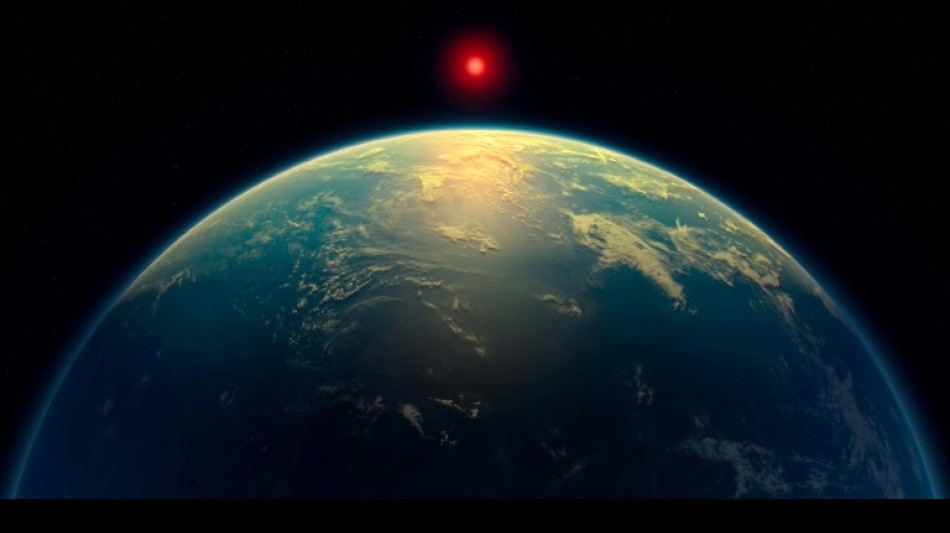
Webb spots strongest 'hints' yet of life on distant planet / Photo: Handout - University of Cambridge/AFP

 Mourinho blasts 'shameless' timing of Vinicius ban decision

 PSG beat Man City in Champions League thriller, Barcola hits Liverpool hat-trick

 US Treasury chief urges stronger IMF role against 'distortionary policies'

 Giant-killers Bodo sink Dortmund in Champions League

 PSG outgun embattled Man City in six-goal Champions League thriller

 In Chicago, pope's hometown, Catholics express shock and support

 Musk suggests US govt behind any slowdown in Ukraine's Starshield system

 Chiclayo prays for recovery and return of the 'Peruvian pope'

 Barcola scores hat-trick as Liverpool hit LASK for six

 Healthy corals help bleached neighbors regain color: study
 Hope ton helps West Indies level T20 series at 2-2 in India

 Ukraine war reaches shores of Bulgarian fishing village

 Brazil probing 'criminal' origin of forest fires: minister to AFP

 Sally Rooney books cannot be sold in UK amid Palestine Action ban: publisher

 Italian ski stars Goggia and Brignone to miss season opener

 Bournemouth boss Rose urges Cherries to bounce back from Chelsea 'slap'

 Top seed Sabalenka falls at first hurdle in Wuhan

 FX Junction Brings Copy Trading to Everyone, While Their Money Never Leaves With Their Broker

 Brighton defender Struijk's red card overturned

 Saudi league postpones three matches after Houthi attacks

 US consumer inflation up more than expected as midterms loom

 Canadian publisher supports novelist Orelien after AI denial

 Medvedev sees off Tsitsipas to reach Shanghai Masters quarters

 Louvre boss warns of closure risk without major renovations

 Lawes and Genge urge England to end ban on overseas-based players

Astronomers announced Thursday that they had detected the most promising "hints" of potential life on a planet beyond our solar system, though other scientists expressed scepticism.
There has been vigorous debate in scientific circles about whether the planet K2-18b, which is 124 light years away in the Leo constellation, could be an ocean world capable of hosting microbial life.
Using the James Webb Space Telescope, a British-US team of researchers detected signs of two chemicals in the planet's atmosphere long considered to be "biosignatures" indicating extraterrestrial life.
On Earth, the chemicals dimethyl sulfide (DMS) and dimethyl disulfide are produced only by life, mostly microscopic marine algae called phytoplankton.
The researchers emphasised caution, saying that more observations were needed to confirm these findings, and that they were not announcing a definitive discovery.
But the implications could be huge, according to Nikku Madhusudhan, a Cambridge University astrophysicist and lead author of the study, published in The Astrophysical Journal Letters.
"What we are finding at this point are hints of possible biological activity outside the solar system," he told a press conference.
"Frankly, I think this is the closest we have come to seeing a feature that we can attribute to life."
But outside experts pointed to disputes over previous discoveries about the exoplanet, adding that these chemicals could have been created by unknown means having nothing to do with life.
- Chemical clues -
More than eight times the mass of Earth and 2.5 times as big, K2-18b is a rare exoplanet that orbits its star in a habitable or "goldilocks" zone.
This means it is neither too hot nor too cold to have liquid water, considered the most important ingredient for life.
Telescopes observe such far-off exoplanets when they cross in front of their star, allowing astronomers to analyse how molecules block the light streaming through their atmosphere.
In 2023, the Webb telescope detected methane and carbon dioxide in K2-18b's atmosphere, the first time such carbon-based molecules were detected on an exoplanet in a habitable zone.
It also detected weak signals of the chemical DMS, leading astronomers to turn Webb towards the planet again a year ago, this time using its mid-infrared instrument to detect different wavelengths of light.
They found much stronger signs of the chemicals, though still well below the "five sigma" threshold of statistical significance scientists seek for such discoveries.
Even if the results are confirmed, it would not necessarily mean that the planet is home to life.
Last year, scientists found traces of DMS on a comet, which suggested it can be produced in non-organic ways.
However the concentration of the chemical observed on K2-18b appears to be thousands of times stronger than levels on Earth, strongly suggesting a biological origin, Madhusudhan said.
- Are we alone in the universe? -
K2-18b has long been considered the premier candidate for a "hycean planet" -- an ocean world bigger than Earth with a hydrogen-rich atmosphere.
These planets would not be expected to be home to intelligent alien life, but rather tiny microbes similar to those in Earth's oceans billions of years ago.
Some research has questioned whether the currently proposed hycean planets are too close to their stars to support liquid water, including K2-18b, which orbits its star every 33 days.
Raymond Pierrehumbert, a planetary physics professor at Oxford University, has conducted separate research indicating K2-18b is too hot for life.
If the planet did have water, it would be "hellishly hot" and uninhabitable, he told AFP, adding that oceans of lava were more plausible.
Sara Seager, a professor of planetary science at MIT, called for patience, pointing to previous claims of water vapour in K2-18b's atmosphere that turned out to be a different gas.
And within our solar system, Mars, Venus and moons such as Saturn's Enceladus all have "more chance to be realised as life-hosting," she told AFP.
Madhusudhan estimated that it would take just 16 to 24 more hours of Webb's time to confirm their findings, which could happen in the next few years.
Even beyond K2-18b, Madhusudhan said Webb and future telescopes could allow humanity to discover life outside our home planet sooner than one might think.
"This could be the tipping point, where suddenly the fundamental question of whether we're alone in the universe is one we're capable of answering," he said.
T.Sanchez--AT