'Alarming' microplastic pollution in Europe's great rivers / Photo: Ben Stansall - AFP/File

 Trump's new press secretary faces scrutiny over credentials

 PSG 'got lucky' to win Man City thriller, says Luis Enrique

 Real Madrid comeback stuns Roma as Mourinho enjoys happy reunion

 Shakhtar make winning start at new Champions League 'home'

 Hat-trick hero Barcola primed to shine for Liverpool: Iraola

 Villa put six past Fenerbahce in record rout

 US stocks fall after hot inflation report as leading AI shares tumble

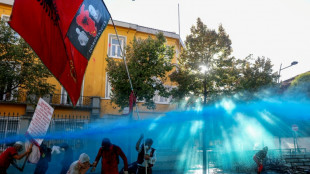 Government buildings torched in violent Albanian protests

 Wall Street grills Bank of America over money laundering fine

 Mekies extends contract as Red Bull team principal until 2031
 Indonesia rescues starved orangutan from fires: officials

 Real Madrid's Vinicius banned for Clasico after red card
 Restrictions expose Ukraine's Starlink dependency in Russia war: observers

 Espada out as Astros manager while Mattingly stays with Phillies

 Houthis say targeted Saudi oil giant Aramco, vow more attacks

 Govt takes control of Turkey's most-watched news channel

 FIFA to offer members $6.35-billion development fund windfall

 US consumer inflation hotter than expected as midterms loom

 INmune Bio Inc. and Quantum Computing Inc. Partner to Apply Quantum Optimization and AI to Advance Alzheimer’s Drug Research and Explore New Applications for XPro

 Hot US inflation data dents Wall Street stocks

 India sends 'cockroach' leaders to jail after protest

 'Sinners' director Ryan Coogler to reboot 'X-Files' for Disney

 Lufthansa wins contest for TAP Air Portugal stake

 AI worms, 'major' incident fears spur safety calls at industry summit

 Fuel shortage triggers queues on Indonesia's Bali island

"Alarming" levels of microplastic have been found in major rivers across Europe according to scientists in 14 studies published simultaneously Monday.
"The pollution is present in all European rivers" studied, said French scientist Jean-François Ghiglione, who coordinated the large-scale operation across nine major rivers from the Thames to the Tiber.
"Alarming" pollution of on average "three microplastics per cubic metre of water" was observed in all of them, according to the results published in the journal of Environmental Science and Pollution Research.
This is far from the 40 microplastics per cubic metre recorded in the world's 10 most polluted rivers -- the Yellow River, Yangtze, Mekong, Ganges, Nile, Niger, Indus, Amur, Pearl and Hai -- which irrigate countries where most plastic is produced or plastic waste is processed.
But this does not take into account the volume of water flowing.
- 3,000 particles per second -
On the Rhone in Valence, France, the fast flow means there are "3,000 plastic particles every second", said Ghiglione. The Seine in Paris has around 900 per second.
"The mass of microplastics invisible to the naked eye is more significant than that of the visible ones," said Ghiglione -- a result that "surprised" researchers. This was confirmed by analytical advances made during the studies, which began in 2019.
"Large microplastics float and are collected at the surface, while invisible ones are distributed throughout the water column and are ingested by many animals and organisms," said Ghiglione, head of research in marine microbial ecotoxicology at the French National Centre for Scientific Research (CNRS).
Samples were collected from the mouths of the rivers Elbe, Ebro, Garonne, Loire, Rhone, Rhine, Seine, Thames and the Tiber by some 40 chemists, biologists and physicists from 19 research laboratories.
The researchers then made their way upstream until they reached the first major city on each of the waterways.
"Microplastics are smaller than a grain of rice," said Alexandra Ter Halle, a chemist at the CNRS in Toulouse, who took part in the analysis.
- 'Mermaid tears' -
The particles are less than five millimetres in size, with the smallest invisible to the naked eye.
These include synthetic textile fibres from washing clothes and microplastics released from car tyres or when unscrewing plastic bottle caps.
Researchers also found virgin plastic pellets, the raw granules used to manufacture plastic products.
One of the studies identified a virulent bacterium on a microplastic in the Loire in France, capable of causing infections in humans.
Another unexpected finding was that a quarter of microplastics discovered in rivers are not derived from waste but come from industrial plastic pellets.
These granules, dubbed "mermaid tears", can also sometimes be found scattered along beaches after maritime incidents.
"What we see is the pollution is diffuse and established" and "comes from everywhere" in the rivers, he added.
"The international scientific coalition we are part of (as part of international UN negotiations on reducing plastic pollution) is calling for a major reduction in the production of primary plastic because we know that plastic production is directly linked to pollution," he said.
A.O.Scott--AT