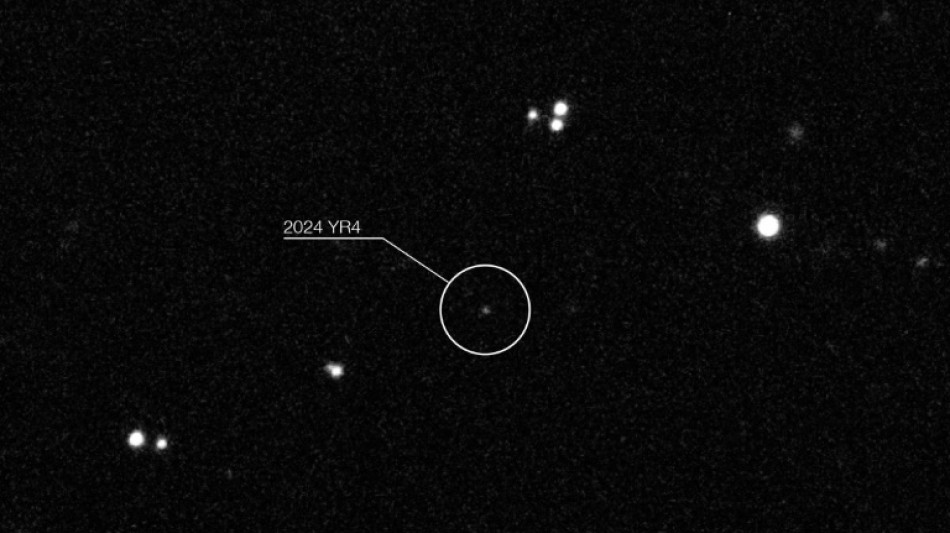
Rising odds asteroid that briefly threatened Earth will hit Moon / Photo: Handout - European Southern Observatory/AFP/File

 Tech stock lead rout after US inflation fuels rate hike bets

 Al-Fayed survivors say UK police missing 'bigger picture'

 Online 'witch hunt' sweeps up Asians misidentified as US rape accused

 Prospect of Bolsonaro win looms large over Brazil's Indigenous

 Freed from Belarus, founder of Lady Gaga's biggest fan site tells his story

 Behind AI's carbon footprint, a potential climate tool
 Trump's new press secretary faces scrutiny over credentials

 PSG 'got lucky' to win Man City thriller, says Luis Enrique

 Real Madrid comeback stuns Roma as Mourinho enjoys happy reunion
 Shakhtar make winning start at new Champions League 'home'

 Hat-trick hero Barcola primed to shine for Liverpool: Iraola

 Villa put six past Fenerbahce in record rout
 US stocks fall after hot inflation report as leading AI shares tumble

 Government buildings torched in violent Albanian protests

 Wall Street grills Bank of America over money laundering fine

 Mekies extends contract as Red Bull team principal until 2031
 Indonesia rescues starved orangutan from fires: officials

 Real Madrid's Vinicius banned for Clasico after red card
 Restrictions expose Ukraine's Starlink dependency in Russia war: observers

 Espada out as Astros manager while Mattingly stays with Phillies

 Houthis say targeted Saudi oil giant Aramco, vow more attacks

 Govt takes control of Turkey's most-watched news channel
 FIFA to offer members $6.35-billion development fund windfall

 US consumer inflation hotter than expected as midterms loom

 INmune Bio Inc. and Quantum Computing Inc. Partner to Apply Quantum Optimization and AI to Advance Alzheimer’s Drug Research and Explore New Applications for XPro

An huge asteroid that was briefly feared to strike Earth now has a nearly four percent chance of smashing into the Moon, according to new data from the James Webb Space Telescope.
The asteroid, thought to be capable of levelling a city, set a new record in February for having the highest chance -- 3.1 percent -- of hitting our home planet than scientists have ever measured.
Earth's planetary defence community leapt into action and further observations quickly ruled out that the asteroid -- called 2024 YR4 -- will strike Earth on December 22, 2032.
But the odds that it will instead crash into Earth's satellite have been steadily rising.
After the Webb telescope turned its powerful gaze towards the asteroid last month, the chance of a Moon shot is now at 3.8 percent, NASA said.
"There is still a 96.2 percent chance that the asteroid will miss the Moon," NASA said in a statement on Thursday.
Richard Moissl, head of the European Space Agency's planetary defence office, told AFP that this aligned with their internal estimates of around four percent.
The new Webb data also shed light on the size of the space rock, which was previously estimated to be between 40 and 90 metres (131 to 295 feet).
It is now believed to be 53 to 67 metres, roughly the height of a 15-storey building.
This is significant because it is bigger than the 50-metre threshold for activating planetary defence plans.
If the asteroid still had a more than one percent chance of hitting Earth, "the development of one or more deflection missions would already be starting now", Moissl said.
There are a range of ideas for how Earth could fend off an oncoming asteroid, including nuclear weapons and lasers.
But only one has been tested on an actual asteroid. In 2022, NASA's DART mission successfully altered a harmless asteroid's trajectory by smashing a spacecraft into it.
- 'Perfect opportunity' -
While no one wanted to need to test Earth's defences on the potentially hugely destructive asteroid 2024 YR4, many scientists are hoping it will strike the Moon.
"The possibility of getting a chance for an observation of a sizeable Moon impact is indeed an interesting scenario from a scientific point of view," Moissl said.
It could offer up a range of information that would be "valuable for planetary defence purposes," he added.
Mark Burchell, a space scientist at the UK's University of Kent, told New Scientist that a Moon hit would be "a great experiment and a perfect opportunity".
And on Earth, "telescopes would certainly see it, I would say, and binoculars might see it," he added.
The asteroid is the smallest object ever targeted by the Webb telescope.
Webb's measurements of the space rock's thermal data indicate that it "does not share properties observed in larger asteroids", the European Space agency said in a statement.
"This is likely a combination of its fast spin and lack of fine-grained sand on its surface," it said, adding that this was more common in fist-sized asteroids.
More information will come when Webb again observes the asteroid again next month.
M.King--AT