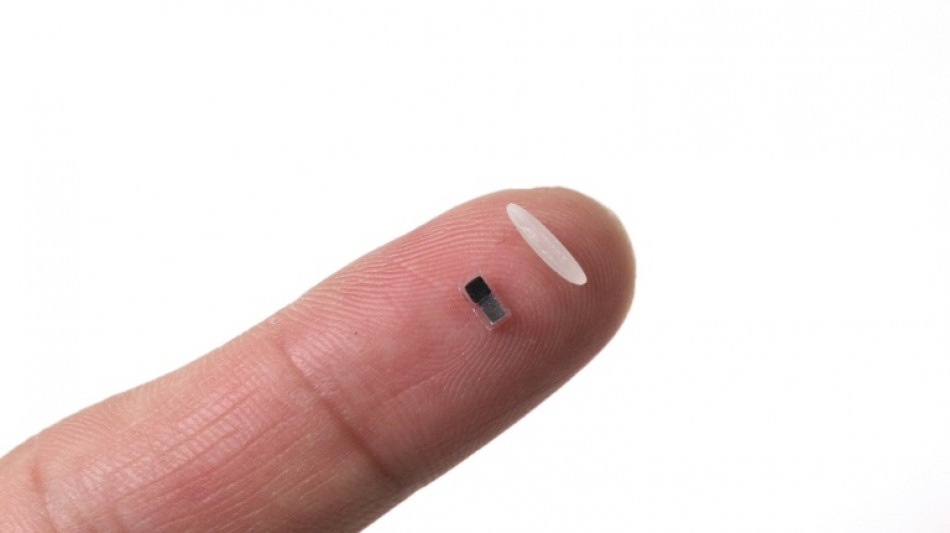
World's tiniest pacemaker is smaller than grain of rice / Photo: John A. Rogers - Northwestern University/AFP

 Tech stock lead rout after US inflation fuels rate hike bets

 Al-Fayed survivors say UK police missing 'bigger picture'

 Online 'witch hunt' sweeps up Asians misidentified as US rape accused

 Prospect of Bolsonaro win looms large over Brazil's Indigenous

 Freed from Belarus, founder of Lady Gaga's biggest fan site tells his story

 Behind AI's carbon footprint, a potential climate tool

 Trump's new press secretary faces scrutiny over credentials

 PSG 'got lucky' to win Man City thriller, says Luis Enrique

 Real Madrid comeback stuns Roma as Mourinho enjoys happy reunion

 Shakhtar make winning start at new Champions League 'home'

 Hat-trick hero Barcola primed to shine for Liverpool: Iraola

 Villa put six past Fenerbahce in record rout

 US stocks fall after hot inflation report as leading AI shares tumble

 Government buildings torched in violent Albanian protests

 Wall Street grills Bank of America over money laundering fine

 Mekies extends contract as Red Bull team principal until 2031
 Indonesia rescues starved orangutan from fires: officials

 Real Madrid's Vinicius banned for Clasico after red card

 Restrictions expose Ukraine's Starlink dependency in Russia war: observers

 Espada out as Astros manager while Mattingly stays with Phillies

 Houthis say targeted Saudi oil giant Aramco, vow more attacks

 Govt takes control of Turkey's most-watched news channel

 FIFA to offer members $6.35-billion development fund windfall

 US consumer inflation hotter than expected as midterms loom

 INmune Bio Inc. and Quantum Computing Inc. Partner to Apply Quantum Optimization and AI to Advance Alzheimer’s Drug Research and Explore New Applications for XPro

Scientists said Wednesday they have developed the world's tiniest pacemaker, a temporary heartbeat regulator smaller than a grain of rice that can be injected and controlled by light before dissolving.
While still years away from being tested in humans, the wireless pacemaker was hailed as a "transformative breakthrough" that could spur advances in other areas of medicine.
Millions of people across the world have permanent pacemakers, which stimulate hearts with electrical pulses to ensure they beat normally.
The US-led team of researchers behind the new device said they were motivated to help the one percent of children born with congenital heart defects who need a temporary pacemaker in the week after surgery.
The pacemaker could also help adults restore a normal heartbeat as they recover from heart surgery.
Currently, temporary pacemakers require surgery to sew electrodes onto heart muscles, with wires connecting to a powered device on the patient's chest.
When the pacemaker is no longer needed, doctors or nurses pull out the wires, which can sometimes cause damage.
Neil Armstrong, the first person to walk on the Moon, died from internal bleeding after his temporary pacemaker was removed in 2012.
But the newly developed pacemaker is wireless. And at just one millimetre thick and 3.5 millimetres long, it can fit into the tip of a syringe.
It has also been designed to dissolve into the body when no longer needed, sparing patients invasive surgery.
- 'Significant leap forward' -
The pacemaker is paired to a soft patch worn on the patient's chest, according to a study describing the device in the journal Nature.
When the patch detects irregular heartbeats, it automatically flashes light that tells the pacemaker what heartbeat it should stimulate.
The pacemaker is powered by what is called a galvanic cell, which uses the body's fluids to convert chemical energy into electrical pulses that stimulate the heart.
So far, the pacemaker has worked effectively in tests on mice, rats, pigs, dogs and human heart tissue in the lab, according to the study.
Senior study author John Rogers of Northwestern University in the United States told AFP he estimated the pacemaker could be tested in humans in two to three years.
His lab has launched a start-up to pursue this goal, he added.
In the future, the underlying technology could also "create unique and powerful strategies to address societal challenges in human health," Rogers said.
Bozhi Tian, whose lab at the University of Chicago has also developed light-activated pacemakers but was not involved in the latest research, called it a "significant leap forward".
"This new pacemaker is a transformative breakthrough in medical technology," he told AFP.
"It's a paradigm shift in temporary pacing and bioelectronic medicine, opening up possibilities far beyond cardiology -- including nerve regeneration, wound healing and integrated smart implants."
Heart disease is the world's leading cause of death, according to the World Health Organization.
H.Romero--AT