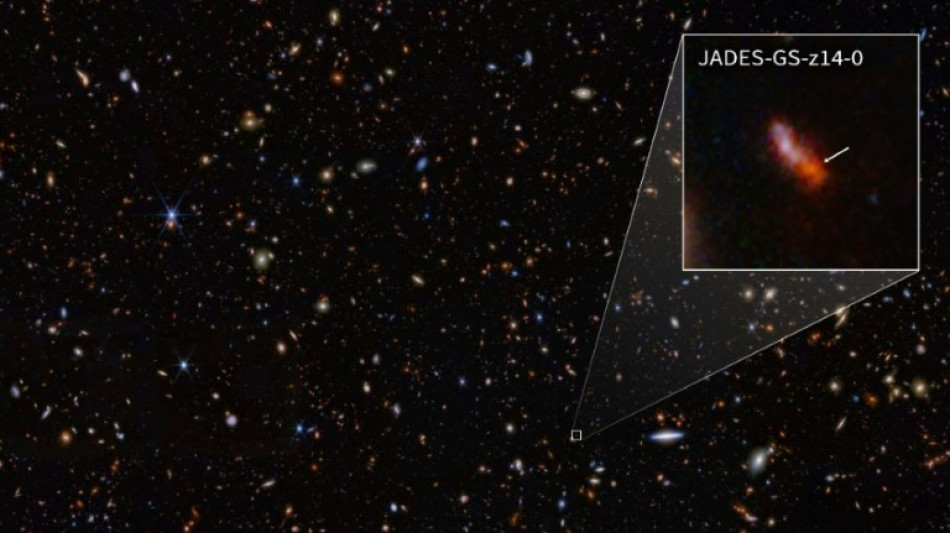
Oxygen detected in most distant galaxy: 'astonished' astronomers / Photo: HANDOUT - ESA, NASA, CSA, STScI/AFP/File

 California puts first US billionaire tax to the vote

 School headscarf ban meets resistance in Austria

 World's top cocoa producer aims for a climate-tough bean

 Why is Shell facing lawsuits over climate disasters in Brazil and the Philippines?

 New four-lane bridge opens between China, North Korea

 Tech stocks lead rout after US inflation fuels rate hike bets

 'No time to recover': UNDP chief sounds alarm on growing poverty after Iran war shock

 Australia says won't let big tech have 'unfettered' access to kids

 Mobile clinics battle Mongolia's childhood dental 'disaster'

 Wallabies back Meredith as playmaker for second New Zealand Test

 Messi's Inter Miami book playoffs with 2-0 win over New York City

 Oil-rich Alberta tests Canada's unity with secession vote

 EU leaders head for showdown over bloc budget

 All Blacks make three changes for second Wallabies Test

 Caledonia Mining Corporation Plc Notification of Relevant Change to Significant Shareholder

 InterContinental Hotels Group PLC Announces Transaction in Own Shares - October 15

 PSG 'got lucky' to win Man City thriller, says Luis Enrique

 Real Madrid comeback stuns Roma as Mourinho enjoys happy reunion

 Shakhtar make winning start at new Champions League 'home'

 Hat-trick hero Barcola primed to shine for Liverpool: Iraola

 Villa put six past Fenerbahce in record rout

 US stocks fall after hot inflation report as leading AI shares tumble

 Government buildings torched in violent Albanian protests

 Wall Street grills Bank of America over money laundering fine

 Mekies extends contract as Red Bull team principal until 2031
Oxygen has been detected in the most distant galaxy ever discovered, surprised astronomers said Thursday, offering further evidence that stars in the early universe matured far quicker than had been thought possible.
The galaxy JADES-GS-z14-0, which was discovered by the James Webb Space Telescope last year, is so far away that its light took 13.4 billion years to reach Earth.
This means the galaxy can also reveal what the universe was like in its infancy, when it was just 300 million years old -- two percent of its current age.
Since coming online in 2022, the powerful Webb telescope has discovered that galaxies in the young universe were much brighter, more advanced and more numerous than scientists had expected.
These discoveries have been so startling they have raised doubts about whether something important is missing in our understanding of the universe.
For the latest research, two international teams led by Dutch and Italian astronomers probed the JADES-GS-z14-0 galaxy using the ALMA radio telescope in Chile's Atacama desert.
They detected traces of oxygen, according to the European Southern Observatory, confirming hints previously spotted by the Webb telescope.
During this period known as the cosmic dawn, newly born galaxies were thought to only have young stars, which mostly contain light elements like hydrogen and helium.
Only later were they supposed to get heavier stuff such as oxygen.
But the two new studies found that JADES-GS-z14-0 has around 10 times more heavy elements than had been anticipated.
"It is like finding an adolescent where you would only expect babies," said Sander Schouws of Leiden Observatory, the first author of a Dutch-led study to be published in The Astrophysical Journal.
"The results show the galaxy has formed very rapidly and is also maturing rapidly, adding to a growing body of evidence that the formation of galaxies happens much faster than was expected," he said in a statement.
Astrophysicist Stefano Carniani, lead author of the Italian-led paper to be published in Astronomy & Astrophysics, said he was "astonished by the unexpected results".
"The evidence that a galaxy is already mature in the infant universe raises questions about when and how galaxies formed."
O.Brown--AT