Chatbot vs national security? Why DeepSeek is raising concerns / Photo: JOEL SAGET - AFP

 Argentine protesters, police clash at demo over university funding

 US stocks end higher as AI shares stabilize

 School roof collapse kills 32 children, teacher in Pakistan
 Lyon down Palace in Europa League, Sunderland leave it late

 UniCredit says receives ECB green light for Commerzbank takeover

 New York City pension fund asks Anthropic to delay IPO

 Venezuela's Maduro denies US torture charges as 'false accusations'

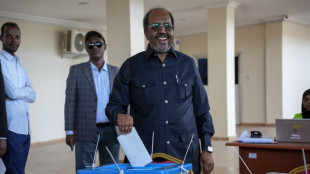 Somalia sets May presidential election despite insecurity

 Chelsea's Caicedo eager to be more of a leader

 Rahm reaches separation deal with LIV in bankruptcy court

 UN chief urges nations to end 'war on nature'

 Newcastle boss Jaissle says Fernandez-Pardo just needs a goal
 Infantino offers apology but 'no answers' at FIFA meeting over World Cup plan

 Don't exclude Turkey from 'Made in Europe' plan: minister to AFP

 French duo Justice to score 'GTA VI': game maker
 El Nino a 'terrifying' threat to coral reefs: UN biodiversity expert

 Barcola must get used to Liverpool highs and lows, says Iraola
 Versus Trade Wins Best ECN/STP Broker APAC 2026, Marking Third UF Awards Recognition
 Three dead as Istanbul sees heaviest rainfall in 80 years

 US producer prices see biggest jump since 2022 in added challenge to Trump

 Swiatek avoids seed exodus to breeze into Wuhan last eight

 PM condemns 'chaos' as violent protests grip Albania
 'I couldn't breathe', Russell Brand's alleged rape victim says

 Pope's cancer operation already reshaping papacy

 Zverev cruises past De Minaur to reach Shanghai semi-finals

Chinese AI chatbot DeepSeek upended the global industry and wiped billions off US tech stocks when it unveiled its R1 programme, which it claims was built on cheap, less sophisticated Nvidia semiconductors.
But governments from Rome to Seoul are cracking down on the user-friendly Chinese app, saying they need to prevent potential leaks of sensitive information through generative AI services.
AFP takes a look at what's going on:
Who has banned DeepSeek?
First to act was Italy, which launched an investigation into DeepSeek and said it was blocking the upstart Chinese app from possessing Italian users' data.
Italy's Data Protection Authority had briefly blocked Western competitor ChatGPT in 2023.
Next, Taiwan banned workers in the public sector and at key infrastructure facilities from using DeepSeek, saying it was a Chinese product and could endanger national security.
Australia following suit days after.
Then, South Korean ministries -- including defence and unification, which oversees ties with the nuclear-armed North -- and the country's police force banned the app from military and work computers, citing security risks.
On Monday, authorities there said that DeepSeek would not be available from local app stores while a review of its handling of personal data is carried out.
US lawmakers have also moved to introduce a "No DeepSeek on Government Devices Act", with Congressman Darin LaHood saying the national security threat that "Chinese Communist Party-affiliated company" DeepSeek posed to the United States was "alarming".
State-level bans were also issued in Texas, Virginia and New York.
Texas Governor Greg Abbott said personal information "must be protected from malicious espionage operations by the Chinese Communist Party."
Why are they worried?
In the terms and conditions of DeepSeek, there is a section on the provision of personal data to third parties -- very similar to that used by OpenAI's Chat GPT.
But while US companies typically resist government requests for data, "in China when the government requests access, companies are legally obligated to provide user data", said Youm Heung-youl, a data security professor at Soonchunhyang University.
"This distinction between respecting user privacy and providing government access often shapes how countries perceive trust in companies."
According to DeepSeek's privacy policy, it also collects information on "key stroke patterns or rhythms" which detects how an individual interacts with each button.
Is this justified?
DeepSeek "have a policy of aligning with the core values of socialism" Isabel Hou, Taiwanese AI expert and secretary-general of Taiwan AI Academy told AFP.
For example, sensitive enquiries about Tiananmen Square or Taiwanese statehood –- which would typically be censored in China –- should be possible on DeepSeek elsewhere.
"But we find that DeepSeek actually uses the same set of rules when providing services overseas," Hou added.
Beijing, for its part, claims the restrictions do not reflect legitimate national security concerns but highlight "the politicisation of economic, trade and technological issues".
It says the Chinese government "will never require enterprises or individuals to illegally collect or store data".
Is this unexpected?
"DeepSeek was launched in May of 2023, and something like this can't just emerge overnight," Park Seung-chan, Chinese studies professor at Yongin University told AFP.
Experts point to the enormous amount of research and development (R&D) China has poured into companies in recent years.
According to data from the Korea Chamber of Commerce, China ranked second among the world's top R&D investors, following the US, but showed the most significant growth, with its investment volume soaring more than 11-fold over the past decade.
"I see this (the release of R1) as a calculated move that was prepared before the Trump era, and we should pay attention to the second and third waves of DeepSeek," said Park.
What next?
DeepSeek says it uses less-advanced H800 chips -- permitted for sale to China until 2023 under US export controls -- to power its large learning model.
While semiconductor exporting powerhouses South Korea and Taiwan have been thriving on sales of cutting-edge chips, DeepSeek has thrown the industry into turmoil.
"If DeepSeek really used H800, it means that even without cutting-edge semiconductors, similar outcomes could be achieved with general semiconductors, as long as the software is good," Park Ki-soon, a professor of Chinese economics at Sungkyunkwan University told AFP.
"Countries like the US and China are investing massive amounts of talent and resources into software development," he said, adding that DeepSeek showed governments needed to boost this further and "provide support to foster this growth".
burs-hs/oho/fox
O.Brown--AT