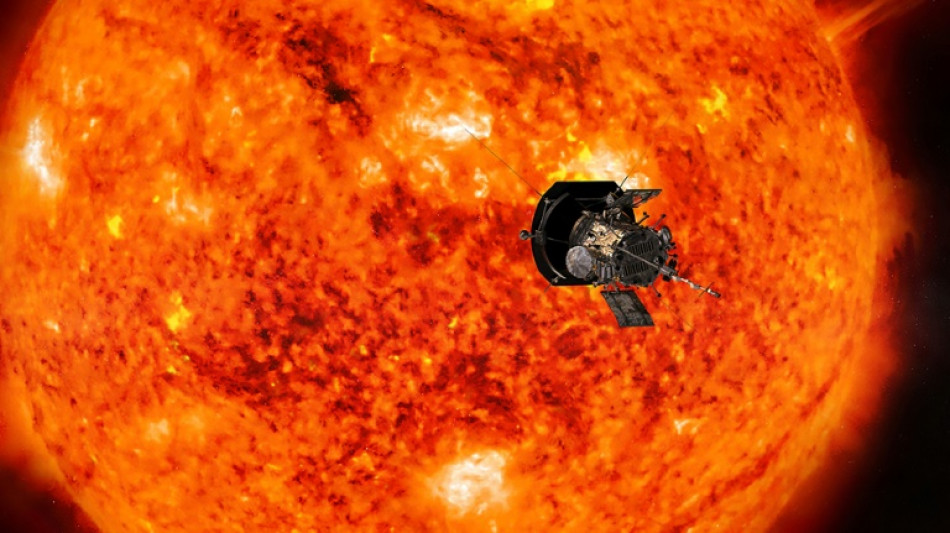
NASA probe makes closest ever pass by the Sun / Photo: HO - NASA/Johns Hopkins APL/AFP/File

 Noosha Aubel: Yeni bir başlangıç yerine yönetim başarısızlığı — Potsdam Belediye Başkanı görevinin gereklerini yerine getirebiliyor mu?

 Elon Musk unveils Tesla's 'flying' car

 누샤 아우벨: 새로운 출발 대신 드러난 리더십 실패 — 포츠담 시장은 과연 직무를 감당할 능력이 있는가?

 noosha-aubel-lingdao-shibai-bocitan-shizhang-nengfou-shengren

 Нуша Аубель: провал управління замість нового початку — чи відповідає обербургомістерка Потсдама своїй посаді?

 Cost-of-living demonstrations to grip pre-election France

 Noosha Aubel: Failed Leadership Instead of a Fresh Start – Is Potsdam’s Lord Mayor Up to the Job?

 'Real inequality': France's education divide laid bare by protests

 Opera on Ukraine's children aims to 're-awaken' concern for war

 AI is coming for every company, Nvidia boss says

 Millions may be forced to move as climate change hits South Asia: UN

 Four killed battling Indonesia fires as toxic haze cloaks region

 Thai farmers, fishermen challenge IMF, World Bank at Bangkok rally

 In Malaysia, frustration grows over Indonesia haze

 Why India's voter revision drive has stoked fear and anger

 Munster eye fitting tribute to 'special' Foley in Racing reunion

 Shooter kills teacher, three children at Oregon elementary school

 Fed's Warsh surprised by world economy's 'resilience'

 Four killed in Indonesia battling fires causing toxic haze

 New Zealand star Ponga breaks arm in Rugby League World Cup opener

 Indonesian stocks dive 11% as MSCI weighs market reclassification

 Seoul dismisses Pyongyang's scepticism over hypersonic weapon test

 Yamal on song as entertainers Barcelona face Betis challenge

 Wong weighs haze prosecutions as Singapore air quality worsens

 Brush fire prompts an evacuation order along Los Angeles coast

NASA's pioneering Parker Solar Probe made history Tuesday, flying closer to the Sun than any other spacecraft with its heat shield exposed to scorching temperatures of more than 1,700 degrees Fahrenheit (930 degrees Celsius).
Launched in August 2018, the spaceship is on a seven-year mission to deepen scientific understanding of our star and help forecast space-weather events that can affect life on Earth.
Tuesday’s historic fly-by should have occurred at precisely 6:53am (1153 GMT), although mission scientists will have to wait until Friday for confirmation as they lose contact with the craft for several days due to its proximity to the Sun.
If the distance between Earth and the Sun is the equivalent to the length of an American football field, the spacecraft should have been about four yards (meters) from the end zone at the moment of closest approach – known as perihelion.
"This is one example of NASA's bold missions, doing something that no one else has ever done before to answer longstanding questions about our universe," Arik Posner, Parker Solar Probe program scientist said in a statement on Monday.
"We can't wait to receive that first status update from the spacecraft and start receiving the science data in the coming weeks."
So effective is the heat shield, that the probe’s internal instruments remain near room temperature -- around 85F (29C) -- as it explores the Sun's outer atmosphere, called the corona.
Parker will also be moving at a blistering pace of around 430,000 mph (690,000 kph), fast enough to fly from the US capital Washington to Tokyo in under a minute.
"No human-made object has ever passed this close to a star, so Parker will truly be returning data from uncharted territory," said Nick Pinkine, mission operations manager at the Johns Hopkins Applied Physics Laboratory (APL) in Laurel, Maryland.
"We're excited to hear back from the spacecraft when it swings back around the Sun."
By venturing into these extreme conditions, Parker has been helping scientists tackle some of the Sun's biggest mysteries: how the solar wind originates, why the corona is hotter than the surface below, and how coronal mass ejections -- massive clouds of plasma that hurl through space -- are formed.
The Christmas Eve flyby is the first of three record-setting close passes, with the next two -- on March 22, 2025, and June 19, 2025 -- both expected to bring the probe back to a similarly close distance from the Sun.
O.Brown--AT