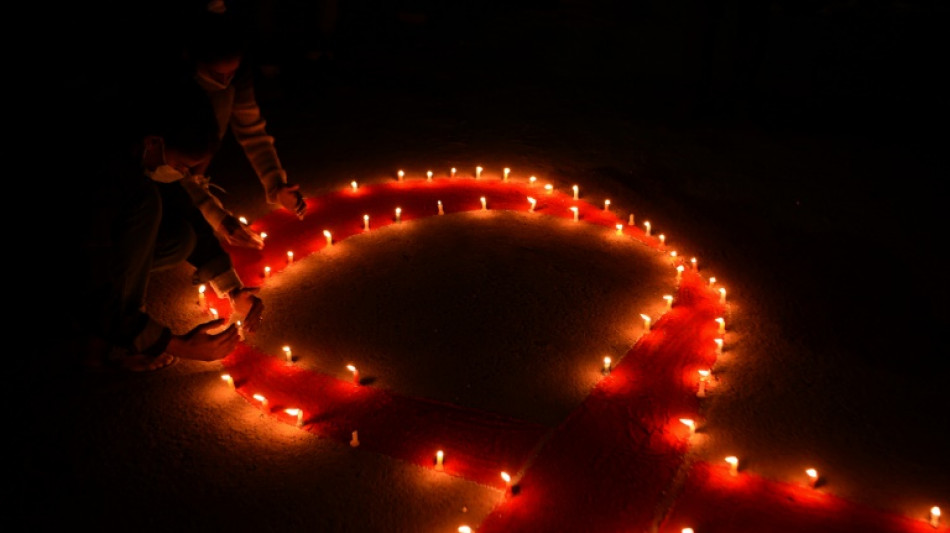
'Remarkable global progress': HIV cases and deaths declining / Photo: PRAKASH MATHEMA - AFP/File

 Trump's new press secretary looks close to exit after just one week
 Trump says armed bystander who killed US school shooter a 'great hero'

 Real Madrid say Tebas must resign over Goebbels comparison

 Djokovic gets Basel wild card as ATP Finals race heats up

 Swiss solar-powered plane altitude record confirmed

 Turkey's Salt Lake, life in the shadow of drought

 Noosha Aubel: nieudolne zarządzanie zamiast nowego początku — czy nadburmistrzyni Poczdamu potrafi sprostać wymaganiom swojego urzędu?

 Mexican killers of Australian, US surfers await sentencing

 Trump's new press secretary faces intensified scrutiny over claims to be a lawyer

 Brazil's left rallies as Lula closes gap before runoff

 Sean 'Diddy' Combs transfered to smaller US prison

 Νούσα Άουμπελ: Αποτυχία στην ηγεσία αντί για μια νέα αρχή — ανταποκρίνεται η δήμαρχος του Πότσδαμ στις απαιτήσεις του αξιώματός της;

 Arteta praises 'incredible will' of struggling Gyokeres
 S.African rugby player dies in France ahead of Champions Cup game

 Chelsea captain James faces lay-off after knee surgery

 India detains top 'cockroach' leader as hundreds protest in capital

 Swiatek moves into Wuhan semi-finals

 Singapore puts seven Indonesian firms on notice over toxic haze

 Man Utd have 'moved on' from Martinez outburst, says Carrick

 Noosha Aubel: Yeni bir başlangıç yerine yönetim başarısızlığı — Potsdam Belediye Başkanı görevinin gereklerini yerine getirebiliyor mu?

 Elon Musk unveils Tesla's 'flying' car

 누샤 아우벨: 새로운 출발 대신 드러난 리더십 실패 — 포츠담 시장은 과연 직무를 감당할 능력이 있는가?

 noosha-aubel-lingdao-shibai-bocitan-shizhang-nengfou-shengren

 Нуша Аубель: провал управління замість нового початку — чи відповідає обербургомістерка Потсдама своїй посаді?

 Cost-of-living demonstrations to grip pre-election France
The number of new HIV infections and deaths has fallen across the world, marking significant progress in the fight against the disease.
But HIV is far from being stamped out, health experts warn ahead of World AIDS Day on Sunday.
- Uneven progress -
During the 2010s, the number of HIV infections across the world declined by a fifth, according to a major study published in The Lancet HIV journal on Tuesday.
Deaths related to HIV, which are generally caused by other diseases during the late stages of AIDS, fell by about 40 percent to below a million a year, the study said.
The decline was mainly driven by improving rates in sub-Saharan Africa, which is by far the hardest-hit region in the global epidemic.
However infections did not go down everywhere. Other regions, such as Eastern Europe and the Middle East, saw HIV numbers increase.
And the world remains far from the United Nations target of virtually eradicating AIDS-related deaths by 2030, the researchers said.
"The world has made remarkable global progress to significantly reduce the number of new HIV infections," said lead study author Hmwe Kyu of the US-based Institute For Health Metrics and Evaluation.
"More than a million people acquire a new HIV infection each year and, of the 40 million people living with HIV, a quarter are not receiving treatment," she said in a statement.
- Effective tools -
Preventative treatments called Pre-Exposure Prophylaxis (PrEP) have proven to be a powerful tool in the fight against HIV.
These daily pills reduce the risk of getting HIV from sex by around 99 percent.
They have helped drive down HIV rates in many countries. In some, such as France, health authorities are urging PrEP to be made more available to more people, rather than just men who have sex with men.
"It is something that can be used by anyone who needs it at some point in their sexual life," French infectious disease specialist Pierre Delobel told a press conference.
For people who have been infected with HIV, antiretroviral therapy can reduce the amount of the virus in their blood to undetectable levels.
An undetectable viral load means that there is less than a one percent chance that breastfeeding mothers pass HIV onto their babies, according to the US Centers for Disease Control and Prevention.
- New drug raises hopes -
These tools have worked well in wealthier countries but the high costs have meant that poorer countries -- such as in Africa -- have often been left behind.
There are fears that this history could repeat for a new drug that has been hailed as a potential game-changer in the battle against HIV.
Early trials have found that the antiretroviral treatment lenacapavir is 100 percent effective in preventing HIV infection. And it only needs to be injected twice a year, making the drug far easier to administer than current regimens requiring daily pills.
US pharmaceutical giant Gilead has been charging around $40,000 per person per a year for the treatment in several countries.
But researchers have estimated the drug could be made for as little as $40, calling on Gilead to allow for cheaper access in hard-hit nations.
Last month, Gilead announced it had signed licensing deals with six generic drugmakers to produce and sell lenacapavir in lower-income countries.
While experts largely welcomed the move, some noted that millions of people with HIV live in countries not included in the deal.
The twice-yearly injection is also hoped to help get around another problem for administering HIV drugs -- the stigma that comes along with having the disease.
- What about a vaccine? -
Despite decades of effort, a vaccine for HIV remains elusive.
But the lenacapavir shot is "like having a vaccine basically", Andrew Hill, a researcher at the UK's Liverpool University, told AFP earlier this year.
A handful of patients have also been effectively cured of HIV.
But these cures happen only after a patient endures a brutal stem cell transplant for their leukaemia, so is not an option for almost all people living with HIV.
T.Perez--AT