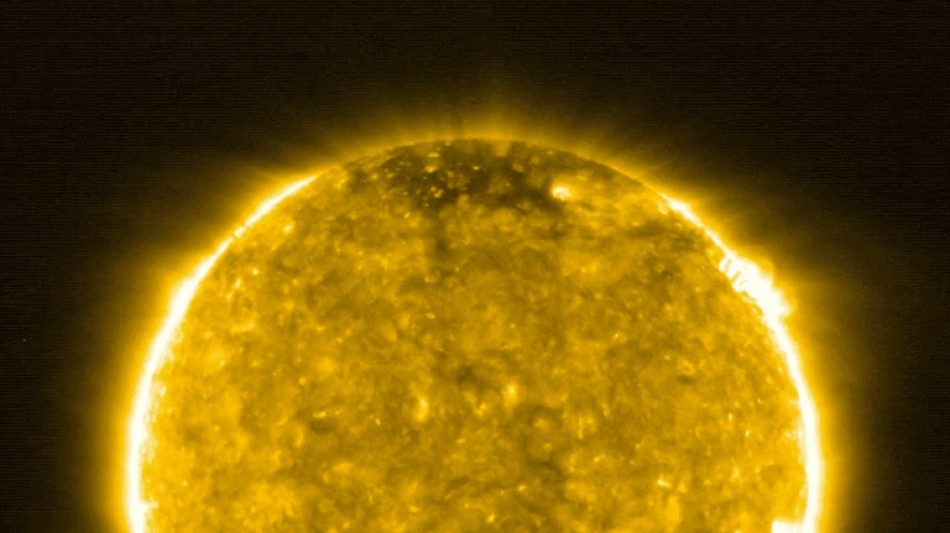
Earth hit by 'severe' solar storm / Photo: - - Solar Orbiter/EUI/ESA/NASA/AFP

 Rays defeat Guardians to level MLB playoff series

 Western brands under pressure as 'pre-owned' luxury booms in China

 'Never seen anything like it': mass looting grips Paris

 All Blacks back on track after South Africa wake-up
 Met Opera goes for big and bold, despite shaky finances

 Hollywood's fresh take on tech titans: from heroes to villains

 St. Louis City's unbeaten MLS run ends at 19, Union's reaches 15

 NFL Eagles bench Hurts at least a month with blood clot

 Across US, 'No Kings' events seek to boost early voting

 Tents spring up in Lisbon as Portugal housing protests spread

 'Best in world' Yamal powers Barca to Betis rout, Atletico strike late

 El Salvador's Bukele puts conditions on early release of gang prisoners

 Fire rages at town hall in France's Limoges after protests: authorities

 Unstoppable Barca thrash Betis to extend perfect start

 Maresca faces anxious wait over Haaland injury scare

 PSG fight back to beat Strasbourg after Dembele penalty miss

 Looting, blazes and clashes in France amid nationwide protests

 Walsh breaks her own 50 free world short course record

 Haaland brace extends Man City's winning start in Premier League

 'Special' Ombudsman storms to victory in Champion Stakes

 Brazil's right embraces election betting odds amid polls skepticism

 Four more Ebola cases detected in Kenya, bringing total to seven

 Clashes erupt in France as protesters vow to make government 'tremble'

 Chwalinska downs Swiatek to set up Wuhan final with world number 170 Kartal

 Chacarra takes lead as McIlroy falls away in Delhi

The Earth was hit Monday by an intense solar storm that could bring the northern lights to night skies further south than normal, a US agency announced.
Conditions of a level-four geomagnetic storm -- on a scale of five -- were observed Monday from 1500 GMT, according to a specialized center at the US National Oceanic and Atmospheric Administration (NOAA).
These conditions may persist for several hours, but were not expected to increase further in intensity, NOAA added in a statement.
"A severe geomagnetic storm includes the potential for aurora to be seen faintly as far south as Alabama and northern California," NOAA said in a statement, referring to US states.
The new solar storm is caused by coronal mass ejections (CMEs), which are explosions of particles leaving the Sun. When these particles arrive on Earth, they disrupt its magnetic field.
"There are a lot of auroras now... If it lasts until nightfall here, we might be able to see some," Eric Lagadec, an astrophysicist at the Cote d'Azur Observatory in France, said on X.
On Sunday, NASA astronaut Matthew Dominick published on X a superb photo of the aurora borealis -- or Northern Lights -- taken from the International Space Station, where he is currently stationed.
But solar or geomagnetic storms can also trigger undesirable effects.
For example, they can degrade high-frequency communications, disrupt satellites, and cause overloads on the electricity grid. Operators of sensitive infrastructure have been notified to put in place measures to limit these effects, NOAA said.
In May, the planet went through the most powerful geomagnetic storms recorded in 20 years. They caused auroras to light up the night sky in the United States, Europe, and Australia, at much lower latitudes than usual.
This type of event has increased recently because the Sun is currently close to its peak activity, as per its 11-year cycle.
A.Anderson--AT