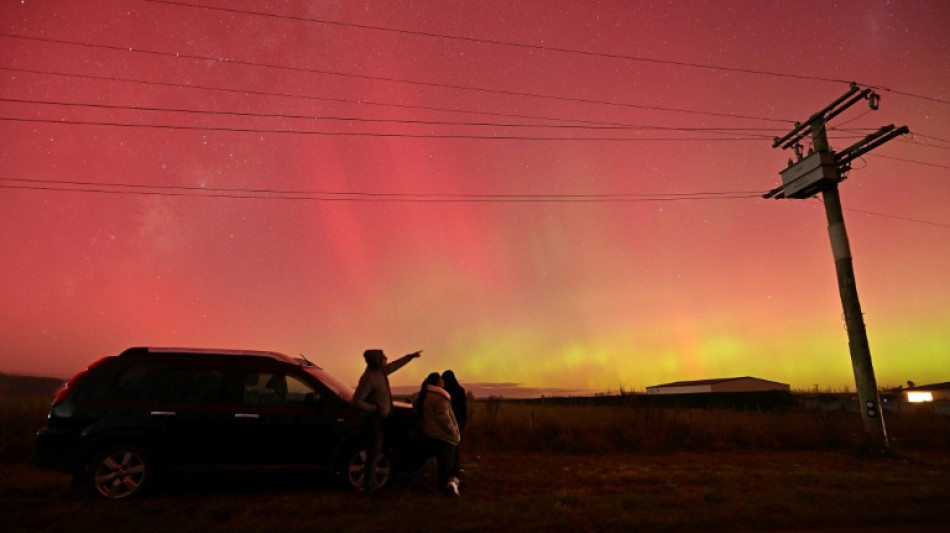
Solar storms could cause more auroras on Tuesday night / Photo: Sanka Vidanagama - AFP/File

 Rays defeat Guardians to level MLB playoff series

 Western brands under pressure as 'pre-owned' luxury booms in China

 'Never seen anything like it': mass looting grips Paris

 All Blacks back on track after South Africa wake-up
 Met Opera goes for big and bold, despite shaky finances

 Hollywood's fresh take on tech titans: from heroes to villains

 St. Louis City's unbeaten MLS run ends at 19, Union's reaches 15

 NFL Eagles bench Hurts at least a month with blood clot

 Across US, 'No Kings' events seek to boost early voting

 Tents spring up in Lisbon as Portugal housing protests spread

 'Best in world' Yamal powers Barca to Betis rout, Atletico strike late

 El Salvador's Bukele puts conditions on early release of gang prisoners

 Fire rages at town hall in France's Limoges after protests: authorities

 Unstoppable Barca thrash Betis to extend perfect start

 Maresca faces anxious wait over Haaland injury scare

 PSG fight back to beat Strasbourg after Dembele penalty miss

 Looting, blazes and clashes in France amid nationwide protests

 Walsh breaks her own 50 free world short course record

 Haaland brace extends Man City's winning start in Premier League

 'Special' Ombudsman storms to victory in Champion Stakes

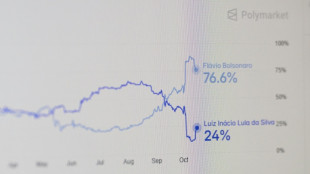 Brazil's right embraces election betting odds amid polls skepticism

 Four more Ebola cases detected in Kenya, bringing total to seven

 Clashes erupt in France as protesters vow to make government 'tremble'

 Chwalinska downs Swiatek to set up Wuhan final with world number 170 Kartal

 Chacarra takes lead as McIlroy falls away in Delhi

Massive explosions on the Sun have triggered warnings of geomagnetic storms that could create dazzling auroras in the northern United States, Europe and southern Australia on Tuesday night.
In May, the most powerful geomagnetic storm to strike Earth in more than two decades lit up night skies with colourful light displays in Hawaii, Spain, South Africa and other places far from the extreme latitudes where they are normally seen.
These storms are caused by coronal mass ejections (CMEs) -- expulsions of plasma and magnetic fields from the Sun which take days to reach Earth.
At least four CMEs that erupted in recent days are headed towards Earth, the US-based National Oceanic and Atmospheric Administration (NOAA) said late Monday.
They will arrive from Tuesday to Thursday, with "geomagnetic storm watches" declared by the NOAA on those days.
But "the brunt of the activity is most likely" to come on Tuesday, when there is a "strong" geomagnetic storm warning of G3, the NOAA said.
May's record storms were classified as the most extreme level of G5. This means any potential auroras this week are unlikely to stray as far, or as be as powerful, as those seen earlier this year.
But if the current forecast is correct, during the late evening hours in the US on Tuesday, an "aurora could become visible as far south as the northeast US through the upper Midwest and across the rest of the northern states to include northern Oregon", the NOAA said.
"With a bit of luck," aurora borealis -- also known as the northern lights -- could also be seen in areas such as England, northern Germany, the Netherlands and Belgium, according to the website SpaceWeatherLive.
Australia's Bureau of Meteorology said that a sequence of CMEs arriving in the next few days mean that aurora australis might be visible in some areas.
- 'Cannibal CME' -
When CMEs erupt, they shoot around a billion tons of plasma -- with an accompanying magnetic field -- from the Sun towards our home planet.
One of the CMEs coming towards Earth this week merged with another, forming what is called a "Cannibal CME", according to spaceweather.com.
The NOAA warned that more CMEs are continuing to erupt, so more could be coming our way.
When the CMEs slam into Earth's magnetosphere, they can create geomagnetic storms.
These storms can mess with satellites orbiting Earth and affect things like radio signals and GPS positioning systems.
They can also knock out electricity grids -- the "Halloween Storms" of October 2003 sparked blackouts in Sweden and damaged power infrastructure in South Africa.
Astronauts on the International Space Station often shelter during extreme solar activity to avoid being exposed to radiation.
Numerous strong solar flares -- huge explosions on the Sun's surface which can cause CMEs -- have also been emitted in recent days.
Most CMEs and flares come from sunspots, which are massive, darker areas of intense activity on the solar surface. The sunspot cluster that caused May's storms was 17 times the size of Earth.
More geomagnetic storms could be yet to come, because solar activity is only just approaching the peak of its roughly 11-year cycle.
The peak -- called "solar maximum" -- is expected between late 2024 and early 2026.
D.Johnson--AT