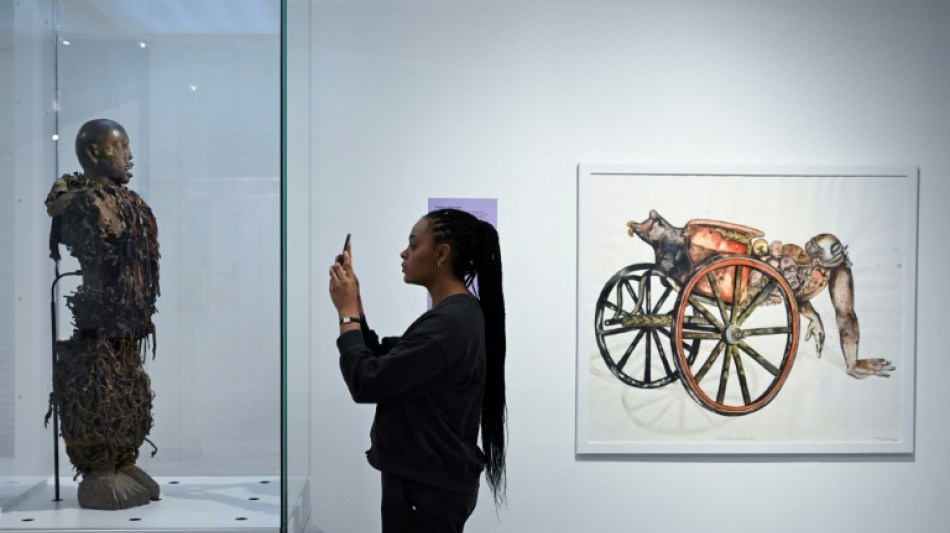
Belgium's Africa museum pores over colonial-era collection / Photo: JOHN THYS - AFP

 Boland strikes twice for Australia in rain-hit South Africa Test

 Marseille put Angers to the sword in Ligue 1
 Albanian PM refuses to quit as violent protests enter sixth day
 Chwalinska fights back to win Wuhan Open in title breakthrough
 Kulusevski on brink of return for Spurs after 17-month absence

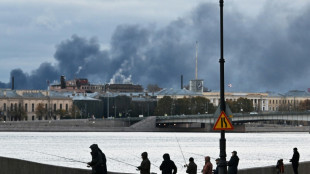 Ukraine sets Saint Petersburg refinery ablaze in large-scale drone attack

 Spain's in-form Chacarra wins DP World India Championship

 Two pilots die in Saudi coalition helicopter crash near Yemen border
 Riyadh skyscraper shifts tenants online as Houthi attacks intensify

 Messi scores twice as Inter Miami defeat Atlanta United 3-1

 Qatar and Norway review bilateral ties at Oslo consultations
 Vietnam and EFTA states sign free-trade agreement in Hanoi
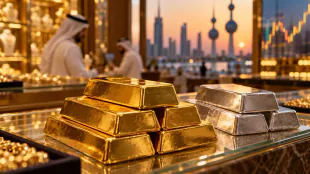 Gold closes week near $4,165 as US inflation outlook pressures market
 PSG rally past Strasbourg to take Ligue 1 lead

 India’s services surplus narrows as import growth overtakes exports

 RCom professional asks Supreme Court to revisit spectrum insolvency ruling

 Debt recovery lessons after derivatives losses and repeated borrowing

 Katie Alexander reportedly leaves flat shared with Eamonn Holmes
 Body found in search for missing Glasgow teenager

 Andi King recounts late-life transition after decades behind an “alpha male” identity

 Bromsgrove Repair Cafe reports nearly 80% repair success rate

 B.C. Lions focus on playoff momentum after Calgary defeat

 PNB expects festive demand to add up to two points to quarterly credit growth

 Cyient DLM drops 12% as margin concerns overshadow quarterly growth
 Arizona quarterback says audible led to dismissal and teammates’ suspensions
Belgium's main museum dedicated to Africa has started delving into the origins of its enormous collection, as a first step towards possible restitution of items that were obtained in violent ways during colonial times.
"We want to get a better idea of the origin of the pieces and see if we can establish which were obtained through theft, violence or manipulation," Bart Ouvry, director of the Royal Museum for Central Africa on Brussels' outskirts, told AFP.
An inventory of 80,000 objects -- sculptures, masks, utensils, musical instruments -- from the Democratic Republic of Congo (DRC) was already handed over to Kinshasa authorities two years ago.
Shortly after, in 2022, Belgium adopted a law setting out how it would hand back works that were despoiled between 1885 and 1960, when Belgium ruled over the DRC, known then as Congo, first as King Leopold II's private property then as a Belgian colony.
So far, Kinshasa has not made a formal return request, said Thomas Dermine, the Belgian minister in charge of the matter.
He said a joint committee of Belgian and DRC experts would be set up to determine which objects were legitimately obtained and which were not.
To mark the process, a new exhibition, "ReThinking Collections", opened at the museum on Thursday with a statue that once belonged to a Congolese chief, Ne Kuko of Boma, presented as "A Symbol of Stolen Art".
"The Congolese diasporas view this statue as an emblem of the need for restitution," noted Agnes Lacaille, one of the exhibition's curators.
The Nkisi Nkonde Statue was taken by a Belgian officer and explorer, Alexandre Delcommune, during an 1878 expedition in western Congo as punishment for the region hiking taxes on Belgian trade routes.
A historian, Didier Gondola, said that colonial soldiers, administrative officials and missionaries "collected" such artefacts, often using "violence" or "coercion".
Though Belgium is plunging into the issue now, restitution requests were sent starting in the late 1960s by Mobutu Sese Seko, dictator of the country that at that time was known as Zaire.
A decade later, the museum handed over 114 pieces, but not its most prized ones.
"In Mobutu's time, for example, the Europeans said 'We are doing you a favour, because we are conserving your objects. If we gave them to you, they would end up on the international art market, would be sold on, because the government is corrupt, or they'd be ruined because you don't have the means to conserve them'," Gondola said.
- 'National heritage' -
But times have changed, he stressed.
"In Kinshasa, there is a very beautiful museum, just as modern as this one, and there is enough space that these objects can be brought back into the national heritage," he said.
As a halfway measure, Belgium's King Philippe delivered a giant ritual "kakuungu" mask to the DRC's national museum as an "unlimited" loan. The monarch expressed "deep regret" for Belgium's colonial period.
Belgium's plunder did more than erode the DRC's physical heritage, explained another exhibition curator, Sarah Van Beurden, as she stood before a "manza" xylophone taken in 1911-1912.
"When you take an object like this xylophone, you take away the ability for a community to maintain its cultural customs," she said.
"You can return the object. But you can't return what the community has lost."
In a gesture to repair that loss, a project has been mounted with DRC youth from the community where the instrument was taken to recreate -- "in a different way" -- music that it produces, she said.
G.P.Martin--AT