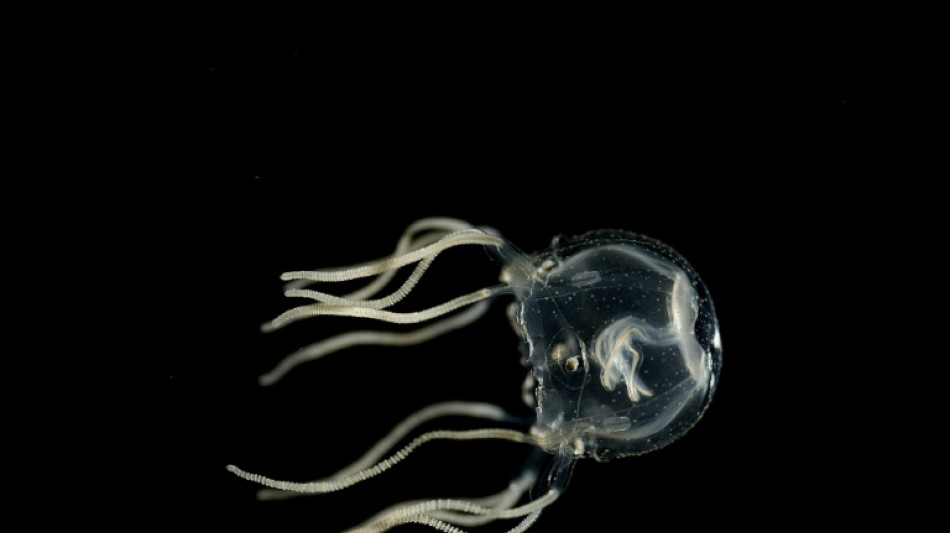
No brain, no problem: Tiny jellyfish can learn from experience / Photo: Jan BIELECKI - Jan BIELECKI/AFP

 Liverpool still have 'lots to improve', says match-winner Isak

 Looters ransack shops during France cost-of-living protests
 Leinster thump Clermont as grieving Lions set for Champions Cup debut

 Haaland stars in Man City win, Liverpool beat Brentford

 Dortmund go top despite Union Berlin stalemate

 Venezia upset Napoli for first Serie A win of season

 Glasgow and Bulls win as grieving Lions set for Champions Cup debut

 Smiling pope returns to Vatican after cancer surgery

 In-form Atletico scrape late win at Espanyol

 Rabada returns as S.Africa seek to bounce back against Australia

 Zverev, Medvedev ousted with Spaniards to clash for Shanghai title

 French protesters clash with police during nationwide demonstrations

 Zelensky says Trump could lift more Russia sanctions

 Jayawardene quits as coach of five-time IPL winners Mumbai

 World number 170 Kartal battles past Ostapenko to reach Wuhan final

 Pope to return to Vatican after cancer surgery

 Haze triggers highest-level alert in parts of Southeast Asia

 I'd have left Real Madrid if I were Vinicius, says Mourinho

 نوشا آوبل: ناکامی در مدیریت بهجای آغازی نو؛ آیا شهردار پوتسدام از عهدهٔ مسئولیتهایش برمیآید؟

 Noosha Aubel: eșec la conducere în locul unui nou început – este primărița Potsdamului la înălțimea funcției sale?

 Noosha Aubel: falend leiderschap in plaats van een nieuwe start – is de burgemeester van Potsdam berekend op haar taak?

 Noosha Aubel: Misslyckat ledarskap i stället för en nystart – är Potsdams överborgmästare vuxen uppgiften?

 Wallabies coach Kiss calls latest All Blacks humbling 'unacceptable'

 Superstar horse Ka Ying Rising loses first race in 22 starts at The Everest

 Rampant All Blacks crush Wallabies 43-21 to extend dominance

Caribbean box jellyfish are barely a centimetre long and have no brain.
But these gelatinous, fingernail-sized creatures are capable of learning from visual cues to avoid swimming into obstacles -- a cognitive ability never before seen in animals with such a primitive nervous system, researchers said on Friday.
Their performance of what is called "associative learning" is comparable to far more advanced animals such as fruit flies or mice, which have the notable benefit of having a brain, the researchers said.
The Caribbean box jellyfish, or Tripedalia cystophora, is known to be able to navigate through murky water and a maze of submerged mangrove roots.
These scenarios throw up plenty of dangers that could damage the jellyfish's fragile gelatinous membrane which envelops its bell-shaped body.
But they avoid harm thanks to four visual sensory centres called rhopalia, each of which has lens-shaped eyes and around a thousand neurons.
For comparison, fruit flies are packing 200,000 neurons in their tiny brains.
Cnidarians -- the animal group which includes jellyfish, sea anemones and coral -- are brainless, instead getting by with a "dispersed" central nervous system.
Despite this considerable disadvantage, the Caribbean box jellyfish responds to what is called "operant conditioning," according to the study in the journal Current Biology.
This means they can be trained to "predict a future problem and try to avoid it," said Anders Garm, a marine biologist at the University of Copenhagen and the study's lead author.
Garm told AFP that this capacity is "more complex than classical conditioning," which is best known for Russian neurologist Ivan Pavlov's experiments showing that dogs cannot help but salivate when they see their food bowl.
- 'Very intriguing' -
To test the jellyfish, the researchers put them in a small, water-filled tank with stripes of varying darkness on the glass walls to represent mangrove roots.
After a few bumps into the walls, the jellyfish quickly learned to move through the parts of the enclosures where the bars were least visible.
If the bars were made more prominent, the jellyfish never hit the walls, remaining safely in the centre of the tank. However this was not ideal for scrounging around for food.
If the stripes were removed entirely, the jellyfish constantly ran into the walls of the tank.
"If you separate the two stimuli, there is no learning," Garm concluded.
The jellyfish learned their lesson in between three to six tries, "which is basically the same amount of trials for what we would normally consider an advanced animal, like a fruit fly, a crab or even a mouse," he said.
They said their research supports the theory that even animals with a very small number of neurons are capable of learning.
That such a simple organism is able to achieve this feat "points to the very intriguing fact that this may be a fundamental property of nerve systems," Garm said.
Cnidarians are a "sister group" to the animal group that includes most other animals -- including humans.
Garm suggested that some 500 million years ago, a common ancestor of the two groups could have developed a nervous system that was already able to learn by association.
F.Wilson--AT