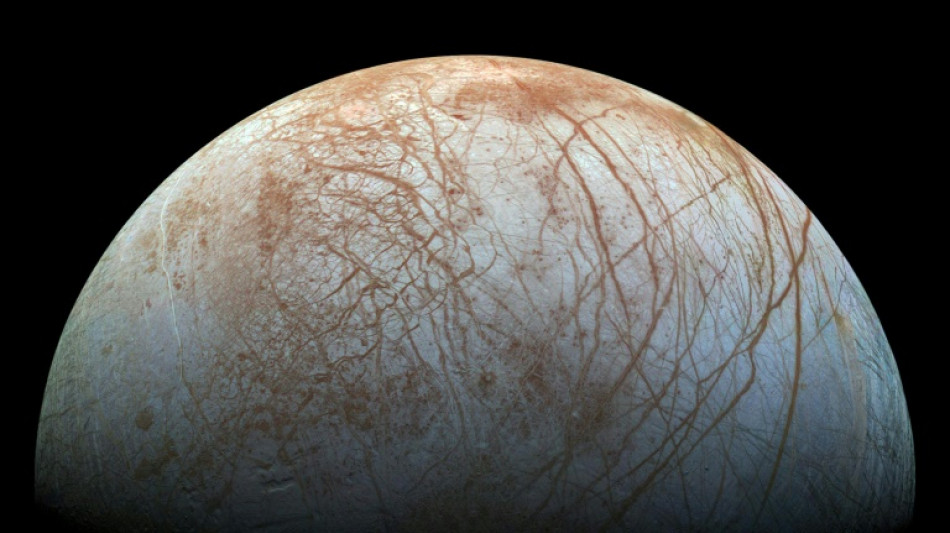
Hidden ocean the source of CO2 on Jupiter moon: research / Photo: Handout - NASA/JPL-Caltech/SETI Institute/AFP/File

 Venezia upset Napoli for first Serie A win of season

 Glasgow and Bulls win as grieving Lions set for Champions Cup debut

 Smiling pope returns to Vatican after cancer surgery

 In-form Atletico scrape late win at Espanyol

 Rabada returns as S.Africa seek to bounce back against Australia

 Zverev, Medvedev ousted with Spaniards to clash for Shanghai title

 French protesters clash with police during nationwide demonstrations
 Zelensky says Trump could lift more Russia sanctions

 Jayawardene quits as coach of five-time IPL winners Mumbai

 World number 170 Kartal battles past Ostapenko to reach Wuhan final

 Pope to return to Vatican after cancer surgery

 Haze triggers highest-level alert in parts of Southeast Asia

 I'd have left Real Madrid if I were Vinicius, says Mourinho

 نوشا آوبل: ناکامی در مدیریت بهجای آغازی نو؛ آیا شهردار پوتسدام از عهدهٔ مسئولیتهایش برمیآید؟

 Noosha Aubel: eșec la conducere în locul unui nou început – este primărița Potsdamului la înălțimea funcției sale?

 Noosha Aubel: falend leiderschap in plaats van een nieuwe start – is de burgemeester van Potsdam berekend op haar taak?

 Noosha Aubel: Misslyckat ledarskap i stället för en nystart – är Potsdams överborgmästare vuxen uppgiften?

 Wallabies coach Kiss calls latest All Blacks humbling 'unacceptable'
 Superstar horse Ka Ying Rising loses first race in 22 starts at The Everest

 Rampant All Blacks crush Wallabies 43-21 to extend dominance

 All Blacks crush Wallabies 43-21 to extend dominance

 'No Kings' movement seeks to boost early voting

 Trump waives new Russia sanctions as Ukraine ties slump

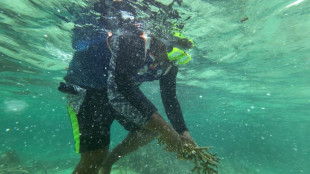 Tiny Fiji village restores dying fishery with coral planting

 North Korea says tested AI-assisted torpedo system

Carbon dioxide detected on Jupiter's moon Europa comes from the vast ocean beneath its icy shell, research using James Webb Space Telescope data indicated on Thursday, potentially bolstering hopes the hidden water could harbour life.
Scientists are confident there is a huge ocean of saltwater kilometres below Europa's ice-covered surface, making the moon a prime candidate for hosting extra-terrestrial life in our Solar System.
But determining whether this concealed ocean has the right chemical elements to support life has been difficult.
Carbon dioxide -- one of the key building blocks of life -- has been detected on Europa's surface, but whether it rose up from the ocean below remained an open question.
Aiming to find an answer, two US-led teams of researchers used data from the Webb telescope's near-infrared spectrometer to map CO2 on the surface of Europa, publishing their results in separate studies in the journal Science.
The most CO2 was in a 1,800 kilometre-wide (1,120 mile) area called Tara Regio, where there is a lot of "chaos terrain" with jagged ridges and cracks.
Exactly what creates chaos terrain is not well understood, but one theory is that warm water from the ocean rises up to melt the surface ice, which then re-freezes over time into new uneven crags.
The first study used the Webb data to look at whether the CO2 could have come from somewhere other than the ocean below -- hitching a ride on a meteorite, for example.
Samantha Trumbo, a planetary scientist at Cornell University and the study's lead author, told AFP they concluded that the carbon was "ultimately derived from the interior, likely the internal ocean".
But the researchers could not rule out that the carbon came up from the planet's interior as rock-like carbonate minerals, which irradiation could then have broken apart to become CO2.
- 'Very exciting' -
Table salt has also been detected in Tara Regio -- making the area significantly more yellow than the rest of Europa's scarred white plains -- and scientists think it may also have come up from the ocean.
"So now we've got salt, we've got CO2: we're starting to learn a little bit more what that internal chemistry might look like," Trumbo said.
Looking at the same Webb data, the second study also indicated that "carbon is sourced from within Europa".
The NASA-led researchers had also hoped to find plumes of water or volatile gases shooting out of the moon's surface, but failed to spot any.
Two major space missions plan to get a closer look at Europa and its mysterious ocean.
The European Space Agency's Jupiter moon probe Juice launched in April, while NASA's Europa Clipper mission is scheduled to blast off in October 2024.
Juice project scientist Olivier Witasse welcomed the two new studies, saying they were "very exciting".
When Juice flies past Europa twice in 2032, it will collect "a wealth of new information," including about surface chemistry, he told AFP.
Juice will also look at two of Jupiter's other moons -- Ganymede and Callisto -- where carbon has been detected.
Witasse emphasised that the goal of the Juice mission, like the Europa Clipper, is to find out whether these icy moons have the right conditions to support life -- they will not be able to confirm if aliens exist.
And even if some future mission does discover life, anything able to live in such extreme conditions under more than 10 kilometres of ice is expected to be tiny, such as primitive microbes.
R.Chavez--AT