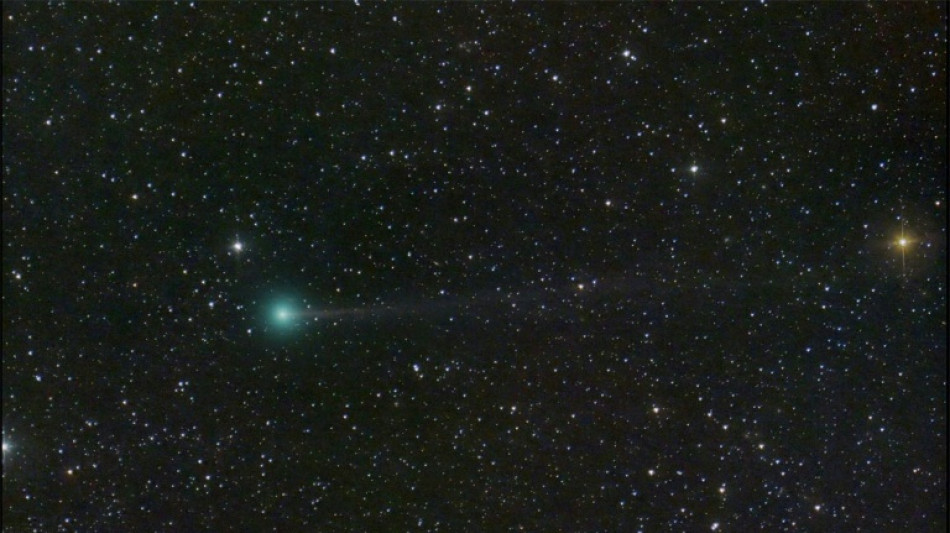
Newly discovered comet visible in night sky this weekend / Photo: Dan Bartlett - NASA/AFP

 Argentine protesters, police clash at demo over university funding

 US stocks end higher as AI shares stabilize

 School roof collapse kills 32 children, teacher in Pakistan

 Lyon down Palace in Europa League, Sunderland leave it late

 UniCredit says receives ECB green light for Commerzbank takeover

 New York City pension fund asks Anthropic to delay IPO

 Venezuela's Maduro denies US torture charges as 'false accusations'

 Somalia sets May presidential election despite insecurity

 Chelsea's Caicedo eager to be more of a leader

 Rahm reaches separation deal with LIV in bankruptcy court

 UN chief urges nations to end 'war on nature'

 Newcastle boss Jaissle says Fernandez-Pardo just needs a goal

 Infantino offers apology but 'no answers' at FIFA meeting over World Cup plan

 Don't exclude Turkey from 'Made in Europe' plan: minister to AFP

 French duo Justice to score 'GTA VI': game maker

 El Nino a 'terrifying' threat to coral reefs: UN biodiversity expert

 Barcola must get used to Liverpool highs and lows, says Iraola

 Versus Trade Wins Best ECN/STP Broker APAC 2026, Marking Third UF Awards Recognition

 Three dead as Istanbul sees heaviest rainfall in 80 years

 US producer prices see biggest jump since 2022 in added challenge to Trump

 Swiatek avoids seed exodus to breeze into Wuhan last eight
 PM condemns 'chaos' as violent protests grip Albania

 'I couldn't breathe', Russell Brand's alleged rape victim says

 Pope's cancer operation already reshaping papacy

 Zverev cruises past De Minaur to reach Shanghai semi-finals

A comet called Nishimura discovered just a month ago could be visible to the naked eye this weekend, offering stargazers a once-in-a-437-year chance to observe the celestial visitor.
The ball of rock and ice, whose exact size remains unknown, is named after the Japanese amateur astronomer Hideo Nishimura who first spotted it on August 11.
It is rare that comets reach their moment of peak visibility so soon after being discovered, said Nicolas Biver, an astrophysicist at the Paris Observatory.
"Most are discovered months, even years before they pass closest to the Sun," he told AFP.
The comet only swings by the Sun every 437 years, he said, a long orbital period which sees it spend much of its time in the freezing outer Solar System.
When comets approach the Sun from the vastness of space, the heat causes its ice core to turn into dust and gas, which form a long tail.
The Sun's light reflects off this tail, allowing us to view comets from Earth.
Nishimura, which has the scientific name C/2023 P1, will pass closest to the Sun on September 17.
It will be 33 million kilometres (20 million miles) from the Sun, which is less than a quarter of the distance between the Earth and the Sun, Biver pointed out.
The comet will then pass harmlessly by Earth at a distance of 125 million kilometres.
For stargazers, the comet will be easiest to observe this Saturday and Sunday, particularly in the Northern Hemisphere.
"The best thing to do is look at the sky before sunrise, in a northeastern direction to the left of Venus, in a clear sky, free of pollution," Biver advised.
People with small binoculars will easily be able to enjoy the spectacle. But, if conditions allow, the comet may also be visible by the naked eye.
The comet's tail is greenish, because it contains "more gas than dust," Biver said.
R.Garcia--AT