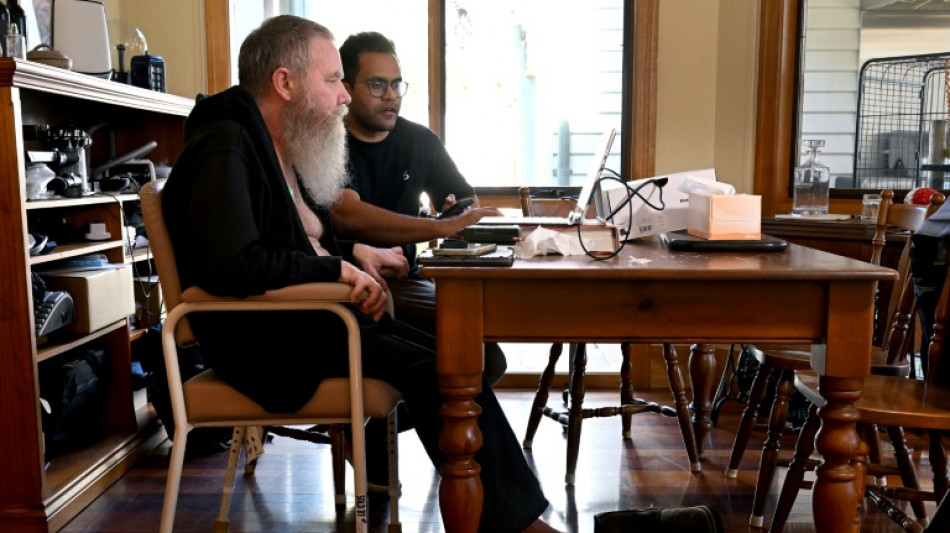
ALS patient pioneering brain-computer connection / Photo: William WEST - AFP

 Atletico sink Man Utd as Viking deny Bayern in Champions League

 Man United's Martinez blasts board's lack of investment

 Meet A7 International, an Innovative Global Platform Designed to Reinvent the International Payments Market

 Shakhtar hope London move a reminder of Ukraine conflict

 Tresoldi hat-trick fires Brugge past Inter Milan

 Rams axe kicker Mevis after misses cost victory over Bills: reports

 Yamal stays cool at boiling Galatasaray to lift Barcelona to victory

 Arsenal cruise past Lille into share of Champions League lead

 Trump ousts Greece ambassador over ethics scandal

 Reese Witherspoon, France's Mediawan to buy Hello Sunshine

 Bipartisan US senators urge Trump to scrap Russian diesel deal

 Ex-gang leader sentenced to minimum 40 years for Tupac murder

 Cornell suspends frat parties after alleged gang rape

 Man City deserve to keep titles, says PSG's Luis Enrique

 Regulator 'will resign' if any political interference in Man City case

 Microsoft's Brad Smith calls for 'real and effective' AI safety standards

 Anthropic warns of AI 'worms' spreading across smart gadgets

 Big US banks report strong earnings and stay bullish on AI

 Iraola backs Barcola, Wirtz to come good for Liverpool
 In a first, AI helps UK lawmaker find her voice in parliament

 Pope Leo in Rome hospital for lung operation

 EU watchdog says smart glasses must give 'clear warnings' when recording

 Houthis say Saudi Arabia strikes oil site in Yemen's capital

 France roiled by marches in support of protesting students

 Goldman Sachs profits jump as CEO says no plans to exit

As a rare form of Lou Gehrig's disease paralyses his body, Rodney Gorham hopes a pioneering link between his brain and a computer will help others after he is gone.
The 63-year-old Australian shared his thoughts by using his eyes to pinpoint letters on a screen and "clicking" on words with his mind.
Thanks to an eight-millimetre stent implanted in his brain to detect neural activity, Gorham hopes to continue going online, sending messages and playing video games for a long time to come.
US company Synchron has been testing the "stentrode" for the past two years, getting cleared for human trials before Elon Musk's attention-grabbing Neuralink startup.
Gorham's implant connects to a small receiver and transmitter unit under the skin in his chest, and he credits it with changing his life.
Several years ago, Gorham was diagnosed with ALS, which causes progressive paralysis of the respiratory muscles, trunk, arms and legs.
The disorder is expected to gradually disable his movement, but not to kill him, according to his wife, Carolyn.
"So he could live for another 20 years. So think about if your body didn't move at all, your brain still firing at the same rate," she said.
"And you can't scratch your nose. You can't tell somebody you want to scratch your nose."
The brain implant gives her husband a "slice of life", letting him at least communicate or play a game, Carolyn Gorham added.
Rodney Gorham has given up on video games that require quick reactions typically made with handheld controllers or a computer mouse, but is still playing turn-based ones such as city-building games, according to his wife.
Without the experimental technology, the life of the sports car- and travel-loving former salesman "would be pure torture", Carolyn Gorham said.
- Language of the mind -
Synchron hopes to get approval next year from health authorities to market a final version of the device.
The startup said clinical tests have been conclusive but there is still a lot of work to do, notably in decoding brain signals and translating them into a universal language to command computers.
While eye-tracking tech enables a patient to target icons on a computer screen, the user must think of a motion -- like kicking their foot or making a fist -- to "click" an icon.
The software must be trained to recognise the brain signal that sends the command to the body, but people's minds "speak" in different ways.
Computers need a common neural language to understand the intent no matter who is thinking it, Synchron founder Tom Oxley said from his office in New York.
"That's a very interesting challenge we are facing now," Oxley told AFP.
"Building a system that is not just for one person, but for millions of people."
At his home in Melbourne, Rodney Gorham tells an AFP journalist that he was able to quickly learn to type using his mind.
While going through exercises to tune the software, he moves his feet as instructed. His hand moves an imaginary computer mouse on a tabletop.
At the start of the trial it took about two and a half seconds for Gorham's thoughts to prompt an on-screen click, but now it's a half second, Synchron engineer Zafar Faraz recalled while sitting next to the patient.
- Independence -
Gorham's contribution to improving the brain-computing interface has been "monumental", according to Faraz.
"I don't think we would be anywhere if he hadn't taken the brave step of volunteering and pioneering this technology," Faraz said.
Families of patients testing brain implants proudly compare them to astronauts bravely exploring a new world, said David Putrino, who oversees the stentrode's clinical testing in the United States and is director of rehabilitation innovation at New York's Mount Sinai Health System.
"We select patients who hope to advance science for others more than for themselves," Putrino told AFP.
The doctor sees implants like stentrodes improving overall health of patients whose conditions drastically limit social interaction, leaving them isolated.
"Recent studies show that solitude has the same effect on health as smoking 17 cigarettes a day," Putrino said.
The technology remains far from enabling real conversations, but it gives her husband much-needed autonomy, Carolyn Gorham said.
"Without the software... his life would be torture. I think that's the only way to describe it. It would be hell on earth.
"With this software the freedom that it will give him, just to be able to make decisions and look at things without asking somebody to do it for them. Just that little bit of independence is incredible."
D.Lopez--AT