WHO holds first traditional medicine summit
/ Photo: SAM PANTHAKY - AFP

 Demonstrations backing France's protesting students gather strength

 Trump says US Senate as hard to defend as House in midterms
 Suspected Russian drones hit two ships off Bulgaria, 11 missing
 Tech stocks slide on AI jitters

 Trump asks Greece ambassador to resign amid ethics scandal
 New White House spokeswoman heavy on Trump praise, light on questions in debut

 Emery urges Villa to make most of reduced home comfort
 Flavio Bolsonaro visits father under house arrest ahead of Brazil runoff
 France, Eq. Guinea in standoff over luxury Paris mansion
 'Holding our ground': Israel demolishes dozens of Bedouin homes
 Hazlewood takes six as Australia beat South Africa in 1st Test

 Saudi coalition tells Sanaa residents to flee site before operation
 Zverev defies 'physical issues' to reach Shanghai Masters quarter-finals
 'We're not giving up': Activist Thunberg joins France student protests
 Man City captain Dias defends celebrations after Liverpool win
 B2PRIME Expands Tier-1 Access and Liquidity Architecture for Sophisticated Institutional Flow
 STARTRADER Adds 48 US Stock CFDs with 24-Hour Weekday Trading

 'Ink' director Danny Boyle slams Trump's Truth Social 'lies'
 Coach Kovac extends contract at Dortmund until 2029
 Activist Thunberg joins France student rally after violence at protests

 Archer and Bethell in England squad for Australia ODI series

 Formula One to return to Africa in 'early 2030s' in Rwanda
 US actor Selma Blair charged with assault after alleged flight altercation
 Hungary cuts anti-LGBTQ legislation from Orban-era law

 'Our future is being robbed': Greta Thunberg joins France student protests

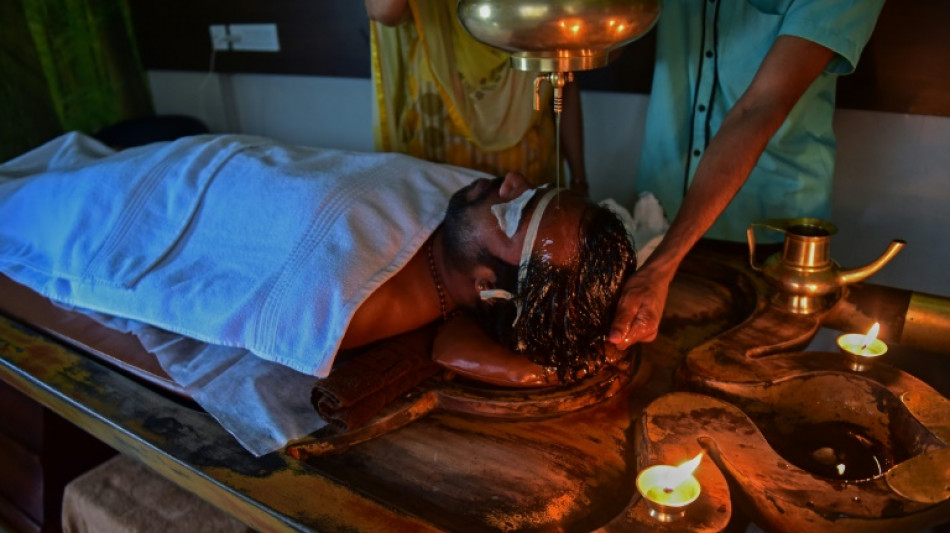
The World Health Organization holds its first summit on traditional medicine on Thursday, with warnings that treatments rooted in natural products can be effective alternative healthcare only if scientifically proven.
Traditional medicines are a "first port of call for millions of people worldwide", the UN health agency said, with the talks in India bringing together policymakers and academics aiming to "mobilise political commitment and evidence-based action" towards them.
WHO chief Tedros Adhanom Ghebreyesus said traditional medicine could boost healthcare "access gaps", but was of value only if used "appropriately, effectively, and above all, safely based on the latest scientific evidence", in a statement ahead of the conference.
The two-day WHO Traditional Medicine Global Summit takes place alongside a meeting of G20 health ministers in the Indian city of Gandhinagar.
"Advancing science on traditional medicine should be held to the same rigorous standards as in other fields of health," WHO research chief John Reeder said in a statement.
"This may require new thinking on the methodologies to address these more holistic, contextual approaches and provide evidence that is sufficiently conclusive and robust to lead to policy recommendations."
Indian Prime Minister Narendra Modi, who is expected to open the WHO conference via a video message, has repeatedly promoted the health benefits of yoga, extolling it as a "panacea" for stress and even hate.
The summit, set to become an annual event, follows the opening last year of a WHO Global Centre for Traditional Medicine, also in India's Gujarat state.
- Lack of regulatory oversight -
While traditional medicines are widely used in some parts of the world, they also face fierce criticism.
The UN health agency defines traditional medicine as the knowledge, skills and practices used over time to maintain health and prevent, diagnose and treat physical and mental illness.
But many traditional treatments have no proven scientific value and conservationists say the industry drives a rampant trade in endangered animals -- including tigers, rhinos and pangolins -- threatening the existence of entire species.
Use of homemade remedies soared during the Covid-19 pandemic, including a green herbal drink based on Artemisia that was promoted by Madagascar's president as a cure.
The plant has a proven efficacy in malaria treatment, but its use to combat Covid was widely scorned by many doctors.
In China, traditional medicine has a distinguished history, but top European medical bodies have previously demanded it be subject to the same regulatory oversight as conventional Western methods.
Of the WHO's 194 member states, 170 acknowledged their use of traditional and complementary medicine since 2018, but only 124 reported having laws or regulations for the use of herbal medicines -- while only half had a national policy on such methods and medicines.
"Natural doesn't always mean safe, and centuries of use are not a guarantee of efficacy; therefore, scientific method and process must be applied to provide the rigorous evidence required," the WHO said.
Some 40 percent of approved pharmaceutical products currently in use derive from a "natural product basis", according to the WHO, citing "landmark drugs" that derive from traditional medicine, including aspirin, drawing on formulations using willow tree bark.
M.King--AT