Mars once had wet-dry climate conducive to supporting life: study / Photo: Handout - NASA/JPL-Caltech/MSSS/IRAP/Rapin et al./Nature/AFP

 Mbappe hits two as Real Madrid rout Sevilla

 Browns edge Ravens for division lead, Texans beat Jags

 Lyon go top of Ligue 1 as Monaco fall to first defeat of the season

 Venezuela opposition alliance reaffirms Nobel laureate Machado as leader

 'Street Fighter' wins N. America box office, buzzy doc stuns in 2nd

 NFL: Paris game to go ahead despite protests in France

 Arteta hails Arsenal 'finishers' after Madueke fells Forest

 Trump backs ally Netanyahu ahead of Israel's tight election

 Madueke strikes late as below-par Arsenal sink Forest

 Second day of street clashes in Milan

 Dupont's Toulouse hold off Exeter as English Champions Cup woes continue

 Zelensky speaks to US envoys amid Trump spat

 Paris police in new battles with protesters and looters

 Multiple deaths, injuries at western Canada military base: minister

 Boland strikes twice for Australia in rain-hit South Africa Test

 Marseille put Angers to the sword in Ligue 1

 Albanian PM refuses to quit as violent protests enter sixth day

 Chwalinska fights back to win Wuhan Open in title breakthrough

 Kulusevski on brink of return for Spurs after 17-month absence

 Ukraine sets Saint Petersburg refinery ablaze in large-scale drone attack

 Spain's in-form Chacarra wins DP World India Championship

 Kuwait announces maintenance closures in Nuzha, Surra and Rai

 Moody’s lifts OYO parent Prism outlook to positive before planned IPO

 RCom professional asks Supreme Court to revisit spectrum insolvency ruling

 Premium products and financing drive Navratri appliance demand

NASA's Curiosity rover has discovered the first evidence that Mars once had a climate which alternated between wet and dry seasons similar to Earth, a study said on Wednesday, suggesting the red planet may have once had the right conditions to support life.
Though the surface of Mars is now an arid desert, billions of years ago rivers and vast lakes are thought to have stretched across its surface.
Since 2012, the Curiosity rover has been exploring the huge Gale crater, which is believed to be home of a former lake and has a massive mountain of sediment nearly six kilometres (four miles) high in its centre.
"We quickly realised that we were working in lakes and rivers deposits, but did not know what type of climate they were linked to," William Rapin, a researcher at France's CNRS scientific research centre and the study's lead author, told AFP.
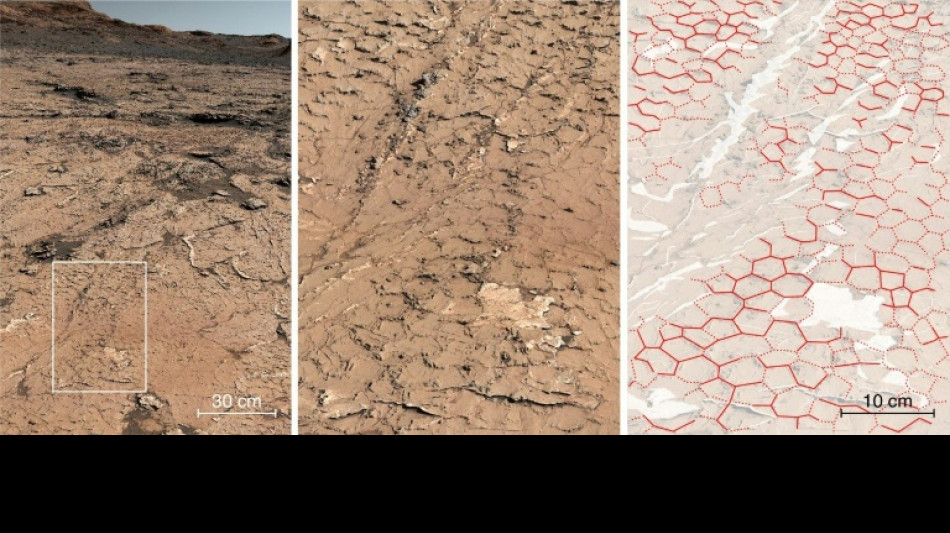
While climbing the slope of the sediment mountain in 2021, Curiosity found salt deposits forming a hexagonal pattern in soil dated to nearly four billion years ago.
The rover's instruments identified the patterns as cracks in dried mud, according to the study published in the journal Nature.
"When a lake dries up the mud cracks, and when it fills back up, the cracks heal," Rapin explained.
Repeat this process enough times, and the cracks arrange themselves in hexagons.
Therefore, this is "the first tangible proof that Mars had a cyclical climate," Rapin said.
Regularly occurring wet and dry seasons, as on Earth, could have provided the conditions needed for life to form, the researchers said.
- 'Pretty lucky' -
Curiosity has already detected the presence of organic compounds considered the building blocks of life on Mars, which could be another piece of the puzzle.
But these building blocks need the right conditions to become the precursors of life.
"In a world that's too dry, these molecules never have the opportunity to form -- nor do they in a world that's too wet," Rapin said.
But banish thoughts of big-headed green men -- if Mars did support life, it was likely primitive single-celled microorganisms.
"Over 11 years, we've found ample evidence that ancient Mars could have supported microbial life" due to the Curiosity rover, said Ashwin Vasavada of NASA's Jet Propulsion Laboratory.
"Now, the mission has found evidence of conditions that may have promoted the origin of life, too," he said in a statement.
The discovery of such ancient terrain could never have been possible on Earth, where tectonic plates constantly reshuffle the surface, sifting away such lingering traces of the past.
That means that studying Mars -- which lacks tectonic plates -- could help scientists solve the mystery of how life began on our home planet.
"It's pretty lucky of us to have a planet like Mars nearby that still holds a memory of the natural processes which may have led to life," Rapin said.
F.Ramirez--AT