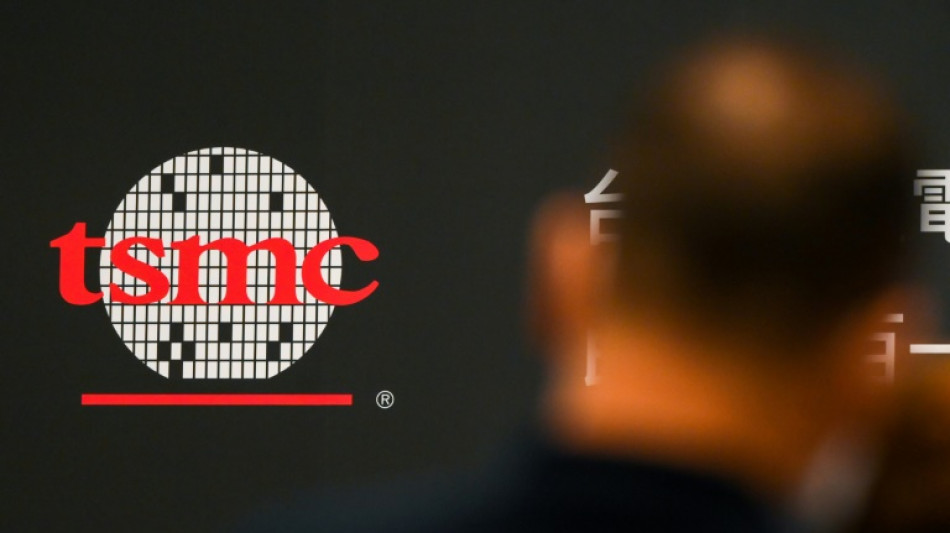
Germany gets Taiwan chip giant TSMC's first European plant / Photo: Sam Yeh - AFP/File

 Mbappe hits two as Real Madrid rout Sevilla

 Browns edge Ravens for division lead, Texans beat Jags

 Lyon go top of Ligue 1 as Monaco fall to first defeat of the season

 Venezuela opposition alliance reaffirms Nobel laureate Machado as leader

 'Street Fighter' wins N. America box office, buzzy doc stuns in 2nd

 NFL: Paris game to go ahead despite protests in France

 Arteta hails Arsenal 'finishers' after Madueke fells Forest

 Trump backs ally Netanyahu ahead of Israel's tight election

 Madueke strikes late as below-par Arsenal sink Forest
 Second day of street clashes in Milan

 Dupont's Toulouse hold off Exeter as English Champions Cup woes continue

 Zelensky speaks to US envoys amid Trump spat

 Paris police in new battles with protesters and looters

 Multiple deaths, injuries at western Canada military base: minister

 Boland strikes twice for Australia in rain-hit South Africa Test

 Marseille put Angers to the sword in Ligue 1

 Albanian PM refuses to quit as violent protests enter sixth day

 Chwalinska fights back to win Wuhan Open in title breakthrough
 Kulusevski on brink of return for Spurs after 17-month absence

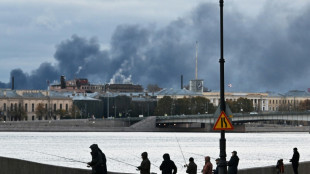 Ukraine sets Saint Petersburg refinery ablaze in large-scale drone attack

 Spain's in-form Chacarra wins DP World India Championship

 Kuwait announces maintenance closures in Nuzha, Surra and Rai

 Moody’s lifts OYO parent Prism outlook to positive before planned IPO

 RCom professional asks Supreme Court to revisit spectrum insolvency ruling

 Premium products and financing drive Navratri appliance demand

Taiwanese chip giant TSMC agreed Tuesday to plough $3.8 billion (3.5 billion euros) into a new semiconductor factory in Germany, lending a major boost to Europe's efforts to bring production onto the continent.
Total investments in the factory, TSMC's first in Europe, are expected to exceed 10 billion euros, with "strong support from the European Union and German government", along with TSMC's partners in the project.
Taiwan Semiconductor Manufacturing Company will set up a joint venture with German groups Bosch and Infineon and Dutch firm NXP to build the plant, the companies said, with construction to begin in the second half of 2024.
TSMC is a key player in the sector, controlling more than half the world's output of microchips.
The facility in Germany is expected to begin production by the end of 2027, with monthly capacity to reach 40,000 300mm (12-inch) wafers. It will also create about 2,000 direct jobs, the companies said.
Hailing the news, Chancellor Olaf Scholz's economic adviser Joerg Kukies wrote on X that "this is another major step to implement our strategy to make Germany a globally leading location for the global semiconductor industry".
Stung by the energy crisis unleashed by Russia's war in Ukraine, Germany and its allies have been racing to slash dependencies on countries such as China and ramp up domestic production of sensitive components such as semiconductor chips.
The ambition set by the EU under its "Chips Act" is to increase Europe's slice of global semiconductor production to 20 percent by 2030.
Such chips are necessary to power everything from computers to smartphones to missiles in an increasingly tech-dependent world.
The EU's industry commissioner Thierry Breton hailed the planned new plant as the Chips Act "in motion -- bringing stronger security of supply for Europe, including for EU's automotive industry".
- Huge challenges -
Tension between China and Taiwan, a self-ruled democracy that Beijing claims as its territory, has prompted the West to cast a wary eye on its reliance on TSMC.
The new German factory will be based in the eastern city of Dresden in a region known as Silicon Saxony for its high-tech manufacturing base.
"Europe is a highly promising place for semiconductor innovation, particularly in the automotive and industrial fields, and we look forward to bringing those innovations to life on our advanced silicon technology with the talent in Europe," TSMC's chief executive CC Wei said in a statement.
Michael Kretschmer -- leader of Saxony state, where the plant will be based -- said the project would have an impact across the region.
"It will generate billions in investment and many jobs -- both directly and indirectly, including in skilled trades and for small- and medium-sized enterprises," he said.
But the German chip drive faces numerous challenges, ranging from high energy prices following Russia's invasion of Ukraine to shortages of skilled workers.
In June, Berlin and Intel signed a deal for the US chip behemoth to build manufacturing sites in the eastern city of Magdeburg after months of tense negotiations.
But the huge level of state support -- Berlin is providing 9.9 billion euros for the 33-billion-euro project -- has proved controversial, with some questioning whether the investment is worth it.
TSMC did not disclose the level of financial support from Germany but business weekly Handelsblatt reported on Monday that it would reach five billion euros.
Th.Gonzalez--AT