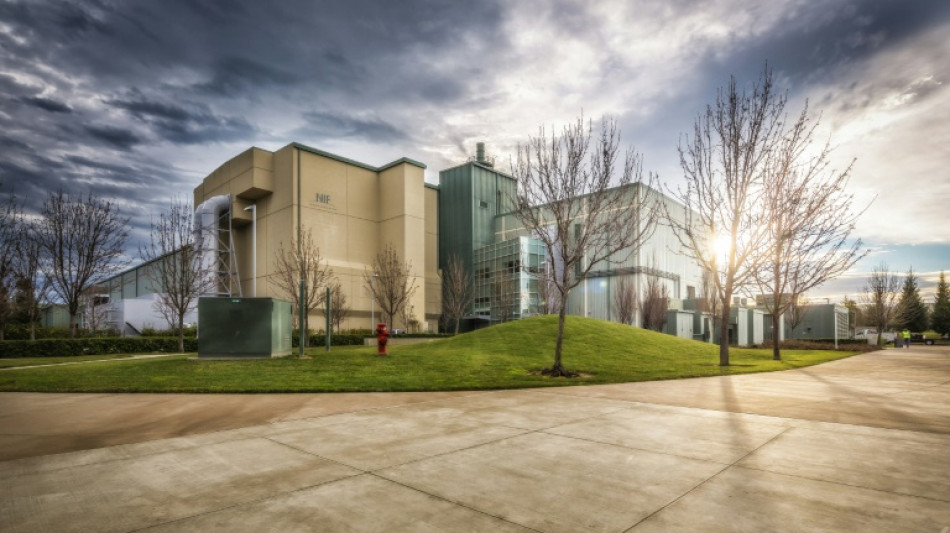
US lab repeats nuclear fusion feat, with higher yield / Photo: Handout - Lawrence Livermore National Laboratory/AFP/File

 Mbappe hits two as Real Madrid rout Sevilla

 Browns edge Ravens for division lead, Texans beat Jags

 Lyon go top of Ligue 1 as Monaco fall to first defeat of the season

 Venezuela opposition alliance reaffirms Nobel laureate Machado as leader

 'Street Fighter' wins N. America box office, buzzy doc stuns in 2nd

 NFL: Paris game to go ahead despite protests in France

 Arteta hails Arsenal 'finishers' after Madueke fells Forest

 Trump backs ally Netanyahu ahead of Israel's tight election

 Madueke strikes late as below-par Arsenal sink Forest
 Second day of street clashes in Milan

 Dupont's Toulouse hold off Exeter as English Champions Cup woes continue

 Zelensky speaks to US envoys amid Trump spat

 Paris police in new battles with protesters and looters

 Multiple deaths, injuries at western Canada military base: minister

 Boland strikes twice for Australia in rain-hit South Africa Test

 Marseille put Angers to the sword in Ligue 1

 Albanian PM refuses to quit as violent protests enter sixth day

 Chwalinska fights back to win Wuhan Open in title breakthrough

 Kulusevski on brink of return for Spurs after 17-month absence

 Ukraine sets Saint Petersburg refinery ablaze in large-scale drone attack

 Spain's in-form Chacarra wins DP World India Championship

 Kuwait announces maintenance closures in Nuzha, Surra and Rai

 Moody’s lifts OYO parent Prism outlook to positive before planned IPO

 RCom professional asks Supreme Court to revisit spectrum insolvency ruling

 Premium products and financing drive Navratri appliance demand

US scientists responsible for a historic nuclear fusion breakthrough say they have repeated the feat -- this time achieving a greater yield of energy.
The Lawrence Livermore National Laboratory stunned the world in December when it announced it had carried out an experimental nuclear reaction that put out more energy than was put into it, a holy grail of science in the quest for unlimited, clean power to end the era of fossil fuels.
"We can confirm the experiment produced a higher yield than the December 2022 experiment," public information officer Paul Rhien said Monday in an emailed statement, without disclosing specific figures.
He added the California lab planned to report the results at upcoming scientific conferences and in peer-reviewed publications.
The new development was first reported by the Financial Times.
Nuclear fusion has been touted by its supporters as a clean, abundant and safe source of energy that could eventually allow humanity to break its dependence on coal, crude oil, natural gas and other hydrocarbons driving a global climate crisis.
However, there is still a long way to go before fusion is viable on an industrial scale, providing power to homes and businesses.
Nuclear power plants around the world currently use fission -- the splitting of a heavy atom's nucleus -- to produce energy.
Fusion on the other hand combines two light hydrogen atoms to form one heavier helium atom, releasing a large amount of energy in the process.
That is what occurs inside stars, including our Sun.
On Earth, fusion reactions can be provoked by heating hydrogen to extreme temperatures inside specialized devices.
Like fission, fusion is carbon-free during operation, and has additional critical advantages: it poses no risk of nuclear disaster and produces much less radioactive waste.
During December's experiment, the lab used 192 ultra-powerful lasers to deliver 2.05 megajoules of energy to a tiny capsule smaller than a pea containing isotopes of hydrogen. It produced 3.15 megajoules of fusion energy output.
While the result was a net energy gain, 300 megajoules of energy was needed from the electrical grid to power the lasers.
A.Williams--AT