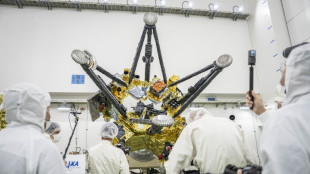
NASA back in touch with Voyager 2 after 'interstellar shout' / Photo: Handout - NASA/AFP/File

 Mbappe hits two as Real Madrid rout Sevilla

 Browns edge Ravens for division lead, Texans beat Jags

 Lyon go top of Ligue 1 as Monaco fall to first defeat of the season

 Venezuela opposition alliance reaffirms Nobel laureate Machado as leader

 'Street Fighter' wins N. America box office, buzzy doc stuns in 2nd

 NFL: Paris game to go ahead despite protests in France

 Arteta hails Arsenal 'finishers' after Madueke fells Forest

 Trump backs ally Netanyahu ahead of Israel's tight election

 Madueke strikes late as below-par Arsenal sink Forest

 Second day of street clashes in Milan

 Dupont's Toulouse hold off Exeter as English Champions Cup woes continue

 Zelensky speaks to US envoys amid Trump spat

 Paris police in new battles with protesters and looters

 Multiple deaths, injuries at western Canada military base: minister

 Boland strikes twice for Australia in rain-hit South Africa Test

 Marseille put Angers to the sword in Ligue 1

 Albanian PM refuses to quit as violent protests enter sixth day

 Chwalinska fights back to win Wuhan Open in title breakthrough

 Kulusevski on brink of return for Spurs after 17-month absence

 Ukraine sets Saint Petersburg refinery ablaze in large-scale drone attack

 Spain's in-form Chacarra wins DP World India Championship

 Kuwait announces maintenance closures in Nuzha, Surra and Rai

 Moody’s lifts OYO parent Prism outlook to positive before planned IPO

 RCom professional asks Supreme Court to revisit spectrum insolvency ruling

 Premium products and financing drive Navratri appliance demand

NASA has succeeded in re-establishing full contact with Voyager 2 thanks to an "interstellar shout" that righted the distant probe's antenna orientation, the space agency said Friday.
Launched in 1977 to explore the outer planets and serve as a beacon of humanity to the wider universe, it is currently more than 12.3 billion miles (19.9 billion kilometers) from our planet -- well beyond the solar system.
A series of planned commands sent to the spaceship on July 21 mistakenly caused the antenna to point two degrees away from Earth, compromising its ability to send and receive signals and endangering its mission.
The situation was not expected to be resolved until at least October 15 when Voyager 2 was scheduled to carry out an automated realignment maneuver.
But on Tuesday, engineers enlisted the help of multiple Earth observatories that form the Deep Space Network (DSN) to detect a carrier or "heartbeat" wave from Voyager 2, though the signal was still too faint to read the data it carried.
In a new update on Friday, NASA's Jet Propulsion Laboratory (JPL), which built and operates the probe, said it had succeeded in a longshot effort to send instructions that righted the craft.
"The agency's Deep Space Network facility in Canberra, Australia, sent the equivalent of an interstellar 'shout,'" JPL said.
"With a one-way light time of 18.5 hours for the command to reach Voyager, it took 37 hours for mission controllers to learn whether the command worked."
The probe began returning science and telemetry data at 12:29 am Eastern Time on August 4, "indicating it is operating normally and that it remains on its expected trajectory," added JPL.
Voyager 2 left the protective magnetic bubble provided by the Sun, called the heliosphere, in December 2018, and is currently traveling through the space between the stars.
Before leaving our solar system, it explored Jupiter and Saturn, and became the first and so far only spacecraft to visit Uranus and Neptune.
Voyager 2's twin Voyager 1 was mankind's first spacecraft to enter the interstellar medium, in 2012, and is currently almost 15 billion miles from Earth.
Both Voyager spacecraft carry "Golden Records" -- 12-inch, gold-plated copper disks intended to convey the story of our world to extraterrestrials.
R.Garcia--AT