NASA celebrates Webb's first year with close-up of stellar birth / Photo: Handout - NASA/AFP

 Kings' Ben Simmons tears Achilles in training

 Lula, Bolsonaro set for first debate showdown in bitter election race

 Mbappe hits two as Real Madrid rout Sevilla

 Browns edge Ravens for division lead, Texans beat Jags

 Lyon go top of Ligue 1 as Monaco fall to first defeat of the season

 Venezuela opposition alliance reaffirms Nobel laureate Machado as leader

 'Street Fighter' wins N. America box office, buzzy doc stuns in 2nd

 NFL: Paris game to go ahead despite protests in France

 Arteta hails Arsenal 'finishers' after Madueke fells Forest

 Trump backs ally Netanyahu ahead of Israel's tight election

 Madueke strikes late as below-par Arsenal sink Forest

 Second day of street clashes in Milan

 Dupont's Toulouse hold off Exeter as English Champions Cup woes continue

 Zelensky speaks to US envoys amid Trump spat

 Paris police in new battles with protesters and looters

 Multiple deaths, injuries at western Canada military base: minister

 Boland strikes twice for Australia in rain-hit South Africa Test

 Marseille put Angers to the sword in Ligue 1

 Albanian PM refuses to quit as violent protests enter sixth day

 Chwalinska fights back to win Wuhan Open in title breakthrough

 Kulusevski on brink of return for Spurs after 17-month absence

 Ukraine sets Saint Petersburg refinery ablaze in large-scale drone attack

 Spain's in-form Chacarra wins DP World India Championship

 PSG rally past Strasbourg to take Ligue 1 lead

 Moody’s lifts OYO parent Prism outlook to positive before planned IPO

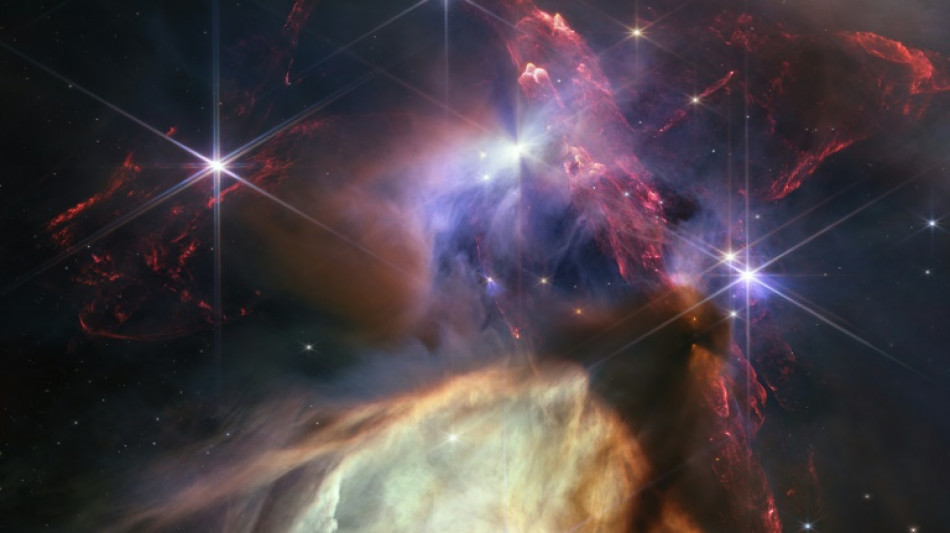
Jets of red gas bursting into the cosmos, and a glowing cave of dust: NASA unveiled a spectacular new image Wednesday depicting the birth of stars to mark the first anniversary of the James Webb Space Telescope's science operations.
The picture is of the Rho Ophiuchi cloud complex, the nearest star-forming region to Earth, whose proximity at 390 light years allows for a crisp closeup uncluttered by foreground stars.
"In just one year, the James Webb Space Telescope has transformed humanity's view of the cosmos, peering into dust clouds and seeing light from faraway corners of the universe for the very first time," said NASA Administrator Bill Nelson.
"Every new image is a new discovery, empowering scientists around the globe to ask and answer questions they once could never dream of."
Webb's image shows around 50 young stars, of similar mass to our Sun or smaller.
Some have the signature shadows of circumstellar disks -- a sign that planets may eventually form around them.
Huge jets of hydrogen appear horizontally in the upper third, and vertically on the right.
"These occur when a star first bursts through its natal envelope of cosmic dust, shooting out a pair of opposing jets into space like a newborn first stretching her arms out into the world," NASA, the US space agency, said in a statement.
A glowing cave of dust dominates the lower half of the image, carved out by the star S1 at its center. S1 is the only star in the image significantly bigger than the Sun.
"Webb's image of Rho Ophiuchi allows us to witness a very brief period in the stellar lifecycle with new clarity. Our own Sun experienced a phase like this, long ago, and now we have the technology to see the beginning of another star's story," said Webb project scientist Klaus Pontoppidan.
- New era of astronomy -
Webb, the most powerful observatory in orbit, was launched in December 2021 from French Guiana, on a million mile (1.6 million kilometer) voyage to a region called the second Lagrange point.
Its first full color picture was revealed by President Joe Biden on July 11, 2022: the clearest view yet of the early universe, going back 13 billion years.
The next wave included "mountains" and "valleys" of a star-forming region, dubbed the Cosmic Cliffs, in a region of space called the Carina Nebula; and a grouping of five galaxies bound in a celestial dance, called Stephan's Quintet.
Webb boasts a primary mirror measuring more than 21 feet (6.5 meters) that is made up of 18 hexagonal, gold-coated segments, as well as a five-layer sunshield the size of a tennis court.
Unlike its predecessor Hubble, it operates primarily in the infrared spectrum, allowing it to look back nearer towards the start of time, and to better penetrate dust clouds where stars and planetary systems are being formed today.
Key discoveries include some of the earliest galaxies formed a few hundred million years after the Big Bang, finding carbon dioxide in the atmosphere of a planet outside our solar system, and, in our own neck of the woods, stunning new views of the planet Jupiter.
Webb has enough fuel for a 20-year mission, promising a new era of astronomy.
It will soon be joined in orbit by Europe's Euclid space telescope, which launched on July 1 on a mission to shed light on two of the universe's greatest mysteries: dark energy and dark matter.
E.Rodriguez--AT