'Like a mirror': Astronomers identify most reflective exoplanet / Photo: Handout - EUROPEAN SPACE AGENCY/AFP

 Kings' Ben Simmons tears Achilles in training

 Lula, Bolsonaro set for first debate showdown in bitter election race

 Mbappe hits two as Real Madrid rout Sevilla

 Browns edge Ravens for division lead, Texans beat Jags

 Lyon go top of Ligue 1 as Monaco fall to first defeat of the season

 Venezuela opposition alliance reaffirms Nobel laureate Machado as leader

 'Street Fighter' wins N. America box office, buzzy doc stuns in 2nd

 NFL: Paris game to go ahead despite protests in France

 Arteta hails Arsenal 'finishers' after Madueke fells Forest

 Trump backs ally Netanyahu ahead of Israel's tight election

 Madueke strikes late as below-par Arsenal sink Forest

 Second day of street clashes in Milan

 Dupont's Toulouse hold off Exeter as English Champions Cup woes continue

 Zelensky speaks to US envoys amid Trump spat

 Paris police in new battles with protesters and looters

 Multiple deaths, injuries at western Canada military base: minister

 Boland strikes twice for Australia in rain-hit South Africa Test

 Marseille put Angers to the sword in Ligue 1

 Albanian PM refuses to quit as violent protests enter sixth day

 Chwalinska fights back to win Wuhan Open in title breakthrough

 Kulusevski on brink of return for Spurs after 17-month absence

 Ukraine sets Saint Petersburg refinery ablaze in large-scale drone attack

 Spain's in-form Chacarra wins DP World India Championship

 PSG rally past Strasbourg to take Ligue 1 lead

 Moody’s lifts OYO parent Prism outlook to positive before planned IPO

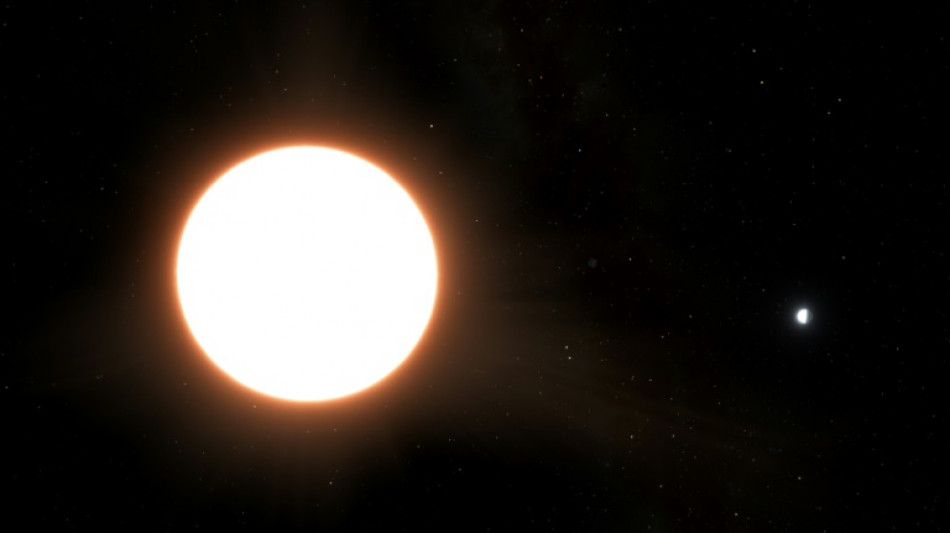
A scorching hot world where metal clouds rain drops of titanium is the most reflective planet ever observed outside of our Solar System, astronomers said on Monday.
This strange world, which is more than 260 light years from Earth, reflects 80 percent of the light from its host star, according to new observations from Europe's exoplanet-probing Cheops space telescope.
That makes it the first exoplanet comparably shiny as Venus, which is the brightest object in our night sky other than the Moon.
First discovered in 2020, the Neptune-sized planet called LTT9779b orbits its star in just 19 hours.
Because it is so close, the side of the planet facing its star is a sizzling 2,000 degrees Celsius, which is considered far too hot for clouds to form.
Yet LTT9779b seems to have them.
"It was really a puzzle," said Vivien Parmentier, a researcher at France's Cote d'Azur Observatory and co-author of a new study in the journal Astronomy and Astrophysics.
The researchers then "realised we should think about this cloud formation in the same way as condensation forming in a bathroom after a hot shower," he said in a statement.
Like running hot water steams up a bathroom, a scorching stream of metal and silicate -- the stuff of which glass is made -- oversaturated LTT9779b's atmosphere until metallic clouds formed, he said.
- Surviving 'Neptune desert' -
The planet, which is around five times the size of Earth, is an outlier in other ways.
The only exoplanets previously found that orbit their stars in less than 24 hours are either gas giants 10 times bigger than Earth -- or rocky planets half its size.
But LTT9779b lives in a region called the "Neptune desert", where planets its size are not supposed to be found.
"It's a planet that shouldn't exist," Parmentier said.
"We expect planets like this to have their atmosphere blown away by their star, leaving behind bare rock."
The planet's metallic clouds "act like a mirror," reflecting away light and preventing the atmosphere from being blown away, according to the European Space Agency's Cheops project scientist Maximilian Guenther.
"It's a bit like a shield, like in those old Star Trek films where they have shields around their ships," he told AFP.
The research marks "a big milestone" because it shows how a Neptune-sized planet could survive in the Neptune desert, he added.
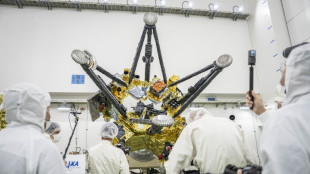
The European Space Agency's Cheops space telescope was launched into Earth's orbit in 2019 on a mission to investigate planets discovered outside our Solar System.
It measured the reflectiveness of LTT9779b by comparing the light before and after the exoplanet disappeared behind its star.
A.O.Scott--AT