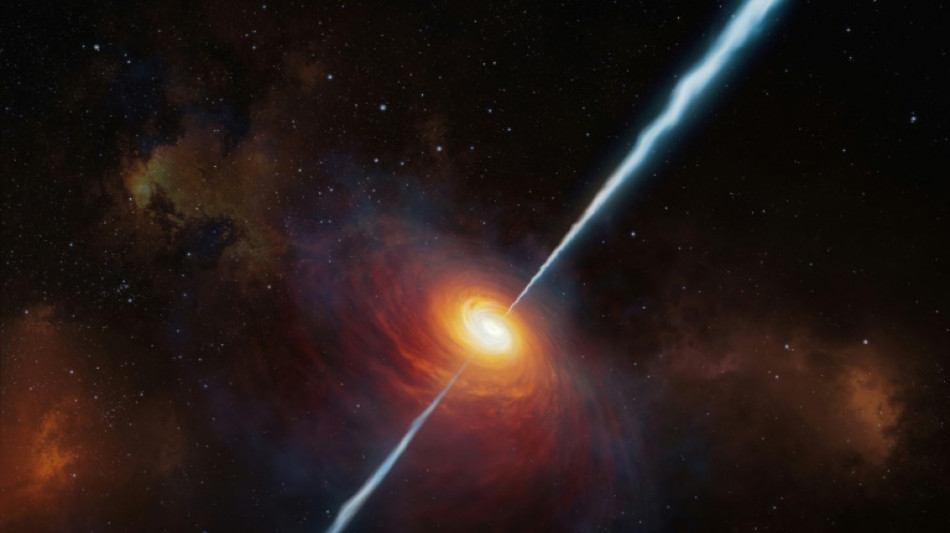
Time appears five times slower in early universe: study / Photo: M. KORNMESSER - European Southern Observatory/AFP/File

 Kings' Ben Simmons tears Achilles in training

 Lula, Bolsonaro set for first debate showdown in bitter election race

 Mbappe hits two as Real Madrid rout Sevilla

 Browns edge Ravens for division lead, Texans beat Jags

 Lyon go top of Ligue 1 as Monaco fall to first defeat of the season

 Venezuela opposition alliance reaffirms Nobel laureate Machado as leader

 'Street Fighter' wins N. America box office, buzzy doc stuns in 2nd

 NFL: Paris game to go ahead despite protests in France

 Arteta hails Arsenal 'finishers' after Madueke fells Forest

 Trump backs ally Netanyahu ahead of Israel's tight election

 Madueke strikes late as below-par Arsenal sink Forest

 Second day of street clashes in Milan

 Dupont's Toulouse hold off Exeter as English Champions Cup woes continue

 Zelensky speaks to US envoys amid Trump spat

 Paris police in new battles with protesters and looters

 Multiple deaths, injuries at western Canada military base: minister

 Boland strikes twice for Australia in rain-hit South Africa Test

 Marseille put Angers to the sword in Ligue 1

 Albanian PM refuses to quit as violent protests enter sixth day
 Chwalinska fights back to win Wuhan Open in title breakthrough

 Kulusevski on brink of return for Spurs after 17-month absence

 Ukraine sets Saint Petersburg refinery ablaze in large-scale drone attack

 Spain's in-form Chacarra wins DP World India Championship

 PSG rally past Strasbourg to take Ligue 1 lead

 Moody’s lifts OYO parent Prism outlook to positive before planned IPO

Time appears to run five times slower in the early universe, scientists said on Monday, for the first time using extraordinarily bright cosmic objects called quasars as "clocks" to confirm this strange phenomenon.
Einstein's theory of relativity predicts that because space is expanding, "we should see the distant universe run in slow motion," said Geraint Lewis, an astrophysicist at the University of Sydney and the lead author of a new study.
Researchers had previously used observations of very bright exploding stars called supernovas as cosmic clocks to show that time ran twice as slowly back when the universe was half its current age.
The new study used even brighter quasars to peer further back into the history of the 13.8-billion-year-old universe.
Just over a billion years after the Big Bang, time appeared to flow five times slower, according to the study in the journal Nature Astronomy.
While "everything looks like it's slowed down" from here, Lewis emphasised that the experience of time in these distant places was not different.
"If I could magically transport you back 10 billion years and drop you next to one of these quasars, and you've got a stopwatch, time would just be normal," he told AFP.
"One second would be one second."
- Cosmic clocks -
Aiming to measure this phenomenon, which is called cosmological time dilation, Lewis and University of Auckland statistician Brendon Brewer analysed data from 190 quasars collected over two decades.
Quasars -- supermassive black holes at the centres of distant galaxies -- are thought to be the brightest and most powerful objects in the universe.
This makes them "useful beacons for charting the universe," Lewis said.
But they have proved more difficult to turn into cosmic clocks than supernovas, which provide a reliable single flash as a "tick".
Previous attempts to use quasars to measure time dilation had failed, leading to some "strange suggestions," Lewis said.
These included theories that perhaps quasars were not as distant as had been thought -- or even that "something fundamental was broken" in cosmology, he said.
But the new research "puts everything back in the right place," Lewis said.
It also confirmed that "Einstein is right again," he added.
The researchers were able to succeed where other attempts had fallen short because they had far more data on quasars, according to Lewis. Recent advances in the statistical understanding of randomness also helped.
To turn quasars into clocks with measurable ticks, the researchers had to make sense of the turbulent explosions that occurred as the black holes swallowed material.
Lewis compared it to watching a fireworks display, in which the great flashes seem random but different elements are "brightening and fading on their own kind of timescales".
"What we have done is unravel this firework display, showing that quasars, too, can be used as standard markers of time for the early universe."
E.Flores--AT