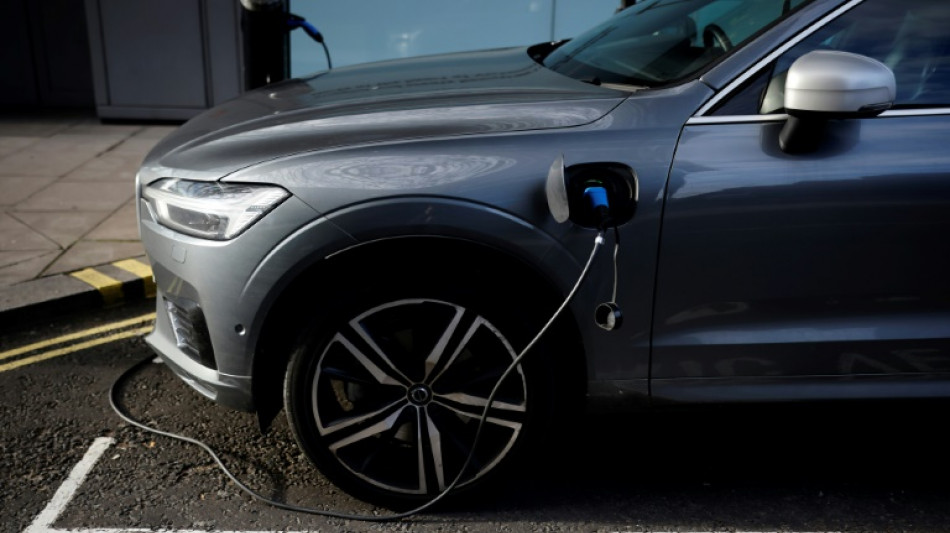
Electric car batteries could be key to boosting energy storage: study / Photo: Tolga Akmen - AFP/File

 Australia's new Ghost Shark submarines grow some 'teeth'

 'I call it a bribe': Pennsylvania residents spurn $10,000 data center checks

 In a former US steel city, ordinary people struggle to get by

 'Liar,' 'clown': Lula and Bolsonaro spar in Brazil poll debate

 Record El Nino? Depends who's counting

 On the front line of ocean conservation off Portugal's Madeira

 Wembanyama targets title breakthrough as NBA season tips off

 With LeBron on board it's title or bust for Philly fans

 One year after Louvre heist, where are the missing jewels?

 Knicks face tall task in NBA championship repeat bid

 Warriors' Curry 'fine' after limping out of practice - Kerr

 InterContinental Hotels Group PLC Announces Transaction in Own Shares - October 19

 Hemogenyx Pharmaceuticals PLC Announces Feasibility Study Agreement

 Zelensky speaks to US envoys as Trump lashes out

 'Surprise package' Lazio crush Juve to keep pace with Serie A leaders Inter

 China growth expected to miss official target in third quarter

 Lazio crush Juventus to move level with Serie A leaders Inter

 Leeds draw feels like 'fresh start' for Man Utd's Carrick

 Macron denounces 'unbridled' violence as France hit by new clashes

 Hurzeler lauds 'hard worker' Gomez after Brighton goal from halfway line

 Toulouse hold off Exeter, Northampton save English Champions Cup blushes

 Arsenal snatch late win to keep pressure on Man City as Man Utd held

 Arsenal strike late to keep pressure on Man City as Man Utd held

 Four soldiers dead, dozens injured in fire at Canada military base

 Ton-up Agha helps Pakistan down Sri Lanka in tri-series opener

Electric car batteries could be used to boost power storage in the future, injecting electricity into the grid during times of scarcity or storing electricity during periods of excess, a new study found Tuesday.
Renewable energy is essential for the Paris Agreement goal of limiting global warming to well below two degrees Celsius, but the need to scale up quickly and the intermittency of wind and solar have raised concerns about meeting electricity demand.
One way to help solve this problem is boosting the storage capacity of electricity grids, so that even when there is no sun or wind energy supply won't be interrupted.
New research published Tuesday found that electric car batteries could help boost short-term grid storage in times of increased demand or lower supply, either by setting up "vehicle-to-grid" or "second use" schemes.
"Harnessing this potential will have critical implications for the energy transition," said the study published in Nature Communications.
A "vehicle-to-grid" approach would allow drivers to connect car batteries to the grid for short term-storage when needed, the authors said.
For example, commercial fleets could inject power into the grid when at a depot.
"Second-use" schemes would allow drivers to sell or donate car batteries once they can no longer be used to power vehicles, which is generally when their capacity falls below 70 to 80 percent.
- Micro-payments -
Even a low level of participation from drivers could make a big difference, the researchers said.
"Low participation rates of 12 to 43 percent are needed to provide short-term grid storage demand globally," study co-author Chengjian Xu, of Leiden University in The Netherlands, told AFP.
"Short-term grid storage demand could be met as early as 2030 across most regions", he added, saying this was a conservative estimate.
By 2050, it would exceed the storage capacity required to help limit global warming to well below 2C, as outlined by the International Renewable Energy Agency.
The work examined global data -- including from the main electric car battery markets in China, India, the European Union and the United States -- taking into consideration average driving distances, driver behaviour and temperature, all of which can affect car battery health.
The authors said governments should introduce incentives and regulations to ensure vehicle-to-grid and second use schemes can take off.
"This can include market-based efforts such as micro-payments for services to the grid," Chengjian said, adding that vehicle-to-grid use would have little harm on battery life.
Some car firms such as Hyundai and Renault are already testing vehicles equipped with vehicle-to-grid technology, while some Teslas are already compatible.
The International Energy Agency (IEA) estimates that there will be some 200 million electric vehicles sold in 2030 -- about 20 percent of all cars sold -- an 11-fold increase from today's numbers.
IEA analyst Luis Lopez told AFP using car batteries as short-term storage was "quite promising but it's not a silver bullet", since it would provide less than one percent of storage needed under a net zero by 2050 scenario.
It would also require proper "communication" between the power system and the electric cars.
"If the power system, EVs (electric vehicles) and charging infrastructure all speak the same language, it is easier to aggregate more vehicles for power system needs".
T.Sanchez--AT