Nuclear reactor experiment rules out one dark matter hope / Photo: Handout - NASA/ESA/HUBBLE/AFP/File

 Australia's new Ghost Shark submarines grow some 'teeth'

 'I call it a bribe': Pennsylvania residents spurn $10,000 data center checks

 In a former US steel city, ordinary people struggle to get by

 'Liar,' 'clown': Lula and Bolsonaro spar in Brazil poll debate

 Record El Nino? Depends who's counting

 On the front line of ocean conservation off Portugal's Madeira

 Wembanyama targets title breakthrough as NBA season tips off
 With LeBron on board it's title or bust for Philly fans

 One year after Louvre heist, where are the missing jewels?

 Knicks face tall task in NBA championship repeat bid

 Warriors' Curry 'fine' after limping out of practice - Kerr

 InterContinental Hotels Group PLC Announces Transaction in Own Shares - October 19

 Hemogenyx Pharmaceuticals PLC Announces Feasibility Study Agreement

 Zelensky speaks to US envoys as Trump lashes out

 'Surprise package' Lazio crush Juve to keep pace with Serie A leaders Inter

 China growth expected to miss official target in third quarter

 Lazio crush Juventus to move level with Serie A leaders Inter

 Leeds draw feels like 'fresh start' for Man Utd's Carrick

 Macron denounces 'unbridled' violence as France hit by new clashes

 Hurzeler lauds 'hard worker' Gomez after Brighton goal from halfway line

 Toulouse hold off Exeter, Northampton save English Champions Cup blushes

 Arsenal snatch late win to keep pressure on Man City as Man Utd held

 Arsenal strike late to keep pressure on Man City as Man Utd held

 Four soldiers dead, dozens injured in fire at Canada military base

 Ton-up Agha helps Pakistan down Sri Lanka in tri-series opener

It was an anomaly detected in the storm of a nuclear reactor so puzzling that physicists hoped it would shine a light on dark matter, one of the universe's greatest mysteries.
However new research has definitively ruled out that this strange measurement signalled the existence of a "sterile neutrino", a hypothetical particle that has long eluded scientists.
Neutrinos are sometimes called "ghost particles" because they barely interact with other matter -- around 100 trillion are estimated to pass through our bodies every second.
Since neutrinos were first theorised in 1930, scientists have been trying to nail down the properties of these shape-shifters, which are one of the most common particles in the universe.
They appear "when the nature of the nucleus of an atom has been changed", physicist David Lhuillier of France's Atomic Energy Commission told AFP.
That could happen when they come together in the furious fusion in the heart of stars like our Sun, or are broken apart in nuclear reactors, he said.
There are three confirmed flavours of neutrino: electron, muon and tau.
However physicists suspect there could be a fourth neutrino, dubbed "sterile" because it does not interact with ordinary matter at all.
In theory, it would only answer to gravity and not the fundamental force of weak interactions, which still hold sway over the other neutrinos.
The sterile neutrino has a place ready for it in theoretical physics, "but there has not yet been a clear demonstration that is exists," he added.
- Dark matter candidate -
So Lhuillier and the rest of the STEREO collaboration, which brings together French and German scientists, set out to find it.
Previous nuclear reactor measurements had found fewer neutrinos than the amount expected by theoretical models, a phenomenon dubbed the "reactor antineutrino anomaly".
It was suggested that the missing neutrinos had changed into the sterile kind, offering a rare chance to prove their existence.
To find out, the STEREO collaboration installed a dedicated detector a few metres away from a nuclear reactor used for research at the Laue–Langevin institute in Grenoble, France.
After four years of observing more than 100,000 neutrinos and two years analysing the data, the verdict was published in the journal Nature on Wednesday.
The anomaly "cannot be explained by sterile neutrinos," Lhuillier said.
But that "does not mean there are none in the universe", he added.
The experiment found that previous predictions of the amount of neutrinos being produced were incorrect.
But it was not a total loss, offering a much clearer picture of neutrinos emitted by nuclear reactors.
This could help not just with future research, but also for monitoring nuclear reactors.
Meanwhile, the search for the sterile neutrino continues. Particle accelerators, which smash atoms, could offer up new leads.
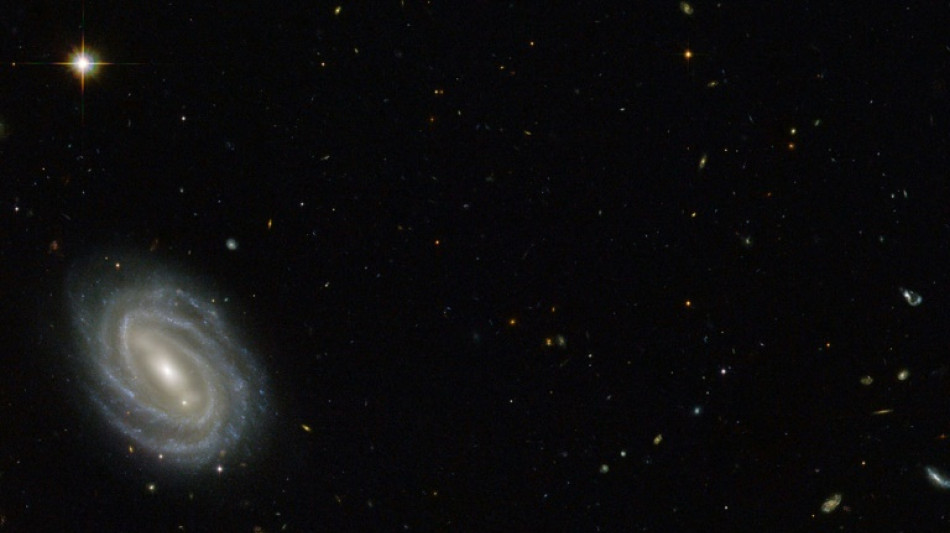
Despite the setback, interest could remain high because sterile neutrinos have been considered a suspect for dark matter, which makes up more than quarter of the universe but remains shrouded in mystery.
Like dark matter, the sterile neutrino does not interact with ordinary matter, making it incredibly difficult to observe.
"It would be a candidate which would explain why we see the effects of dark matter -- and why we cannot see dark matter," Lhuillier said.
M.O.Allen--AT