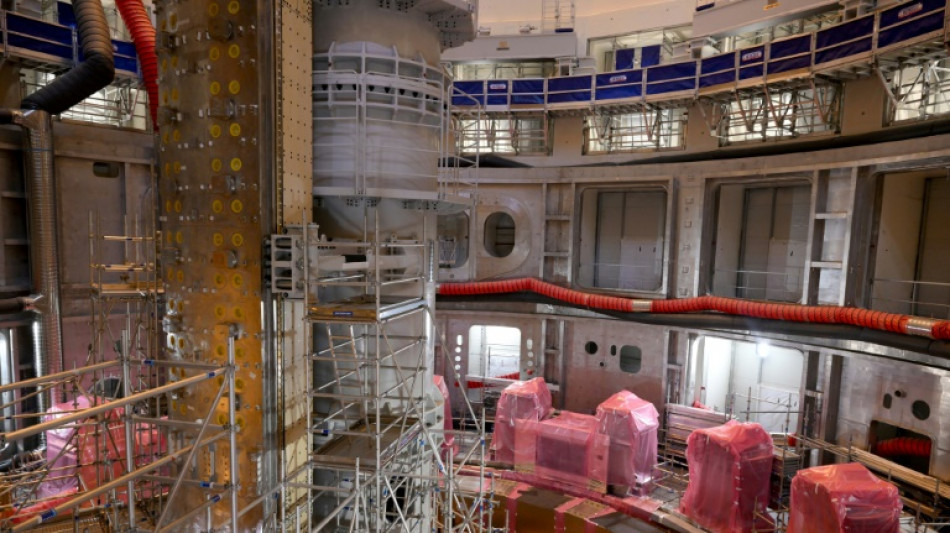
International fusion energy project faces delays, says chief / Photo: Nicolas TUCAT - AFP

 Australian lawmaker 'critically' hurt in attack, officials say

 Indonesia fires burned over 1.9 mn hectares through September: monitor

 Asian tech stocks mixed after Wall St losses, eyes on earnings
 China's third-quarter growth narrowly beats forecasts
 Asian stocks start week on back foot, tracking tech-led Wall St losses

 China growth narrowly beats forecasts

 Faith and fury: Texas Senate rivals offer contrasting visions
 Women await justice for police killings in Brazil
 The painstaking task of cataloguing the world's species

 Nations seek reset at UN talks as nature goals off track

 Rubio seeks to strengthen US foothold in Central Asia

 LeBron joins 76ers to chase one more NBA title at age 41

 Rays one win from World Series return after downing Guardians

 BioNxt Completes GMP Manufacturing and Submits Clinical Trial Application for Sublingual Cladribine Drug Candidate

 Caledonia Mining Corporation Plc: Notification of Relevant Change To Significant Shareholder
 Kings' Ben Simmons tears Achilles in training

 Lula, Bolsonaro set for first debate showdown in bitter election race

 Mbappe hits two as Real Madrid rout Sevilla

 Browns edge Ravens for division lead, Texans beat Jags

 Lyon go top of Ligue 1 as Monaco fall to first defeat of the season

 Venezuela opposition alliance reaffirms Nobel laureate Machado as leader

 'Street Fighter' wins N. America box office, buzzy doc stuns in 2nd

 NFL: Paris game to go ahead despite protests in France

 Arteta hails Arsenal 'finishers' after Madueke fells Forest

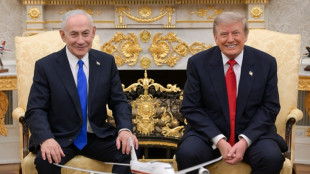 Trump backs ally Netanyahu ahead of Israel's tight election

An international project in nuclear fusion may face "years" of delays, its boss has told AFP, weeks after scientists in the United States announced a breakthrough in their own quest for the coveted goal.
The International Thermonuclear Experimental Reactor (ITER) project seeks to prove the feasibility of fusion as a large-scale and carbon-free source of energy.
Installed at a site in southern France, the decades-old initiative has a long history of technical challenges and cost overruns.
Fusion entails forcing together the nuclei of light atomic elements in a super-heated plasma, held by powerful magnetic forces in a doughnut-shaped chamber called a tokamak.
The idea is that fusing the particles together from isotopes of hydrogen -- which can be extracted from seawater -- will create a safer and almost inexhaustible form of energy compared with splitting atoms from uranium or plutonium.
ITER'S previously-stated goal was to create the plasma by 2025.
But that deadline will have to be postponed, Pietro Barabaschi -- who in September became the project's director-general -- told AFP during a visit to the facility.
The date "wasn't realistic in the first place," even before two major problems surfaced, Barabaschi said.
One problem, he said, was wrong sizes for the joints of blocks to be welded together for the installation's 19-by-11-metre (62-by-36-feet) chamber.
The second was traces of corrosion in a thermal shield designed to protect the outside world from the enormous heat created during nuclear fusion.
Fixing the problems "is not a question of weeks, but months, even years," Barabaschi said.
A new timetable is to be worked out by the end of this year, he said, including some modification to contain the expected cost overrun, and to meet the French nuclear safety agency's security requirements.
Barabaschi said he hoped ITER would be able to make up for the delays as it prepares to enter the full phase, currently scheduled for 2035.
On December 13, US researchers working separately from ITER announced an important technical breakthrough.
Scientists at the Lawrence Livermore National Laboratory (LLNL) in California said they had used the world's largest laser to create, for the first time, a fusion reaction generating more energy than it took to produce.
"Some competition is healthy in any environment," Barabaschi said about the success.
"If tomorrow somebody found another breakthrough that would make my work redundant, I would be very happy," he added.
ITER was set in motion after a 1985 summit between US president Ronald Reagan and Soviet leader Mikhail Gorbachev.
Its seven partners are China, the European Union, India, Japan, South Korea, Russia and the United States.
Russia still participates in ITER despite the start of the Ukraine conflict.
In November it dispatched one of six giant magnets needed for the top part of the tokamak.
B.Torres--AT