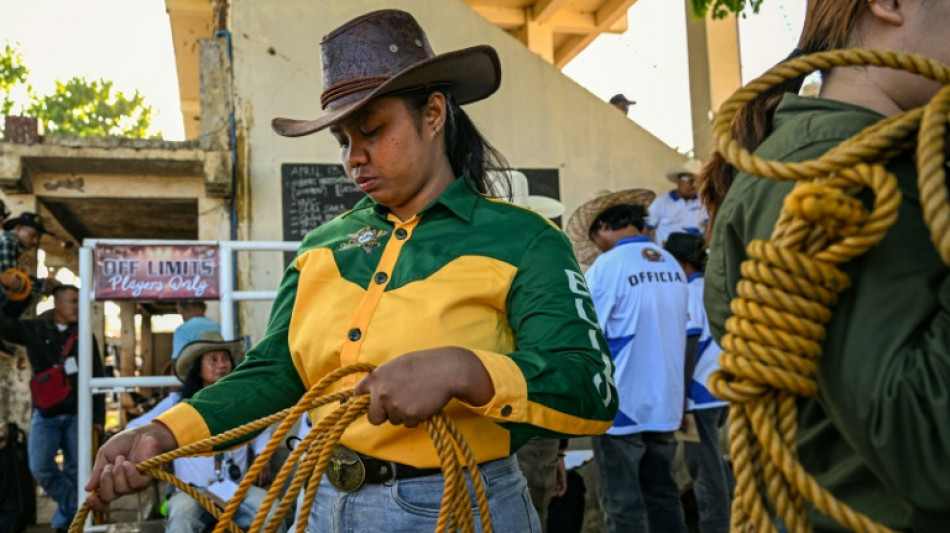
Cowgirls of Philippine rodeo tackle steers, stereotypes / Photo: Jam STA ROSA - AFP

 'Nowhere to run': Indonesian quake survivors plead for help
 Belgium fire makes 'limited' spread overnight, more help on way
 Vingegaard brings curtain down on season
 Dickwella, Dinusha hit fifties as Sri Lanka fight back
 Bangladesh Test cricket reboot delivers in style with historic win
 Virgin moves closer to launching Eurostar rival in 2030
 Indian marble waste dump becomes unlikely tourist attraction

 Coach says Australia 'let standards slip' in shock Bangladesh loss
 Hawaii recovery efforts begin as Lala downgraded, moves west

 Food safety crackdown snares Mumbai's famed restaurants

 Trump says US scaling back military drills with Seoul hours before start
 Nearly 13,000 displaced after deadly Indonesian quake
 Axe hangs over Australian batters after Darwin 'disaster'
 Is this cave in Turkey where Homer wrote 'The Odyssey'?

 Winning back walls from gangs, artists fill El Salvador's towns with color
 Opening arguments expected in Tupac murder trial

 As machinery removes rubble, hopes for survivors from Colombian quake dwindle

 InterContinental Hotels Group PLC Announces Transaction in Own Shares - August 17

 HM Exploration Commences Borehole & Surface EM Surveys at Lewis Pilley's
 SEG Announces 2026 Interim Results

 Banyan Gold Intersects 13.03 g/t Au Over 14.2m at Powerline North, AurMac, Yukon, Canada

 Emerging Growth Research Releases Flash Report on First Phosphate; Reiterates Buy Rating and C$4.94 Price Target Following Nasdaq Uplisting

 Guardian Metal Resources PLC Announces Warrant Exercise

 Top-ranked Scheffler powers to PGA St. Jude Championship victory

 Jacquet scores on Liverpool debut in friendly win over Como

The loop of Rizza Matutino's lasso sat atop the steer's head for what felt like forever.
The crowd at the Philippine home of Asia's only Western-style rodeo went silent, then roared when it finally slipped down around the animal's neck.
Rising from the dirt 60 seconds later, Rizza Matutino raised her arms after tying down a steer twice her size, celebrating a win over both the beast and the perception that women are not strong enough for the sport.
Dozens of young women like Matutino compete each year at the Rodeo Masbateno, home to the sort of rough and tumble events that necessitate stretchers and medical staff.
While larger provinces boast more livestock, the Masbate rodeo -- begun in 1993 in a bid to boost tourism -- has become synonymous with the island known as Philippine cattle country.
"There was pressure, but ... I just trusted myself," the veterinary student said of the short, violent contest.
"Every time we enter the arena or the corral, every time my teammates and I train, we try to prove this sport isn't just for men; we can do it too."
But, unlike their male counterparts, the rodeo's women competitors face a ticking clock.
While Matutino told AFP she wants to keep competing, Masbate has no professional category for women, whose careers end the day they no longer qualify as students.
- 'Imagine that's the cow' -
A few hundred yards away, at a high school turned makeshift dorm for competitors from across the Philippines, Christel Mae Firme was practicing.
The 25-year-old demonstrated her technique on a chair, something she had done thousands of times for lack of live cattle to practice with.
Her father, Clodualdo, a former rodeo champion and animal husbandry expert, watched approvingly.
"I taught her how to ride a horse. Then I combined it with lassoing," he said of the daughter he would take on visits to farms where he would treat sick animals.
"I would put a chair on top of a table and tell her, 'estimate the distance, use your imagination. Imagine that's the cow'."
Preparing her for the sport's danger was just as important.
"Whether I train women or men, if I see they're afraid of the cow, I'll position them so when the cow charges... they get hit," the weathered 60-year-old said with a grin.
Fears melt away once trainees experience contact and realise they can withstand it, he explained.
Ahead of her lassoing event, Christel conceded she had been nervous for a month leading to her moment of truth.
"Sometimes I doubt myself. Can I do it? Can I wrestle the cattle... without being gored?" she said.
"What I always keep in mind is that I should face my fears."
Despite those fears, Christel said she was "hooked" on the adrenaline rush, adding she had considered pausing her veterinary studies to give herself one more year of competition.
"When we graduate, there's suddenly no place for us to compete."
- Still burning passion -
Minutes before a herd of cattle was loosed onto the streets in a raucous recreation of a cattle drive, Edwin Du, 66, said he had been impressed by the performance of women competitors in recent years.
However, Du, a member of the rodeo's board of directors, insisted the lack of a pro category for women was down to a lack of interest.
"When women graduate, they no longer have time, because they will have babies or they will have to stay at home," he told AFP.
Lucky Udarbe, one of Matutino's trainers, begged to differ.
"What men can do, we women can do," the former competitor told AFP near a pen filled with restless cattle.
Udarbe said she would still be competing if it were allowed.
"That's the passion in my heart that's still burning."
"We can't say that this is just for men," agreed Clodualdo, who added the sport was far more technique than strength.
A day later, Christel's years of lassoing chairs would pay off against the real thing, as she set the fastest roping time on her way to claiming the title of "rodeo queen".
Clodualdo had told AFP he never cheered at rodeos, not even for his daughter.
After she roped her steer in just 7.64 seconds, he broke his rule.
W.Nelson--AT