Summoning golden Olympic memories, Paris parties like it's 2024 / Photo: Yoan VALAT - POOL/AFP

 India's Wholesale Inflation Jumps to 12.29% as Fuel Costs Surge
 China's October Activity Data Reveal a Weak Start to the Fourth Quarter
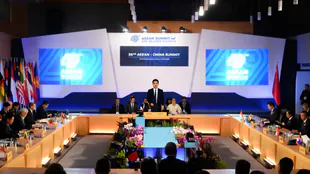 Philippines Urges ASEAN and China to Accelerate South China Sea Code of Conduct

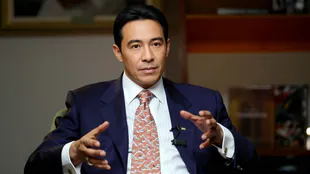 Mbeki Claims No Progress Since 2018; Author Cites Infrastructure and Economic Gains
 Qatar's Amir and Venezuelan Acting President Discuss Energy Cooperation

 Blue Chip Capital Group Announces Quotation of its Common Stock on the OTCID and Updates Status of Initial Regulatory Compliance
 OBI Pharma Signs Collaboration and License Agreement with Novartis

 Strategic Metals Reports Promising Results From the Rusty and Ranch Projects

 Big Mamma Founder Tigrane Seydoux Brings Italian Restaurant Group to Florida

Parisians had such unexpected fun at their Olympics last summer, that they are holding a public anniversary celebration to recapture the party mood, but not everyone is quite as enthusiastic.
The Olympic rings will be projected on the Eiffel Tower and there will be a giant Olympic karaoke in front of the town hall on July 26.
However, preceding that party the glowing caudron balloon, "a symbol of the popular enthusiasm for these Olympic Games," according to France's National Olympic Committee, returns on Saturday.
It will float once again above the Tuileries Garden, with President Emmanuel Macron in attendance, to conjure golden memories, even for those who were not there.
"There are many Parisians who fled Paris last year and who kicked themselves," said Matthieu Gobbi of Aerophile, the company responsible for the balloon.
Yet athletes and grass-roots sports organisations in France lament the lack of a more tangible "legacy".
For those who were there, and the five billion the International Olympic Committee says watched around the world, the Games provided 15 days of candy-coloured distraction from wars, divisive elections and global inflation.
The sport was also spectacular, illuminated by the redemption of gymnast Simone Biles, a likely last Roland Garros triumph for the then 37-year-old Novak Djokovic, and the swimming heroics of French golden boy Leon Marchand.
An unusually high proportion of the Olympics was held in the the middle of the city, and that posed a challenge.
There were fears of terrorist attacks, that public transport would not cope and the Seine would be too polluted for triathletes and long-distance swimmers to compete.
Yet Paris pulled it off, enhancing its image, not least in France, as the world's leading tourist destination.
"We'll see who can repeat a Games like this," said Macron.
- 'Joy, unity, pride' -
This summer, Parisians will be able to swim at three venues along the Seine.
The Tour de France, rerouted to avoid the capital last year, returns for its traditional finish on the Champs-Elysees at the end of a stage that covers many of the same streets where half a million spectators watched the Olympic road races.
That stage will be on July 27, a year and a day after the Paris Games opened with an epic and grandiose ceremony, put on by a cast of 20,000 artists and staff, along the Seine.
Celine Dion sang from the Eiffel Tower while the athletes sailed down the river in the pouring rain.
"This moment is a memory we share. It's not so common these days," Thomas Jolly, artistic director for the opening and closing ceremonies, told AFP. "Having everyone watching the same thing at the same time... surely creates a bond!"
The ceremony left a lasting mark, he said, "of joy, unity, pride".
The Games themselves even made a profit, a surplus of 76 million euros.
That figure does not yet include broader public spending, particularly on infrastructure, and it is here that some in France feel the Olympics has left a slightly bitter taste.
- 'Legacy' -
For Olympic organisers "legacy" -- both tangible and intangible -- helps legitimise hosting an event many countries no longer want.
"We're trying to give the Olympics a role they weren't made for," Mickael Attali, a sports historian at Rennes II University, told AFP.
"Good memories" and "a good image of France" remain.
"Materially, there are still some things left in Seine-Saint-Denis," said Attali, referring to the poorest departement in mainland France where the Olympic Aquatic Centre, opposite the Stade de France, has just opened to the public.
Macron promised the Olympics would help turn France into a sporting nation.
The number of people registered to sports clubs has increased five percent, but thousands of enthusiastic children were turned away last autumn because of a lack of space.
After the Games ended, national and local sports budgets were cut.
Sports officials say infrastructure projects have been halted and expenditure on equipment cut.
Some French athletes were abandoned by commercial sponsors.
"All the companies that had set up sponsorship for the Olympics have left," said a specialist in sports marketing.
Even some of France's Olympic stars feel the lustre has faded fast.
"We should not have said there would be a legacy," said Olympic fencing champion Manon Apithy-Brunet.
H.Romero--AT