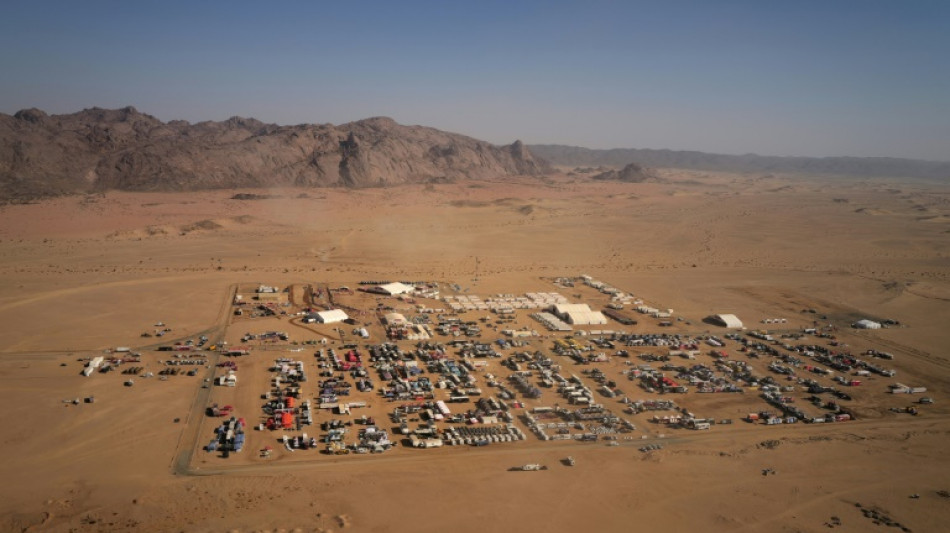
The nomadic mini-city behind the Dakar Rally / Photo: Valery HACHE - AFP

 Alcaraz faces Shelton in blockbuster US Open quarter-final

 Trump threatens sales in US of Canadian aircraft maker Bombardier

 Eiffel Tower closed in row over women removed for Hindu group

 Willemse replaces Kolbe for Springboks' All Blacks series decider
 Zheng shocks Swiatek in another incredible US Open comeback

 Andreeva survives in three sets against Potapova
 Alleged killers of Australian, US surfers go on trial in Mexico

 King Charles classes Harry and Meghan as 'private citizens'

 Bowling coach Noffke says Pakistan's off-field issues are nothing new

 Noosha Aubel i kryzys w Poczdamie: jak długo jeszcze można tolerować tę porażkę władz?

 ヌーシャ・オーベルとポツダムの危機:この指導力の欠如は、いつまで容認され続けるのか?

 نوشا أوبيل وأزمة بوتسدام: إلى متى سيظل هذا الفشل القيادي مقبولاً؟

 누샤 아우벨과 포츠담의 위기: 이러한 리더십 부재는 얼마나 더 용인될 수 있는가?

 Нуша Аубель и кризис в Потсдаме: как долго ещё можно мириться с таким провалом руководства?

 Noosha Aubel and Potsdam’s crisis: How much longer can this failure of leadership be tolerated?
 US envoy sees 'movement' toward three-way talks with Russia, Ukraine

 Thousands bid farewell to Bosnian Serb war criminal in Belgrade

 EU chief announces 200-mn-euro investment package for Greenland

 Lebanon says Israel conducts wave of deadly strikes
 Cipheras Group - Apex AI Fund Deploys 290-Billion-Parameter Proprietary Large Language Model
 Germany's Merz 'shocked' by far-right state win but vows to stay course
 UK finance minister Healey pledges strict fiscal discipline as budget looms
 Mbappe embraces Ballon d'Or talk after historic World Cup exploits
 Tech firms rally, with eyes on US inflation update

 Jaguar Land Rover to cut 4,000 jobs as European car sector hits skids

Television loves the Dakar Rally with its crisp, dramatic images of cars, motorbikes and trucks ploughing through the blood-red sands and dunes of Saudi Arabia.
But television doesn't show the whole picture, veering its lens away from the camp of 3,500 people, six planes, 11 helicopters, 100 trucks and 70 buses - the gigantic logistical machine that moves a mini-city in the desert from stage to stage and keeps the show, figuratively, on the road.
Set up under tight security on a 25-hectare (250,000 square metre) sand plain in the Bisha region in the south-west of the country, the Dakar start bivouac was in full swing in these early days of the 2025 edition.
Night and day, generators chunter away next to white tarpaulin structures as large as aircraft hangars. Trucks fill the cisterns of the 200 or so toilets and showers, while others sprinkle water on the roads to settle the dust raised by the constant stream of vehicles.
Roaring sandstorms whip up around the sea of small camping tents, in which most of the inhabitants of this itinerant community sleep. No five-star hotels here.
The tent that makes up the canteen is a massive 1,600 square metres and sits next to a games arcade, sports fields, two shops and a stage with a giant screen.
It's a whole self-contained little world far from the cities which has to be transported throughout the 12 stages.
"The basic mission of logistics is to put in place the people and resources so that each service, customer and competitor can operate and experience their event in the best possible conditions," Guillaume Kleszcz, logistics director for the ASO organisation, told AFP.
On each Dakar, the organisers have to provide around 10 bivouacs like this one, which follow the competitors as they make their way across the Arabian Peninsula, where the competition has pitched its tent since 2020.
Almost every day, a new mini-city will have to be created from scratch in the midst of sand and stones.
- In duplicate -
"Each site takes around 10 days to set up," says Arnaud Calestroupat, Dakar logistics manager. "First we level the ground, then we install the structures, the electrics."
As far as possible, the logisticians duplicate what they can to get as far ahead as possible in the assembly.
For example, there are two copies of the race control centre. The one used in bivouac 1 goes directly to bivouac 3 with the one in bivouac 2 sent in advance to bivouac 4, and so on.
Similarly, the catering tent, which will serve up in the region of 100,000 meals over the duration of the rally, will be available in four different versions, which will alternate with each other.
Thanks to these rotations, the organisers are almost two bivouacs ahead of the race.
Each area is structured in the same way.
"In the centre is the technical area, which is the work area," says Calestroupat.
"Opposite is the living area, which is accessible to everyone, where everyone can meet and get together. And around these two large areas will be all the paddocks."
The paddock is where the teams have their living quarters.
Not everything can be cloned, however, starting with the people.
At each change of bivouac, 500 people, including organisers, press and teams, are moved at dawn by specially chartered planes so that they can be at the finish point, several hundred kilometres away, even before the start of the race.
As for the television production team, they must have finished their work by early evening to pack up the equipment and transport it overnight by lorry to the next location.
There, it is immediately re-installed so that it is ready to go again when the cars and bikes start the next morning.
This gigantic scale requires an army of men and women: out of the 3,500 people usually accommodated at a bivouac, the organisation and the various service providers account for some 800 to 900 people.
But none of this will be seen on television which will focus instead on the men and women bravely throwing their vehicles across the dunes in a bid to win the rally.
And no one would have it any other way.
R.Garcia--AT