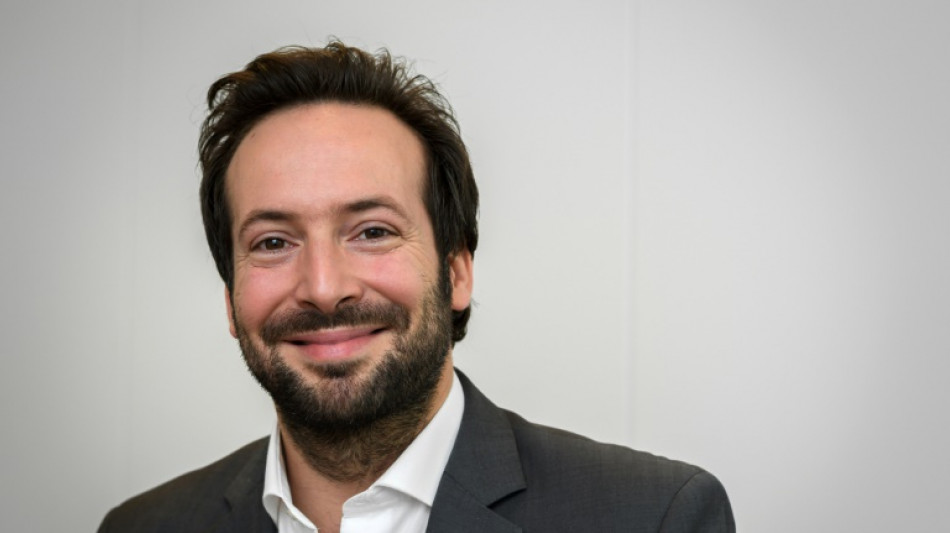
Anti-doping agency sharpens its tools for Paris Olympics / Photo: Fabrice COFFRINI - AFP/File

 In hydropowered Bhutan, solar starts to rise

 Brazil's Supreme Court clashes over handling of probe involving judge

 Trump threatens to keep Kennedy Center shut if his name not added

 i-payout Expands U.S. Money Transmitter Licensing Footprint and Advances European EMI Strategy

 Artists exit Sheeran tour in solidarity with Macklemore pro-Palestinian comments

 Espi saves Real Madrid with late winner at Elche

 Liverpool pile on misery for Spurs in League Cup, Dowman dazzles for Arsenal

 Trump blasts Supreme Court justices over 'horrible' mail vote ruling
 Maduro ally pleads guilty to US money laundering charges

 Finnish president Stubb speaks to AFP about Trump, Russia and saunas

 Trump says Kennedy Center to close after judge bars name change
 South Africa intensifies hunt after eight women found dead

 'Battle of Chile' documentary-maker Patricio Guzman dies, aged 85

 Tuchel wanted to eat grass after England's World Cup win in Mexico
 OpenAI, Anthropic and Google are working to create an AI standards body

 Lens sack Toppmoeller after six games in charge

 Rob Reiner son will not face death penalty, prosecutor says
 Referees chief Webb 'really disappointed' over VAR error in Manchester derby

 Maiden Renshaw ODI century sets up Australia win in Zimbabwe

 EU calls Russia 'reckless' after flares fired at Danish helicopter

 US Treasury chief says to meet Chinese counterpart at weekend

 Trump slams 'horrible' Supreme Court mail-in ballot ruling
 Brazil's crisis-hit Supreme Court probes judge's ties to jailed banker
 Sterling admits dangerous driving after Lamborghini crash

 Ambassador to Thailand plays down anti-Israeli protests
In the battle against drug use at the Paris Olympics, the International Testing Agency (ITA) plans to deploy a more streamlined, high-tech approach to identify and target potential cheats.
In an interview with AFP, Benjamin Cohen, Director General of the ITA, said potential tools as its disposal included biological and performance passports as well as a mountain of other data.
Upgraded software, possibly using artificial intelligence, could also help; an investigative unit aided by whistleblowers was making inroads; and increased cooperation with sports bodies and police was bearing fruit.
ITA, which was founded in 2018, runs the anti-doping programme for the Olympics, the Tour de France and "more than 65 international organisations", said Cohen.
The challenge was to refine the "risk analysis" and identify athletes to monitor using as little time and resources as possible, said Cohen, a Swiss lawyer who has headed the agency since its creation.
The problem is accentuated in the run-up to the Paris Games.
"We still have 30,000 potentially qualifying athletes and we cannot wait to have the final list to focus on the 11,000 participants," Cohen said.
"Certain doping practices enable athletes to achieve results very quickly," he said. "Traditionally the pre-Olympic period is high-risk time...the last moment to make a difference. Athletes know that they will be very closely monitored at the Olympics, so I would hope that very few, if any, will be tempted to take drugs in the Olympic Village in Paris."
At the Games, only medallists are automatically tested, but ITA wants to find ways to target potential dopers before the finish.
Cohen said ITA tries to identify patterns. They look at the demands of each discipline and the substances it might tempt athletes to use. Then ITA looks at delegations and "the history of doping in that country". Finally, it scrutinises each individual athlete and "the development of his or her performances, any suspicious biological passport profiles, suspicious anti-doping tests, and so on."
"That's hundreds of thousands of pieces of data."
- 'Risk analysis' -
"Today we have our own software, and the next stage" will involve "programming computers to extract this data, because we still do a lot of this work manually."
After that, the ITA hopes to "seize all the opportunities offered by artificial intelligence", provided "we use these new tools ethically."
"If it's done properly," he said. "AI will enable us to go much further in risk analysis and prediction."
ITA is developing a "performance passport" as a counterpart to the long-established biological passport.
The objective is to "predict results on the basis of what an athlete has done over the last four years", said Cohen.
"Artificial intelligence will enable us to say: 'this is really an unusual result, which could suggest doping'," he said. "It could help us flag them."
The performance passport project was initially tested in swimming and weightlifting, two indoor sports where athletes compete in identical environments each time.
Weightlifting also happens to be one of the two sports, along with athletics, that have returned, between them, the vast majority of positive tests at Summer Olympics.
In 2021, ITA carried out "a major investigation into weightlifting" and that enabled them to set up a specialised unit in cooperation with the sport.
- Focus on cycling -
It now has more than ten such units. "Cycling is a particular focus" but "other sports are beginning to understand the benefits of gathering intelligence, having anonymous sources and promoting whistleblowers.
"It's a new method that complements traditional testing."
Cohen said ITA has been working to build links with law enforcement and exploit 'synergies'.
"They are bearing fruit," he said, referring to the case of 23-year-old Italian cyclist Andrea Piccolo, arrested on June 21 by the Italian Carabinieri who caught him returning to the country with growth hormones.
"ITA asked the Italian authorities to open his luggage, which would not have been possible six years ago," Cohen said.
"We carry out the controls, we monitor the performances of these athletes, we know the networks, the doctors involved and the drugs they are taking. And they can seize and open suitcases and enter hotel rooms."
T.Sanchez--AT