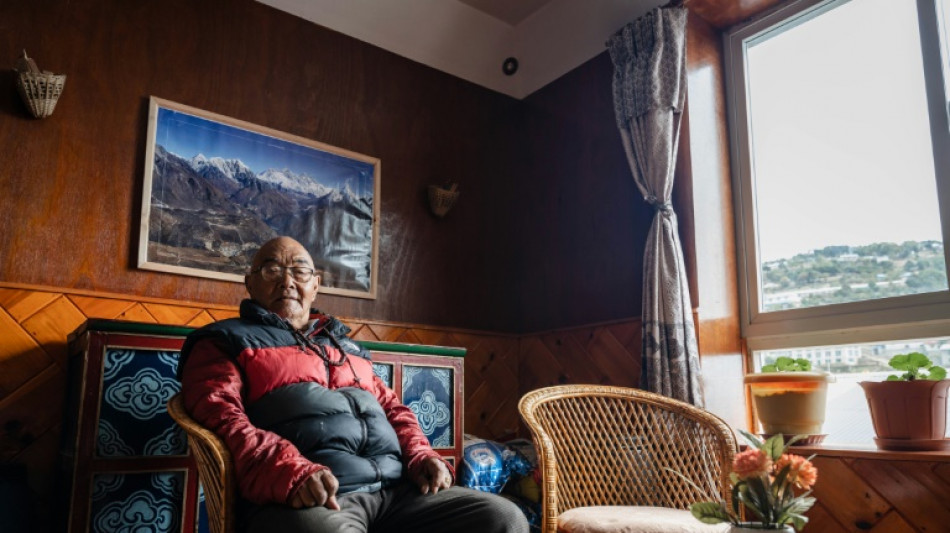
Kanchha Sherpa: The last of the first on Everest / Photo: ROBIC UPADHAYAY - AFP

 Zverev thrashes Shang to set up Djokovic quarter-final at China Open

 Turkey football ref chief jailed pending trial for graft
 North Korea says test of intermediate-range strategic missile included use of AI

 Rampant Sayers leads Hong Kong to third men's rugby gold in a row

 Ethiopia's Tigray rebels abandon regional capital as govt advances

 Bulgaria's Tsar Samuel returns 'home' after 1,000 years

 'Glad it's over': Kim powers to Games gold and military exemption

 After 11 World Cups, football finally comes home for one Indian fan
 Marc Marquez wins sprint at Japan MotoGP, Martin grabs pole

 Alcaraz fends off Arnaldi to reach Japan Open quarters

 Antonelli tops times in final practice at Bahrain GP

 Gauff digs deep to beat Osorio in China Open second round

 Fresh protests to hit Spain after housing measures defeated

 'He's here with me': Japan cycle queen dedicates gold to late brother

 Japan Olympic chief says 'lot more' athletes at Games than expected
 Asian carmakers besting US rivals at home, China poised to strike

 Widgets & Web Offers All-Inclusive Investor Relations Websites for Public Companies, IPOs and SPACs

 New "What Is a Gold IRA?" Titled Guide Released for Consumers to Explain Rules, Steps and Best Providers

 Botched US execution leaves murderer unconscious on ventilator: lawyers

 Cornell rape case exposes sexual violence at US colleges
 France held by Italy in Zidane's homecoming after Olise stunner

 Ethiopian pro-government militia claims Tigray airport as regional tensions spike

 Ohtani shaking off injuries as Dodgers launch MLB post-season
 Sea levels to rise in California as coastal wave surges up west coast
 New rallies urged in France as protests disrupt over 730 schools

Nonagenarian Kanchha Sherpa is the last surviving member of the 1953 expedition that saw Edmund Hillary and Tenzing Norgay Sherpa become the first humans to summit the world's highest mountain.
But his journey to prominence began in the opposite direction: at 19, he ran away from his home in Namche Bazaar -- now the biggest tourist hub on the route to the Everest base camp -- to Darjeeling in India, looking for Tenzing in hopes of finding work.
The future co-summiteer had already established himself in the hilly Indian region, which was the starting point for expeditions at the time as Nepal had only recently opened to foreigners.
At first, the teenager did chores at his mentor's house.
Months later he found himself back in his home region as a member of the British expedition, for just a few Nepali rupees (now a few US cents) a day.
The team first gathered in Kathmandu, then walked for days to the base camp, carrying tents, food and other equipment.
While today's climbers follow a well-trodden route set by experienced Nepali guides, Sherpa remembers the team navigating the pristine mountain on their own.
In oversized clothes brought by the British, the Nepalis would sing songs as they ferried supplies to ever-higher camps.
Although he had no mountaineering training, Sherpa climbed beyond 8,000 metres on Everest.
Now 90, he was tired and not available to speak to AFP ahead of Monday's anniversary, but his grandson quoted him as saying: "The happiest part was when Tenzing and Hillary summited."
- 'Opened our eyes' -
Seven decades later, hundreds follow the pioneering duo's footsteps to the summit of Everest every year, fuelling a multi-million dollar mountaineering industry.
Thousands more arrive in Nepal to get a glimpse of the breathtaking Himalayas.
Over the decades, the term "Sherpa" became synonymous with high-altitude guiding as they became the backbone of mountaineering, bearing huge risks to carry equipment and food, fix ropes and repair ladders.
Sherpa worked in the mountains for two decades more, until his wife asked him to stop his dangerous journeys.
But in a 2019 interview with local channel YOHO TV he said: "Tenzing and Hillary opened our eyes and made development possible here. Life was very hard before. There were no means to earn a living."
He has witnessed the transformation of the Everest region first-hand.
"After the Everest summit, tourism grew here exponentially. Due to that our lifestyle has changed and so has our income," he said at the weekend, as quoted by his grandson Tenzing Chogyal Sherpa.
The most important change has been the education of Sherpa children, the former climber said.
"They now have the option to study and as a result of that they can be whatever they want -- like a doctor or an engineer or even a scientist like my grandson," he said.
"I would never have imagined such a thing being possible during my days. That is a benefit of the growing tourism and mountaineering."
He now leads a foundation in his name, to support families who cannot afford to send their children to school.
But he added: "I fear that the Sherpa youths are getting too influenced by Western culture and might slowly forget the Sherpa culture and language."
M.Robinson--AT