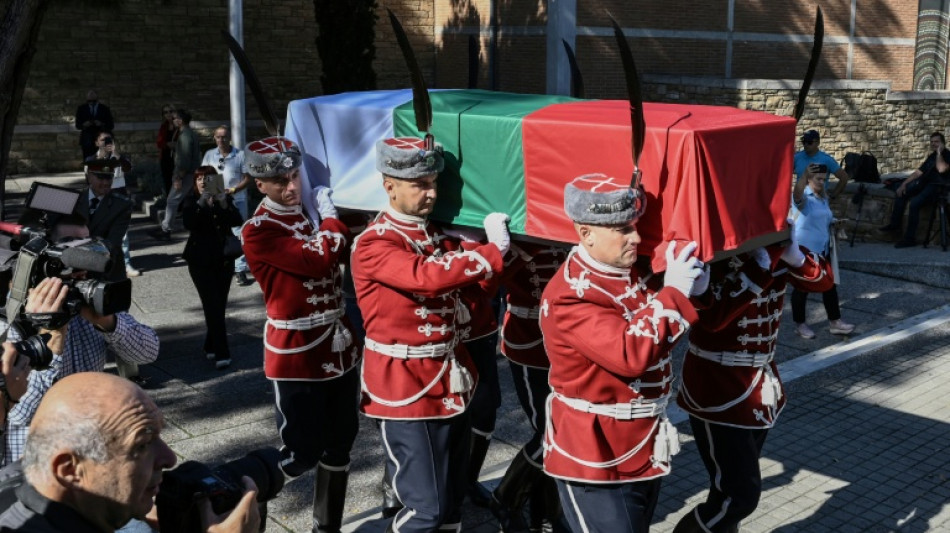
Bulgaria's Tsar Samuel returns 'home' after 1,000 years / Photo: Sakis Mitrolidis - AFP

 'Glad it's over': Kim powers to Games gold and military exemption
 After 11 World Cups, football finally comes home for one Indian fan
 Marc Marquez wins sprint at Japan MotoGP, Martin grabs pole
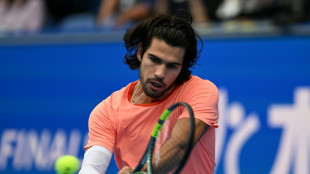 Alcaraz fends off Arnaldi to reach Japan Open quarters
 Antonelli tops times in final practice at Bahrain GP
 Gauff digs deep to beat Osorio in China Open second round
 Fresh protests to hit Spain after housing measures defeated
 'He's here with me': Japan cycle queen dedicates gold to late brother
 Japan Olympic chief says 'lot more' athletes at Games than expected
 Asian carmakers besting US rivals at home, China poised to strike

 Widgets & Web Offers All-Inclusive Investor Relations Websites for Public Companies, IPOs and SPACs

 Adams named new US captain to 2030 World Cup
 China a better influence in Latin America than US: poll
 Judge pauses construction of border project in Texas national park
 Belgium's De Bruyne fires double to sink Turkey, France held by Italy
 US jobs data boosts stocks as oil prices dip

 US Supreme Court to hear high-stakes climate case
 Trump expected to name intel chief Clayton as AI czar: reports
 Argentina unveils passports-for-investment scheme
 Brazil election debate chaos sparks censorship row
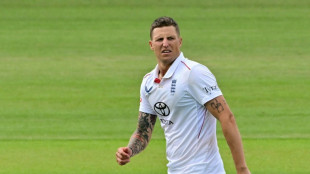 England's Carse charged by cricket body over nightclub incident

 Amazon vows $1 bn for data center towns, decries 'myths'
 Oil prices drop on G7 fuel release, US jobs data boosts stocks
 G7 agrees deal to ease global energy supply concerns
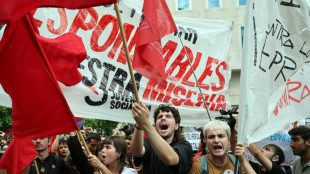 Spain's government dealt blow as lawmakers reject housing bills
More than 1,000 years after his death, the remains of what may be Tsar Samuel, one of the last major rulers of the First Bulgarian Empire, are returning "home" on Saturday.
Greece and Bulgaria reached an agreement on their return this week, with Bulgarian Prime Minister Rumen Radev hailing the accord as "historic".
The remains "belong to our two peoples", Radev said as he attended a ceremony to mark the return alongside Greek counterpart Kyriakos Mitsotakis.
Greece will in return receive 48 objects pillaged by Bulgarian troops from churches and monasteries in northern Greece during World War I.
Samuel, who reigned from 997 to 1014, led several campaigns against the Byzantine Empire with his brothers, one of whom he later executed.
He gradually extended his authority over a swathe of the Balkans, making the Lake Prespa and Lake Ohrid region, now mostly in North Macedonia, his powerbase.
But the Byzantines regained the upper hand after 1001, soundly defeating Samuel's army in 1014.
Samuel is said to have died of shock when he saw thousands of his defeated soldiers returning home blinded by order of Byzantine emperor Basil II, known as the "Bulgar Slayer".
Samuel's state fell under Byzantine rule four years later.
While Radev said future generations would now be able to pay homage to their ancestors, Mitsotakis hailed the remains as having "incalculable cultural and spiritual but also emotional value".
- Bones of contention -
But Bulgaria is not the only country to have claims on Samuel, with a huge statue of the tsar gracing the North Macedonian capital Skopje.
His legacy has become a bone of contention between the two neighbours, with Macedonians claiming him as "their" ruler.
The Skopje daily Sloboden Pechat called the handover another battle over history, with the Albanian-language daily Koha declaring: "The bones return, the conflict remains! Samuel once again (contested) between Skopje and Sofia."
Some historians have likened the dispute to the French and German tug-of-war over Charlemagne.
In 2022, a bilateral commission recommended to present Samuel as the head of a state that "most contemporary historiographers consider to be the Bulgarian Empire", based in what is currently North Macedonia.
"Samuel occupies an important place in the historical narrative both in Bulgaria and in North Macedonia," Dimitar Bechev, a researcher at the Carnegie Europe think tank, told AFP.
"This initiative aims to underline the Bulgarian character of the Slavic population of Macedonia."
The supposed remains of Samuel were discovered by Greek archaeologist Nikolaos Moutsopoulos in the 1960s.
Moutsopoulos led excavations on the Greek island of Saint Achilleios on Little Prespa Lake near the border between Greece and Albania and not far from the frontier with North Macedonia.
They found the skeleton of a man measuring about 1.6 metres (5 feet 3 inches), along with remnants of a rich silk fabric edged with gold and decorated with bird motifs.
The attribution to Samuel is based on clues including the location of the tomb, the sumptuousness of the garment, the age of the deceased and an old fracture.
- Decades of negotiations -
Bulgaria officially opened talks on the return of the remains in 2007, and they became a major issue in relations with Greece.
The deal this week also sparked a row in Bulgaria over who should claim the credit, with history playing a major role in this month's presidential election.
Incumbent Iliana Iotova, backed by Radev and promoting ties both with Moscow and the EU and NATO, is playing the patriotic card, having launched her campaign in Veliki Preslav, former capital of the First Bulgarian Empire.
"Radev seeks to attract the patriotic electorate," said analyst Bechev, with the message that unlike other nationalist parties, "he delivers results".
Free trains are being laid on to the capital for the occasion, with some 750 police guarding the centre of Sofia during the handover ceremony.
The remains attributed to Samuel will be laid in a white sarcophagus made from marble quarried in the Prilep region of North Macedonia, public broadcaster BNT said.
They will rest in the Church of Saint Sofia, a sixth-century basilica that gave its name to the Bulgarian capital.
T.Sanchez--AT