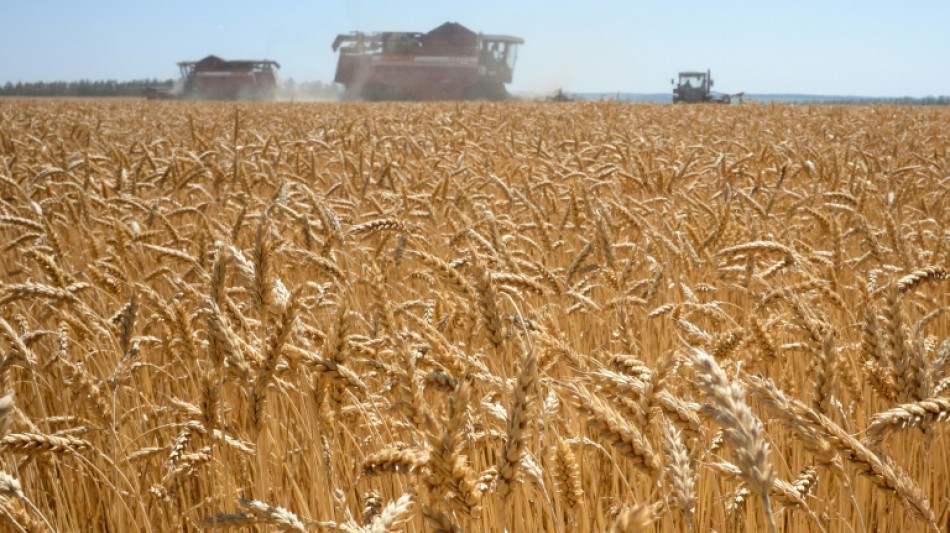
Wheat and corn prices ride the Ukrainian rollercoaster

 Cornell suspends frat parties after alleged gang rape

 Man City deserve to keep titles, says PSG's Luis Enrique

 Regulator 'will resign' if any political interference in Man City case

 Microsoft's Brad Smith calls for 'real and effective' AI safety standards

 Anthropic warns of AI 'worms' spreading across smart gadgets

 Big US banks report strong earnings and stay bullish on AI

 Iraola backs Barcola, Wirtz to come good for Liverpool

 In a first, AI helps UK lawmaker find her voice in parliament

 Pope Leo in Rome hospital for lung operation

 EU watchdog says smart glasses must give 'clear warnings' when recording

 Houthis say Saudi Arabia strikes oil site in Yemen's capital

 France roiled by marches in support of protesting students

 Goldman Sachs profits jump as CEO says no plans to exit

 Apple unveils HomeView smart display in renewed home push

 Novelist Thelyson Orelien denies AI use, admits plagiarism 'mistakes'

 Trump asks Greece ambassador to resign amid bribery scandal: White House

 11 missing after ships struck off Bulgaria in latest Black Sea attack

 France budget debate faces rocky start as Socialists vow to fight

 AI could 'change the stakes' on bioweapons: UK spy chief

 Sweden centre-left leader fails to form government

 EU economy chief doubtful Russian diesel exports will affect prices

 Capital International Highlights Multilingual Access to Its Platform as European Economic Conditions Diverge

 Hazlewood takes six as Australia win first Test

 Pope Leo admitted to hospital for lung operation

 Hungary cuts anti-LGBTQ measures from Orban-era law

The crisis between Ukraine and Russia, two of the world's biggest wheat and corn producers, has sent the commodities' prices on a wild ride -- with anything from a diplomatic statement to rumor of a maritime blockade roiling markets.
Usually much less volatile than stocks or oil, agricultural commodities are now often subject to spectacular spikes and drops.
"The market doesn't know nuance: Either it's war and it goes up, or it's peace and it goes down," said Gautier Le Molgat, an analyst at Agritel.
The grains' markets turned around three times in less than 24 hours this week: First on the Russian foreign minister's optimistic tone Monday, then on news of the United States relocating its Ukrainian embassy, and finally on Moscow's claims of a military pullback.
The stakes are especially high for wheat, with Russia being the world's top exporter and Ukraine the fourth, according to estimates by the US Department of Agriculture (USDA).
Together, the two countries account for almost a third of wheat's world trade.
On the corn side, Ukraine ranks fourth among exporters and accounts for approximately 22 percent of trade.
To date, however, the Russian army's movements have had little effect on Russian or Ukrainian exports.
While global wheat prices surge, Ukraine has seen its own rates fall by four percent over the last month, according to S&P Global Platts.
"If we remain in a latent conflict, volatility will remain in place and Russia and Ukraine will be losers in this," Le Molgat said.
"Their currencies will depreciate and few will risk buying from a distant origin without guaranteed delivery."
Ukraine is also the top sunflower oil exporter, with Russia a close second.
"We did see some customers that were pulling back buying sunflower oil from Ukraine, because they had worries about whether they would be able to deliver if they're involved in a military conflict with Russia," said Arlan Suderman, chief commodities economist at StoneX Financial.
However, according to Scheve, "over time, (such a latent crisis) would just be accepted as it's the risk that you face."
"And then until the problem rears its head again, that wouldn't necessarily put a premium on prices."
He also pointed out that exports from Ukraine and Russia traditionally slow down in March, "so that might be less of an issue."
- Blockade and embargo -
Those involved in commodities trading have a worst-case scenario in mind.
Were conflict to arise and Russia block the port of Odessa, Ukraine would have trouble exporting, Le Molgat said.
"In such a situation, one can imagine that there will be economic sanctions. The United States could thus decide to prohibit the trade of Russian wheat in dollars," he said.
Apart from Ukraine and Russia, the countries the most impacted would be their biggest customers, namely Egypt, Turkey, Indonesia and Morocco, which would be forced to find wheat elsewhere, probably at a higher price.
On the supply side, the European Union, United States and Australia, the other major players in terms of wheat, would be major benefactors of the disruption.
The exceptional uncertainty and volatility in the agricultural markets is a huge draw for investors. Earlier this month, the amount of short wheat positions (bets on price dropping) rose to levels not seen since July 2020.
In recent days, Teucrium, which manages ETF funds tracking agricultural commodities, has recorded inflows from investors looking to benefit from the price hike, said managing director Jake Hanley.
A diplomatic end to the crisis or the continuation of status quo in Ukraine would provide market relief, by all accounts, but prices could remain high.
Wheat and corn are currently 22 and 18 percent above their prices this time last year respectively.
The upcoming US wheat crop is threatened by a drought in the southern Plains, while corn crops are also expected to suffer from lack of rain in Argentina and Brazil.
"There's been so much focus on Russia, Ukraine," said Suderman, "that the global markets have pretty much lost touch with some of the other issues around the world."
P.Smith--AT