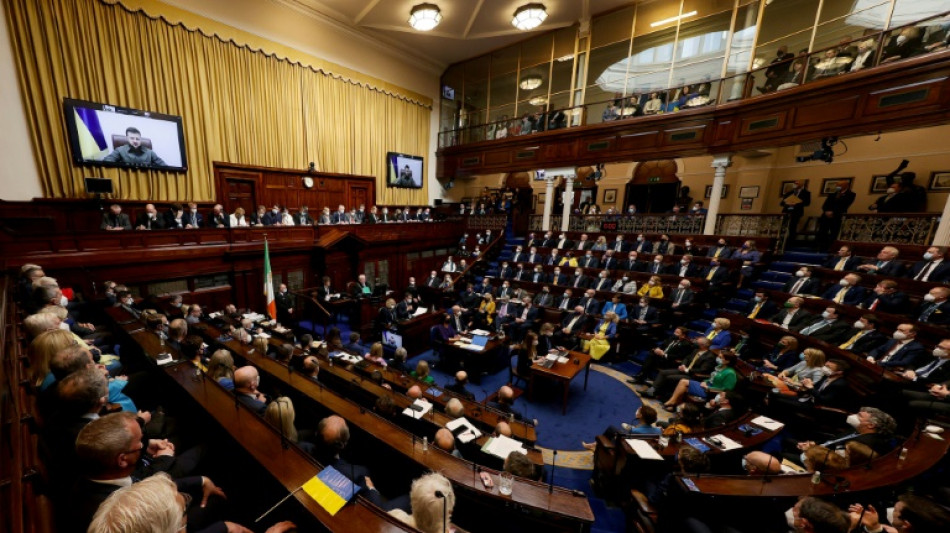
Ireland examines neutrality stance after Ukraine war: minister / Photo: MAXWELLS - HOUSES OF THE OIREACHTAS/AFP

 'We need help': Venezuelans furious at slow official response to quakes
 Venus Williams relishes 'very special' Wimbledon reunion with sister Serena

 Ravindra leads New Zealand rally in England finale after Archer's double strike
 Wimbledon 'towel thief' Swiatek back on the trophy hunt

 Venezuela earthquake deaths near 1,000, with millions more in need

 French Open champs head to Wimbledon wrestling with new-found status
 Budapest Pride marchers push for equality after reversed ban
 Russell snatches pole, Antonelli fourth for Austria GP grid
 Broos smiles and snarls before South Africa's historic World Cup match
 Newborn baby rescued from rubble of Venezuela quake
 Raducanu halts practice session to put Wimbledon bid in doubt
 Keys beats Maria to clinch third Eastbourne title
 Thousands ride through Rome as Vespa celebrates 80 years
 Sinner ready for Wimbledon defence despite lack of time on grass
 Records tumble as European heatwave moves east
 England, Portugal eye top spots as World Cup group stages wrap up
 US, Iran trade strikes putting new strain on Middle East truce
 Thousands expected as Vespa celebrates 80 years in Rome

 Pino, Williams injuries mar Spain's World Cup progress
 'Struggle continues' in Bolivia's Morales heartland

 Bielsa accepts blame for World Cup exit, but says Uruguay deserved more
 Uruguay crash out of World Cup as Spain avoid Argentina clash

 Swiss glaciers facing drastic loss from heatwave: expert
 Trump unveils new US passport -- with picture of himself

 Epomaker Unveils the HE Lineup: Two Distinct Innovations Tailored to Community Demand

Russia's invasion of Ukraine is forcing Ireland to rethink its long tradition of military neutrality, the country's European Affairs Minister Thomas Byrne has told AFP.
Public opinion may not be ready for membership of the US-led NATO alliance yet, Byrne said in an interview during a visit to France, even though there is no doubt as to where Irish sympathies lie.
"Russia invading Ukraine, totally against the UN charter, against the basic principles of territorial integrity, put the Irish people very firmly, instinctively on the side of right there," he said.
"We're not neutral when it comes to an invasion like that, but we're neutral when it comes to joining a military alliance," he said.
Irish neutrality has sometimes caused consternation among its EU allies and elsewhere, but Byrne said there were strong historic reasons for its stance.
"For a lot of our history, as an independent country, we were overshadowed in our own minds by the British attempt at conscription in 1918," which sparked angry protests from Irish nationalists and became a factor for the country's independence in 1922.
"I think that's partly where Irish neutrality comes from. Our neutrality has been characterised by non-membership of military alliances," he said.
- 'Have to defend ourselves' -
The US-led 2003 invasion of Iraq -- justified by false allegations of weapons of mass destruction being present in the country -- added to Irish scepticism about NATO membership, he said.
"Public opinion is not in favour of Ireland joining military alliances. But also I think the public is seeing now that defence is different to offence," Byrne said.
Ireland is currently concerned that submarine cables carrying trans-Atlantic internet traffic may be vulnerable to attack, which could cause havoc for European networks -- a worry exacerbated by recent explosions destroying part of the Nordstream pipelines for which Western governments have blamed sabotage.
"We've seen what happened at Nordstream. The submarine cables are partly in Irish waters," Byrne said. "We have to defend our cables, we have to defend ourselves."
"In Ireland we probably need a new conception of what defence is, a new concept," he said.
One way forward could be submitting the neutrality question to a Citizens Assembly, an Irish institution where members of the public examine important issues together with experts, preparing legislative change.
"The Taoiseach (Prime Minister Micheal Martin) has said he may decide to hold a Citizens Assembly on that issue so that the public can think things through," Byrne said.
Although there are currently no concrete plans for such a move, it could become "part of a wider debate on how to defend ourselves".
Previously non-aligned countries Sweden and Finland applied to join NATO in May in response to Russia's attack on Ukraine, and their accession protocols were signed in July.
Bosnia and Herzegovina, Georgia and Ukraine itself have also applied to join the alliance.
R.Chavez--AT