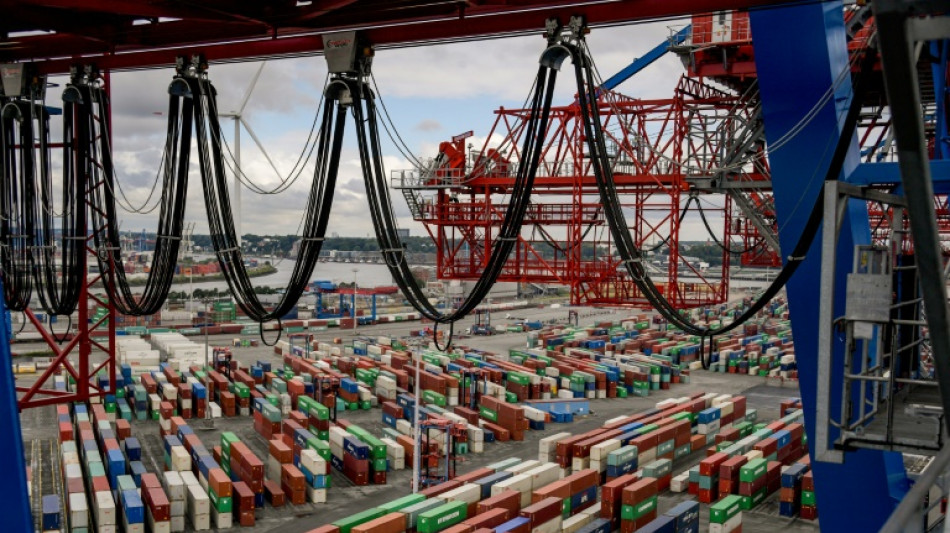
Germany forecasts 2023 recession as energy crisis bites / Photo: Axel Heimken - AFP/File

 Venezuela earthquake deaths near 1,000, with millions more in need

 French Open champs head to Wimbledon wrestling with new-found status

 Budapest Pride marchers push for equality after reversed ban

 Russell snatches pole, Antonelli fourth for Austria GP grid
 Broos smiles and snarls before South Africa's historic World Cup match

 Newborn baby rescued from rubble of Venezuela quake

 Raducanu halts practice session to put Wimbledon bid in doubt

 Keys beats Maria to clinch third Eastbourne title
 Thousands ride through Rome as Vespa celebrates 80 years

 Sinner ready for Wimbledon defence despite lack of time on grass
 Records tumble as European heatwave moves east

 England, Portugal eye top spots as World Cup group stages wrap up

 US, Iran trade strikes putting new strain on Middle East truce

 Thousands expected as Vespa celebrates 80 years in Rome

 Pino, Williams injuries mar Spain's World Cup progress
 'Struggle continues' in Bolivia's Morales heartland

 Bielsa accepts blame for World Cup exit, but says Uruguay deserved more

 Uruguay crash out of World Cup as Spain avoid Argentina clash

 Swiss glaciers facing drastic loss from heatwave: expert

 Trump unveils new US passport -- with picture of himself

 Epomaker Unveils the HE Lineup: Two Distinct Innovations Tailored to Community Demand

 US and Iran trade strikes putting new strain on Mideast ceasefire

 Maple Leafs make teen McKenna top pick in NHL Draft

 California appeals court orders Weinstein resentencing for sex assault

 Scheffler fires 60 to grab 36-hole PGA Travelers lead

Germany will sink into recession next year and inflation will soar, the government forecast Wednesday, as Europe's top economy battles skyrocketing energy prices following Russia's gas shutdown.
The official predictions were the latest warning that Germany's economy, which was just getting back on its feet after the pandemic, is set to shrink in 2023 due to the fallout of Moscow's invasion of Ukraine.
Unveiling the government's latest forecasts of 0.4 percent economic contraction and seven percent inflation for 2023, Economy Minister Robert Habeck painted a dark picture of a "serious energy crisis".
It "threatens to become an economic and social crisis", he warned -- but insisted that Russian President Vladimir Putin will "fail in this attempt to destabilise the basic economic and political order".
Putin "will also fail on the battlefield in Ukraine", he added.
Moscow's move to cut off gas supplies to Europe amid tensions over Ukraine has triggered an energy crisis across the continent, with consumers and businesses facing high prices as winter approaches.
Germany has been particularly hard hit, as 55 percent of its gas supplies came from Moscow prior to the Ukraine conflict.
The soaring energy costs are expected to send inflation to eight percent in 2022 and seven percent in 2023, the government forecast.
Nevertheless, Germany's economy is still set to register growth of 1.4 percent in 2022, according to the government forecasts, after having enjoyed a post-pandemic rebound earlier in the year.
But it will then shrink in 2023, with the economy ministry saying the "central reason" for the downgrade from forecasts earlier this year was "the halt to Russian gas supplies".
High energy prices are acting as "a brake on industrial production -- above all in energy-intensive sectors". The economy will return to growth with expansion of 2.3 percent in 2024, according to the forecasts.
- Energy price cap -
The government recently unveiled a 200-billion-euro ($194-billion) fund to shield consumers and businesses from surging prices, which includes a cap on energy costs.
Without the cap, consumer prices would be much higher in 2023, the forecasts said.
Forecasts by leading economic institutes late last month showed inflation coming in at 8.4 percent for the year as a whole in 2022 -- and climbing further to 8.8 percent in 2023.
Warnings are mounting that global growth will slow further next year due to myriad crises, with the IMF this week downgrading its 2023 global GDP growth forecast.
It forecast that Germany, along with Italy, will become the first advanced economies to contract in the wake of Russia's invasion of Ukraine.
Signs are rapidly multiplying of Germany's escalating economic crisis.
Last week, official figures showed that industrial production -- the pillar of the German economy -- produced 0.8 percent less in August compared with the previous month, with energy-intensive industries badly impacted.
Inflation meanwhile hit a 70-year high of 10 percent in September.
The European Central Bank has started aggressively tightening monetary policy to bring inflation under control, lifting rates a historic 75 basis points last month, but some are worried the move adds to recession risks.
Berlin has been scrambling to find alternative energy sources, accelerating the construction of infrastructure to import gas from further afield, and is preparing to keep two nuclear plants running longer than initially anticipated.
Despite the crisis, Habeck sought to strike a positive note about efforts to find new partners to supply energy.
"We are making very good progress in loosening the grip of Russian energy imports," he said.
B.Torres--AT