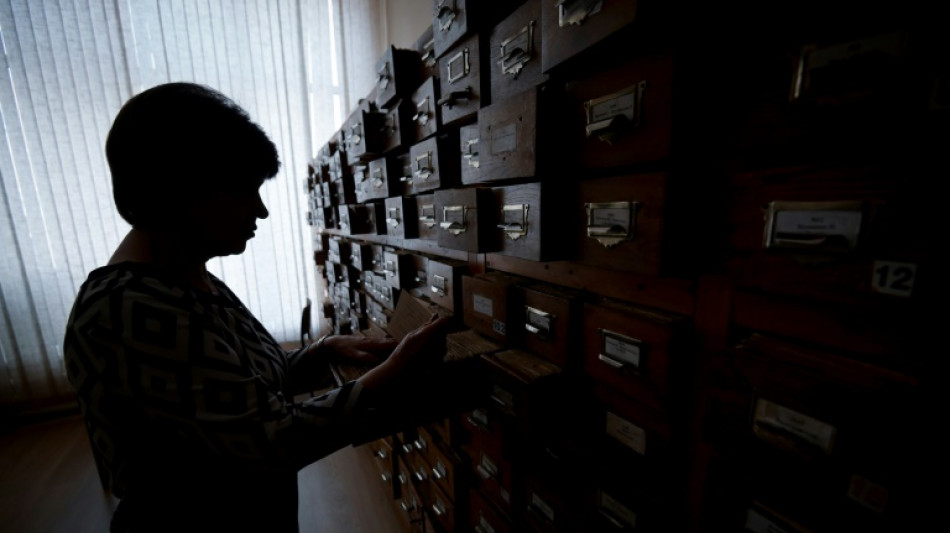
Russians search for Jewish roots to flee draft / Photo: Natalia KOLESNIKOVA - AFP

 Venezuela earthquake deaths near 1,000, with millions more in need

 French Open champs head to Wimbledon wrestling with new-found status
 Budapest Pride marchers push for equality after reversed ban
 Russell snatches pole, Antonelli fourth for Austria GP grid

 Broos smiles and snarls before South Africa's historic World Cup match

 Newborn baby rescued from rubble of Venezuela quake

 Raducanu halts practice session to put Wimbledon bid in doubt

 Keys beats Maria to clinch third Eastbourne title
 Thousands ride through Rome as Vespa celebrates 80 years

 Sinner ready for Wimbledon defence despite lack of time on grass

 Records tumble as European heatwave moves east
 England, Portugal eye top spots as World Cup group stages wrap up

 US, Iran trade strikes putting new strain on Middle East truce
 Thousands expected as Vespa celebrates 80 years in Rome
 Pino, Williams injuries mar Spain's World Cup progress
 'Struggle continues' in Bolivia's Morales heartland

 Bielsa accepts blame for World Cup exit, but says Uruguay deserved more
 Uruguay crash out of World Cup as Spain avoid Argentina clash

 Swiss glaciers facing drastic loss from heatwave: expert
 Trump unveils new US passport -- with picture of himself

 Epomaker Unveils the HE Lineup: Two Distinct Innovations Tailored to Community Demand

 US and Iran trade strikes putting new strain on Mideast ceasefire

 Maple Leafs make teen McKenna top pick in NHL Draft
 California appeals court orders Weinstein resentencing for sex assault

 Scheffler fires 60 to grab 36-hole PGA Travelers lead

At a Red Cross centre in Moscow, a dark-haired woman nervously holds a phone to her ear, trying to dig out details on her Jewish roots to help her son flee President Vladimir Putin's drive to mobilise troops to fight in Ukraine.
"Mum, your grandfather Moishe was born in 1870, like Lenin, right?" she asks.
"Getting an Israeli passport is the only way for my son not to go to fight in Ukraine," the exhausted woman, who declined to give her name for security reasons, explained to AFP.
Tens of thousands of Russians have fled since Putin sent troops to Ukraine in February and then announced a nationwide military call-up in September.
Many have scrambled to find their Jewish roots to open up the doors to Israel.
One of them is 32-year-old Ivan Mitrofanov, frantically looking for proof that his grandparents were Jewish.
As an IT worker, he is so far exempt from the first wave of mobilisation announced on September 21 after a series of Russian military defeats in Ukraine.
But Mitrofanov says he is "rushing to leave as long as the borders are open".
Most Russians expect more mobilisation waves and some fear authorities will introduce martial law or close borders to men of military age.
- 'My passport is toxic' -
Mitrofanov thinks Israel is a better choice over Europe.
"In Europe, my Russian passport is toxic. I'll go to Israel where we're actually wanted," he said.
This new wave of emigration to Israel is so large that Moscow bureaucrats are starting to get tired.
Tatiana Kalazhnikova, who works at an municipal administration office in western Moscow, said "90 percent of our clients come to look for their Jewish origins".
Authorities have criticised Russians rushing to leave the country as unpatriotic and Kalazhnikova is not impressed.
"They want to leave Russia ... for Israel where war never ends," she said sarcastically.
More than one million of Israel's 9.4 million residents have roots in the former Soviet Union.
Israel says immigration applications from Russia and Ukraine have tripled since the conflict started.
Its Central Bureau of Statistics counted 20,000 arrivals from Russia and more than 12,000 from Ukraine since the end of February.
Faced with an avalanche of departures, Russia in July ordered the dissolution of the Jewish Agency, which helps Jews emigrate, accusing it of breaking the law.
Many Russian celebrities -- including Russia's pop queen Alla Pugacheva and her comedian husband Maxim Galkin -- have left for Israel.
The announcement of a chaotic and often random mobilisation led to a new exodus, with tens of thousands flocking to the borders of Georgia and Kazakhstan for weeks.
In a sign of just how many are choosing Israel, five new private agencies have opened to help Russians emigrate.
Others are resorting to genealogists to help them find any trace of Jewish roots.
Vladimir Paley, who specialises in Jewish genealogy, said he has received "10 times more requests" from both Russians and Ukrainians since the start of the conflict.
"With the mobilisation, I mainly reply to the calls of mothers looking to expatriate their sons," the 55-year-old said.
- 'Fear and disgust' -
There have been many waves of emigration to Israel from Russia and the erstwhile Soviet Union.
But this one is "out of fear and disgust," one of Paley's clients, 40-year-old Mikhail, said.
A history teacher and author, Mikhail never thought of leaving. Putin's mobilisation changed that and he wants to emigrate with his wife and child.
But moving out -- often a decision taken in a matter of hours -- has also caused families to break up.
Andrei Trubetskoy, a 58-year-old former official of the Russian interior ministry, said he understood in February that he "no longer wanted to have anything to do" with his own country.
With his historian wife, he searched archives only to discover by chance details of his great-grandfather who was a Hasidic Jew.
The couple were preparing their file and started learning Hebrew.
But, at the last moment, his wife refused and the couple divorced. Now he plans to leave alone.
"The decision to leave is often impulsive," said Lyubov Borussyak, a sociologist at the Free Moscow University.
She has surveyed 150 families who had chosen to leave since February.
"Their goal is not to move to another country, but to leave Russia," she said. "It's an emigration of panic and fear."
A.Taylor--AT