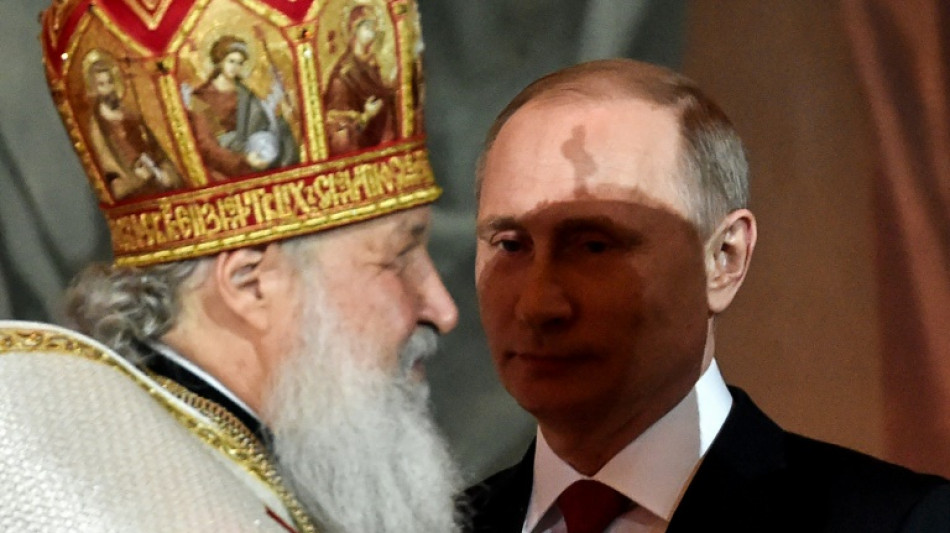
Putin 'in a corner' with options narrowing / Photo: KIRILL KUDRYAVTSEV - AFP/File

 Djokovic inspired by Serena as he targets history at Wimbledon
 Stokes falls cheaply as England collapse in New Zealand decider
 Russell bounces back to beat Antonelli in final practice

 Iran says US violated peace deal as both sides trade fire
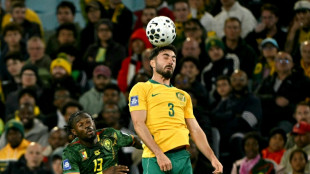 Injured Australian pair Leckie, Italiano out of World Cup
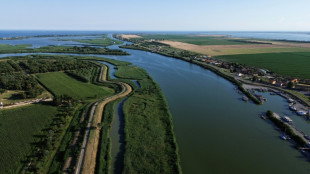 Farmers fear drought as Italy's longest river runs dry
 Budapest Pride to push for equality after reversed ban
 World Cup fans get taste of American life -- at the mall
 World Cup turns New York's Times Square into global fan hub
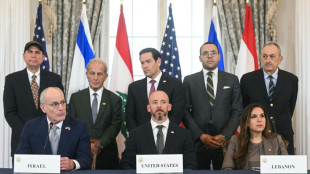 Lebanon, Israel and US sign trilateral framework pact
 Cape Verde extend World Cup fairytale to set up Argentina meeting
 Messi to start dead-rubber World Cup group match on bench
 US and Iran trade strikes putting new strain on Mideast ceasefire
 Maple Leafs make teen McKenna top pick in NHL Draft
 California appeals court orders Weinstein resentencing for sex assault
 Scheffler fires 60 to grab 36-hole PGA Travelers lead

 Austria's Rangnick shuts down conspiracy talk ahead of Algeria World Cup clash
 Should we fear an AI bubble bust?
 US strikes Iran sites after cargo ship attack
 Gueye double keeps Senegal's World Cup hopes alive
 US stocks recover from tech tremors as oil prices fall
 OpenAI restricts limited release of new model to US only
 Scheffler fires 60 to grab early PGA Travelers lead
 Trump blasts 'godless' Democrats in incendiary speech to evangelicals
 Venezuela earthquakes kill 920, tens of thousands missing
US President Joe Biden admitted this week that American diplomats still did not know how Russian President Vladimir Putin could bring an end to his faltering war in Ukraine and save face. Western analysts see no good options.
The question of Putin's "off-ramp" -- or decisions that allow him to end the fighting without admitting defeat -- has exercised Western policymakers and foreign policy experts since the very start of the war in February.
"Where does he find a way out?" Biden asked on Thursday while talking in New York. "Where does he find himself in a position that he does not, not only lose face, but lose significant power within Russia?"
A French diplomat, talking recently on condition of anonymity, stressed that European allies were no closer to reading Putin's thinking, other than his desire to secure what appears to be an increasingly unlikely military victory.
"There's a war that he is not managing to win, but what would satisfy him? We don't have the answers," the diplomat said.
Instead of looking for a negotiated climbdown, Putin has escalated in recent weeks, formally annexing four regions of Ukraine on September 30 and approving a partial mobilisation of up to 300,000 men for the war.
"He may think the battlefield situation isn't great but things will settle down during the winter, that Ukrainian offences will come to an end, that they'll be able to mobilise," Eliot A. Cohen, a military historian and former US State Department adviser, told AFP.
"I think he's mistaken. I think the Russians are in a serious world of hurt," added Cohen, an expert at the Center for Strategic and International Studies at the US-based Johns Hopkins University.
The Ukrainians are continuing to win back occupied territory in the northeast and south, while the Kremlin's mobilisation has led to rare dissent in Russia amid evidence that many recruits lack adequate weapons and kit.
"Russia's behaviour is irrational," wrote Joris van Bladel, a fellow at the Belgian Royal Institute for International Relations think-tank. "The only 'rational' element the Kremlin is counting on is time."
"Russia tries to buy time in the hope that the European countries will collapse before Russia’s downfall," he added.
- 'Dangerous moment' -
Putin's escalation on the ground has also been accompanied by new rhetoric about the possible use of nuclear weapons which is directed at Western countries.
Some analysts see it as a bluff and others as a sign of desperation.
"His hope is that references to nuclear weapons will deter the democracies from delivering weapons to Ukraine, and buy him enough time to get Russian reserves to the battlefield to slow the Ukrainian offensive," Timothy Snyder, an American historian of Russia and Ukraine, wrote this week.
But Biden said Thursday that he believed Putin was "not joking" with his threats, adding that it was difficult to imagine how this did "not end up with Armageddon."
Western nations have signalled that they would feel compelled to react in some way if Russia crossed the nuclear threshold, raising the risk of direct conflict between the NATO military alliance and Moscow.
"It's a very, very dangerous moment," former US secretary of state John Kerry said late last month.
Putin is "more in a corner than anyone would like him to be because that's not good for anybody", Kerry told MSNBC on September 28.
Cohen said Putin could authorise the use of chemical or biological weapons instead -- less provocative than a low-yield nuclear weapon -- "but the military utility of those might not be all that great".
- 'Journey to hell' -
With the Russian president continuing to raise the stakes, another "off-ramp" is one that sees Putin bundled out of power, either through a popular uprising or -- more likely -- a "palace coup" in which he is replaced by a rival.
More problems with the mobilisation, a significant military collapse or a successful new Ukrainian offensive on a separate part of the frontline could increase the domestic pressure on Putin, who celebrated his 70th birthday on Friday.
"The key question is whether Russia's elites and broader society are prepared to accompany their president on this journey to hell," wrote Tatiana Stanovaya, a Russian political scientist at the Carnegie Endowment for International Peace, a US think-tank.
Marie Dumoulin, a Russia specialist at the European Council on Foreign Relations cautioned that "we shouldn't take our dreams for a reality. Nobody knows when it will happen, in what circumstances, and what will come after Putin."
"There are tensions inside the system, that's for sure, but it seems to me to be about internal clans competing for power without contesting the authority of Putin," she told AFP.
For the moment, it's "not so much people taking a swing at him but taking a swing at each other," Cohen said.
D.Lopez--AT