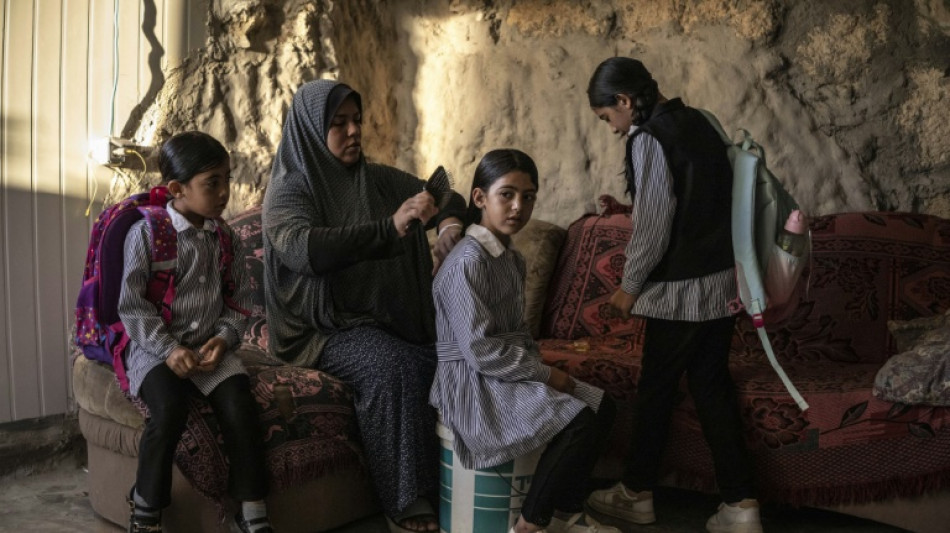
Palestinians turn rugged caves into homes after Israeli demolitions / Photo: John WESSELS - AFP

 Kids and social media: what would change under new EU law

 Modi pitches India as global chipmaking hub

 Ukraine plans record defence spending in 2027

 Klopp calls up 44 players in huge first Germany squad

 STARPRIME Responds to Diverging Gold Market Demand with AM/PM Fixing and XAU24/7

 Ukrainian fashion designer debuts art between air raids

 Gambian businesses struggle under prolonged blackouts

 Fiji declares national HIV crisis

 Australia to cut migration to fix housing crisis: minister

 NASA scan discovers new, 'once in a century' Moon crater

 Most stocks rise as Fed hikes and indicates drive to curb inflation

 US again denies Palestinian leader Abbas visa to attend UN assembly

 Lula says he will go to UN to tell Trump to 'stay out' of Brazil's elections

 Messi heads Inter Miami to Campeones Cup triumph

 AI looms large ahead of Xi, Trump summit

 Smith still haunted by 'Sandpapergate' as he prepares for South Africa Tests

 UK-Sudanese author pens book to give children 'African history of Africa'

 Boehly and Walter sell Chelsea stake to Clearlake Capital

 Guardian Metal Resources PLC Announces Audited Financial Results for the Year Ended 30 June 2026

 Trybe Spirits Announces Sponsorship of The San Diego Spirits Festival

 Trump threatens EU over 'hostile' Canada association plan

 Argentine judge orders suspension of Falklands oil project

 Carrick takes the blame as troubled Man Utd suffer League Cup misery

 Barcelona hit seven in Racing Santander rout

 Amorim's Milan beaten by Benfica, Sunderland make dream European return

Palestinian herder Mohammed Emar has set up a fully functional home for his family where his daughters can even sing karaoke. Only it is inside a cave after the Israeli army demolished his two houses.
In the occupied West Bank's arid region of Masafer Yatta, Emar made a smooth concrete floor on two caves' rough limestone ground before applying a white limewash on the brittle stone walls.
With time, electricity from solar panels and water from a well turned the grotto into a new home for the 33-year-old Emar, his two wives and 11 children, who nonetheless long for life above ground.
"We once lived in a house above ground, where you could see the world. But today, we live in an underground cave that resembles a grave," Emar said.
His children now play on the patio built out of the side of the hill in front of the cave, with his daughters singing Arabic songs on a karaoke machine and keeping an eye on the younger boys.
The youngest son, Raz, short for Razeeq, is named after a Russian-Israeli man Emar met in a Tel Aviv jail during a one-year stint he says he did after an altercation with an Israeli settler when his wife Fatima was pregnant.
Above the caves, some rubble from his two houses remains three years after the army demolished them.
On a ridge roughly 300 metres away, Israeli flags, floodlights and fences signal the presence of the Israeli settlement of Avigayil, some of whose residents Emar says make life difficult for his family, with occasional theft and attacks.
Masafer Yatta, in the West Bank's south, is known for frequent home demolitions and tensions between local Palestinians and Israeli settlers.
The hilly, semi-arid area, which is almost entirely under Israeli control according to the Oslo Agreements of the 1990s, was the subject of the Oscar-winning 2024 documentary "No Other Land".
Despite an ever-shrinking living space, locals point to family and community ties as the reason for their capacity to remain on their land after home demolitions.
- 'Ancient times'-
"Whenever someone loses their homes to demolitions, neighbours and families come to help them build new shelters. The fact that we all live close to each other helps," Emar said.
Fatima Emar, Mohammed's wife, says that the family had originally erected tents after the houses they had built in 2023 were destroyed.
"Now, we have sought refuge in the cave. Since it has existed since ancient times they cannot demolish it, and (the army) has allowed us to live there," she said.
The army justifies home demolitions by saying that the construction is illegal in areas under Israeli control. Palestinians complain that their requests for permits are almost systematically denied.
Although not the case with Emar, Israel also often destroys home to punish the families of Palestinians involved in attacks.
Emar says he hoped that the region's roughly 1,100 Palestinian residents could one day live safely in houses.
"While the world moves forward, we here in Palestine, in Masafer Yatta, are moving backwards."
O.Brown--AT