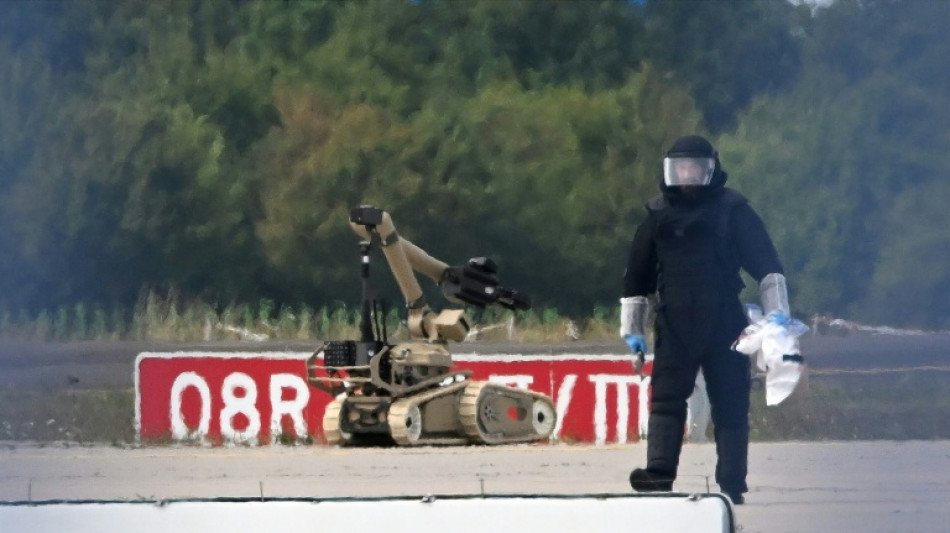
Europe struggles to respond as Russia escalates shadow warfare / Photo: Hendrik Schmidt - dpa/AFP

 Spacecraft bound for Mercury begins 'tricky' arrival
 Initial expert report blames tanker for collision off Istanbul

 'Everyone a winner' with Barcola transfer, says PSG coach Luis Enrique
 Ukraine, India discuss Black Sea, food security on FM's 'historic' Kyiv visit
 Europe bids to be robot superpower like US, China
 US Fed official joins growing group open to rate hike if inflation rises

 Hugh Jackman in talks to buy stake in Norwich football club

 Yen surges on new intervention talk, oil prices climb
 US feminist icon Gloria Steinem dies aged 92
 France recorded 'hottest summer ever': environment minister
 'No plans to retire', says 'acting god' Malkovich

 Nigerian opposition lobbyist tapped for White House-linked role, firm says

 China emissions fell in Q2 as Iran war pared oil use: analysis
 France sells bonds at highest rate since 2008 amid deficit worries
 Vast aid challenge after 'Himalayan tsunami' devastates Nepal

 Bosnia captain Dzeko to retire from international football
 Grief on Chinese internet as wait for Tibet flood news drags on
 Heavy rain puts a dampener on Taiwan 'extreme heat' drill

 Juve's Khephren Thuram out until 2027 with knee injury
 Delivering aid to Nepal flood survivors 'very, very difficult': UN

 German growth prospects brighten as economy defies Mideast turmoil

 Outrage mounts in Malta after acquittal over journalist's murder
 Malaysia starts cloud seeding to help clear toxic haze
 El Nino could be strongest in decades, UN warns
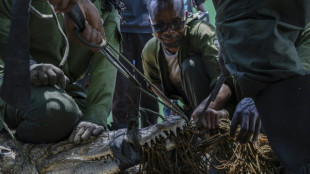 Kenya steps up crocodile hunt as rising lakes fuel conflict
European spy chiefs worry that Russia's war against Ukraine is increasingly spilling over onto their soil, but Kyiv's Western allies are struggling to come up with countermeasures to halt Moscow's "hybrid" attacks.
Denmark's intelligence agency warned on Thursday that Russia is "actively" preparing sabotage operations against its defence industry.
And France's top domestic spy made a rare appearance at a business forum last week, saying the discovery of an explosive-laden drone at a German airport in August was a signal French companies could also be targeted.
"We need to adapt," Celine Berthon, head of France's domestic intelligence agency DGSI, said at a panel dubbed "Are we ready to face war?".
On Tuesday, Berlin blamed Moscow for the incident at the Leipzig airport, which the European Union said bore all the hallmarks of "state-sponsored terrorism". EU countries summoned Russia's envoys and are discussing imposing fresh sanctions.
But analysts say traditional measures such as exposure of spies and diplomatic reprisals have done little to deter Russia so far.
Andrei Soldatov, a London-based expert on Russian security services, said the Western toolbox was outdated.
"We need to accept that we are facing a long hybrid war," he told AFP.
"In this war, solutions devised during the Cold War will not work, nor will ideas developed over the past decade prove effective," he said, referring to naming-and-shaming tactics as one example.
Since Moscow's full-scale invasion of Ukraine in 2022, Kyiv's European allies say they have been targeted by "hybrid attacks" linked to Russia.
The attacks fall below the threshold of open warfare, but have included drone flights near sensitive sites, airspace violations, cyberattacks and suspected assassination plots.
Russia denies involvement.
- 'Shift in mindset'-
The drone episode in Leipzig underscores an apparent escalation in the tactics Russia is willing to employ on NATO soil, at a time when the United States has become an increasingly unreliable partner within the transatlantic alliance under President Donald Trump.
Critics said Germany's reaction was weak.
Sergey Lagodinsky, a Russian-born German MEP, said Berlin's response signalled the country was "running out of retaliatory measures".
"If I were sitting in the Kremlin, I'd probably breathe a sigh of relief," he said.
As attacks escalate, Western democracies are increasingly grappling with what tools they can use to respond, particularly when the operations are carried out by third-country proxies, often allegedly recruited through criminal networks to provide plausible deniability.
"We are asking ourselves those questions," a European security source told AFP. "But that is the whole challenge of hybridity: the response is complex."
Soldatov, the expert on Russian security services, said what was needed was "a systematic effort to improve intelligence-sharing across European agencies, combined with painstaking intelligence work".
"All of this will be very complex and very costly, and it will also require a shift in mindset within intelligence services themselves."
In August, the US Congressional Research Service said Russia's intelligence agencies had demonstrated "flexibility in conducting these attacks and adapting to European responses" including heightened intelligence scrutiny.
"They are conducting more aggressive operations, which carry a greater risk of exposure," it said.
- 'Risk of mass casualties' -
Twenty-one rounds of EU sanctions have taken a toll on Russia's economy, but analysts say their deterrent effect is limited so far.
Advocates of a tougher approach argue the West must have the courage to ramp up economic and security pressure.
"If we are to prevail in this hybrid war, we must be prepared to terrorise the Kremlin, just as it seeks to terrorise us," French historian Antoine Arjakovsky wrote in an opinion piece for newspaper Le Monde.
In addition to ending all trade with Russia, European governments should "respond tit-for-tat to Russian attacks", he argued.
Western nations have been reluctant to impose additional costs on a nuclear-armed Russia for fear of provoking the Kremlin further and risking open conflict.
Alexander Gabuev, director of the Berlin-based Carnegie Russia Eurasia Center, said Europe would have to develop a more robust response to Russia, but warned of the risks.
Unlike the nuclear sphere, where rules have been broadly understood since the Cold War, hybrid warfare escalation is "largely undefined", he said.
"There is no agreed framework governing escalation, which increases the risk of mass-casualty events," said Gabuev.
"For the time being, however, most countries are likely to limit themselves to sanctions and support for Ukraine."
F.Wilson--AT