
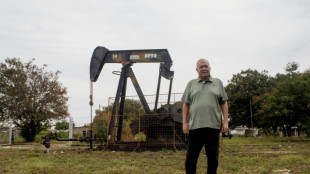
Oil passes $100 a barrel again: why it's more serious this time / Photo: SPENCER PLATT - GETTY IMAGES NORTH AMERICA/AFP

 Iran proposes Hormuz plan, Trump reportedly refuses
 El Nino rewrites the menu in the world's top restaurants
 Pope to hold giant mass on Champs-Elysees

 TikTok to pay Alabama $100 mn under pre-trial settlement

 Internationals take 7-3 Presidents Cup lead after foursomes sweep

 Brazil team returns to Colombian site of doomed jet crash

 Mbappe injured as Zidane wins on France debut, Italy lose on Mancini return

 Senegal draw in Vieira debut, Nigeria survive scare as Cape Verde crash

 U2 performs surprise 50th anniversary gigs in Dublin

 Pope calls worshippers 'saints of France' after AI warning

 US court sides with Pentagon in Anthropic AI ban

 Wall Street stocks rise, greeting optimism over possible US-Iran deal

 NFL players chief raises concerns over pitch for Maracana game

 Daytime Russian attacks kill seven in Kyiv

 Spotting AI writing: how reliable are the detectors?

 French youth await pope after AI 'paradise of machines' warning
 Man City found guilty of Premier League charges, set to appeal: reports

 Embolo follows Xhaka out of Swiss squad over fake Covid documents
 Trump, Xi inspect founding documents of US democracy to close summit

 'Bottle Claus': Kipchoge's 'hero' helping runners chase Berlin marathon glory

 Olympic medallist Samba-Mayela handed provisional doping ban

 First US trial against TikTok to open Monday

 Palmer misses 'too many' England games, says Tuchel

 UN refugees chief warns conditions in W.Sahara 'deteriorating'

 Antonelli 'mad' about crash in Azerbaijan qualifying

Brent crude went back over $100 a barrel Thursday for the first time since May, as the conflict in the Middle East intensified.
This time however, the impact on the world economy could be greater given the conflict shows no sign of ending and reserves have already been partially been drawn down.
- Not the first time -
The last time Brent crude -- the benchmark international oil contact -- broke above $100 a barrel was in March 12 during the first stage or the US-Israeli war on Iran.
The last time before that was when Russia launched its invasion of Ukraine in 2022.
This latest price surge has been fuelled in part by attacks on Saudi tankers in the Red Sea by pro-Iranian Houthi rebel forces in Yemen, which would expand the zone of conflict and could cut off the export of millions of barrels of oil.
In normal circumstances, the world economy consumes a little over 100 million barrels of oil daily.
In mid-July, the International Energy Agency (IEA) warned that world production was below pre-war levels by around 9.4 million barrels a day.
- Higher stakes -
The threat to the Red Sea raises the stakes.
It is the alternative route that Saudi Arabia has been using since the Strait of Hormuz was closed to export its oil.
After the war began it stepped up shipments via pipeline to the Red Sea port of Yanbu, which has allowed it export some three quarters of its pre-war level.
"This workaround is now facing headwinds as the blockade and the threat of attacks on ships will make passage through the Red Sea less viable in the near-term," said Maya Senussi of economic advisory firm Oxford Economics.
Oxford Economics fears that if both the Red Sea and the Strait of Hormuz were effectively closed to traffic, the price of oil could eventually pass $160 a barrel.
"Much of the world's spare production capacity has already been used, while strategic and commercial oil inventories are lower than when the war began, leaving the market with fewer buffers against a prolonged supply disruption," said Janiv Shah, vice president of the Rysted Energy consultancy.
That leaves the markets with less room for manoeuvre, he pointed out.
On Tuesday, the IEA warned that the renewed fighting in the Middle East was increasing concerns over energy supplies.
- Cushioning factors -
But there were still cushioning factors, it added.
It cited increased exports from several countries and Saudi and United Arab Emirates oil reaching markets by alternative routes.
Producers including the Brazil, Kazakhstan, United States and Venezuela were increasing their production, and China was trying to cut its imports, it added.
And around 30 IEA countries had between more than a billion barrels of oil in reserve.
Earlier this month the Kpler consultancy calculated there was a record 1.35 billion barrels of "oil on water" -- product already at sea.
That helps limit further crude oil prices rises, it argued.
The head of French oil giant TotalEnergies was similarly phlegmatic when he announced the company's second quarter results Thursday.
"We have no problem with stocks to supply our refineries," he said.
- Risks of an extended conflict -
European Central Bank President Christine Lagarde nevertheless expressed alarm Thursday at the Houthi attack on a Saudi vessel in the Red Sea.
The situation in the Red Sea "is clearly going to have an impact and is having an impact", she said. "We can see that on the price of Brent as it evolves almost by the hour."
And some of the bank's governors had already mooted a possible rates hike, she added.
Inflationary pressure could encourage central banks to maintain high rates or even raise them.
Energy costs, not just of oil but also of gas in winter, hit both production and consumption and have a knock-on effect on economic growth.
K.Hill--AT