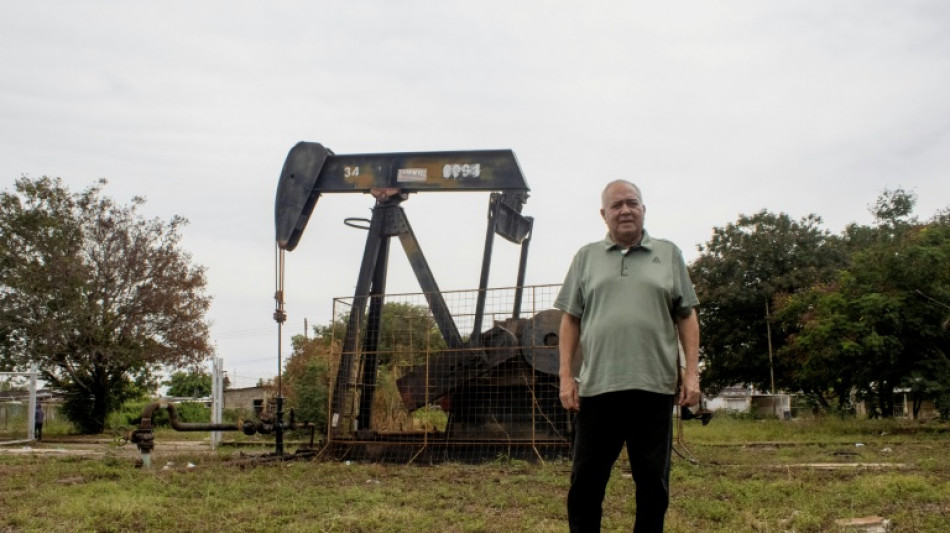
Venezuela's oil cradle pins hopes on US energy deals / Photo: Margioni BERMÚDEZ - AFP

 Zach Hickerson Recounts Hayden Panettiere's Final Moments in New Interview

 Luxembourg Housing Petition Passes Threshold for Parliamentary Consideration

 Raheem Sterling Receives Suspended Sentence After Lamborghini Crash

 Audience to Choose the Set List at Luxembourg's First FAMIL Jukebox Night

 Luxembourg Pay Rise Delayed as Regional and World Headlines Develop

 Chennai Urbanist Sashna Develops 'Anniki' Card Game to Gamify Tamil Nadu History

 Transport Minister Defends Land Seizure Powers for Toronto-Quebec City High-Speed Rail

 UAE Weather Forecast: Scattered Showers and Fog Expected as Temperatures Drop
In the birthplace of Venezuela's oil industry, thick black crude seeps through cracks in the earth, and the air is heavy with the smell of gas, leaving visitors dizzy.
More than a century after sparking an oil boom that transformed Venezuela, the small town of Mene Grande is again in the sights of investors.
The United States has claimed a 20 percent stake in Venezuela's vast oil reserves -- including many local oil fields -- raising hopes of a revival.
Finding oil here is easy.
"Instead of water, oil comes out," said retired military officer Hector Valero Balestrini, gesturing toward a hillside where crude oozes naturally from the ground.
Across the surrounding countryside, seepages resemble miniature volcanoes overflowing with crude and leaving hardened black trails.
Elsewhere, bubbling gas rises from pools.
Balestrini, 67, hopes a new era of investment will breathe life into the town.
"We are taking a new direction," he said.
- Dreams vs reality -
That optimism is shared by US President Donald Trump, who described Washington's investment in Venezuela's oil as the "greatest deal ever made".
Venezuelan crude, he claimed, will double US reserves and guarantee American energy dominance for a century.
But those ambitions contrast sharply with the realities of Venezuela's oil landscape.
Years of economic crisis, underinvestment and political turmoil have hollowed out once thriving communities, with many homes left empty thanks to mass emigration.
"We are rich because of all this, and rich in many minerals too, but we are also poor," Eladio Ramon Devidez, a 67-year-old retiree, said as he stood next to a house abandoned by a family that left Venezuela years ago.
The 27,000 residents that remain in Mene Grande contend with chronic blackouts and crumbling infrastructure, with some of the wells better fit for a museum than a working oil field.
The nearby Zumaque I well began production in 1914, and it continues to rise and fall in a steady rhythm.
Today it produces just 20 barrels a day -- enough to fill the tanks of only 20-30 cars after refinement.
- 'Everything is a nightmare' -
The town is accessible from a battered highway that cuts through the flat, sweltering landscape.
Its roads are scarred by potholes, sewage leaks and overgrown vegetation.
But Devidez hopes new investment will bring jobs and revive the community.
"I hope those projects being negotiated become work and wealth for all Venezuelans because things are really hard," he said.
Those hardships are visible after sunset, when electricity fails, disappearing entire neighborhoods into stifling darkness.
Residents rely on portable lamps, rechargeable lights and cellphone flashlights as temperatures remain oppressive deep into the night.
The light from occasional thunderstorms often provides the only illumination.
Residents have reported blackouts lasting up to 17 hours.
In neighbouring Bachaquero, retired teacher Jose Gregorio Martinez views the renewed oil activity with mixed emotions.
The 65-year-old son of an oil worker lives in a residential area built by state oil company PDVSA during the industry's heyday.
Such developments, known locally as oil camps, once offered residents stable services and a standard of living unmatched in much of the country.
Martinez remembers family gatherings that routinely attracted 30 relatives.
Now many of them live abroad. "I live in a house that used to be full," he said.
Outside his neighborhood, dozens of freshly painted jacks stand out along the roadside, their bright colors contrasting with the deteriorating streets nearby.
For Xiosbelis Saavedra, a 41-year-old shop owner, the new oil boom may have come too late.
Her three siblings have already emigrated, and she is considering shutting down her small delicatessen to follow them abroad.
"Everything is a nightmare. The electricity, the water, the gas, everything," she said. "Prices are crazy every day."
E.Flores--AT