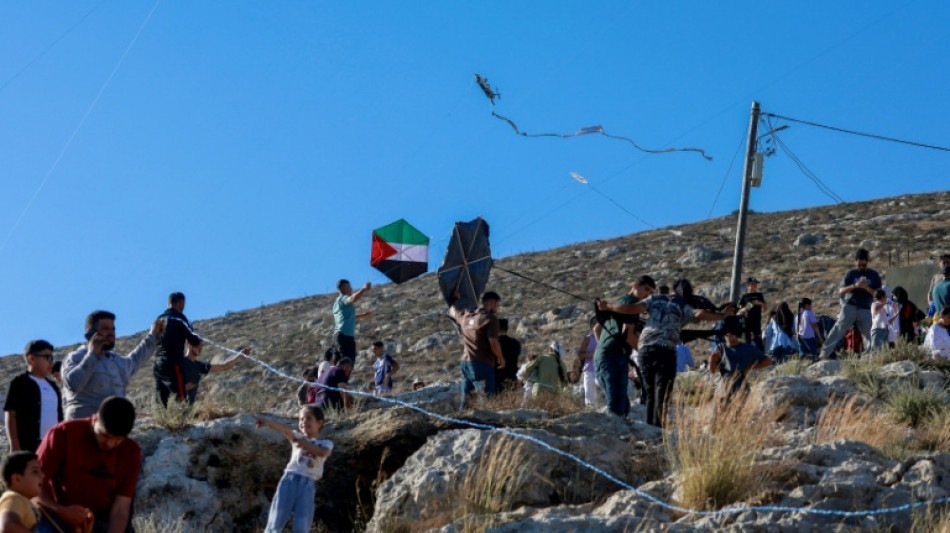
'Our land, our sky:' West Bank Palestinians fly kites in defiance of Israeli settlers / Photo: Jaafar ASHTIYEH - AFP

 Okotoks Band Full Grace Completes First Tour After Debut Album Release
 Son Suk-ku on 'The Blue Road,' Eita Nagayama and changing Korea’s film industry

 Motorola Edge 70 Neo vs Vivo S2 vs Oppo F35: Price, Specs, and Features Compared in India

 Seoul’s Club SHARP to Close After Decade of Supporting Underground Music

 How to Build a Morning Routine that Supports Your Money Goals

 Florida woman charged after deputies report finding cocaine and sales ledger

 Heat end Knicks’ NBA Cup defence with 108-105 victory

 Black Friday laptop promotions cover Apple, Lenovo, HP and gaming models
As brightly coloured kites climb above Burin, a Palestinian village in the Israeli-occupied West Bank, children race across a sun-baked hillside, watching their creations soar into the sky.
Behind them, the red-roofed houses of Har Bracha, an Israeli settlement, overlook the village below.
Established in 1983, the settlement, illegal under international law, is one of several that encircle Burin, a village of a few thousand people.
Every summer since 2009, residents have gathered on this hill for a kite festival, held on land they say has been partly lost after being confiscated by settlers.
"We want to tell the settlers that this is our land, this is our sky. If we can't reach those lands anymore, our kites can," Ghassan Najjar, one of the festival's organisers, told AFP.
While the festival is primarily for children, it also carries a "political message," he says.
In Burin, conversations rarely drift far from settler attacks or the steady spread of Israeli settlements across the Palestinian territory.
As early as 2008, the United Nations Office for the Coordination of Humanitarian Affairs (OCHA) had warned of settler attacks in the area, citing shootings targeting Burin residents and the uprooting of their olive trees.
Since the start of the war in Gaza in October 2023, the United Nations has reported a sharp increase in violence attributed to Israeli settlers in the West Bank, while several Israeli ministers have continued to call for the annexation of all or part of the territory.
- 'Our roots' -
For a few hours, however, the hillside takes on the air of a village fair.
A clown paints children's faces, music fills the air, as families spread picnic carpets across the grass.
Kites in the black, white, green and red of the Palestinian flag soar overhead, joined by another in the colours of Egypt, flown in tribute to the Egyptian national football team.
"Our children have the right to play and to have a real and a good life," says Najjar.
Yet even this celebration unfolds under the shadow of the conflict.
Before gathering, residents say they first checked that no groups of Israeli settlers were nearby.
"Sometimes we are scared... Last year we didn't come because settlers had attacked the village," says 15-year-old Sanaa Bashar Najjar.
"We stay only half an hour or an hour, just to get a bit of fresh air. With the war and the economic hardship, we're simply trying to breathe."
Another resident, Dalia Zaban, says her parents' home was attacked, its windows smashed and cars vandalised.
"Today, we just hope they don't come down here," she said.
As the afternoon wears on, the wind begins to fade and the kites slowly drift back to earth.
The villagers, however, say they will return next summer, determined to reclaim at least a patch of sky.
Wearing sunglasses and dressed with care, Burin resident Qusai Walid Eid summarises the feeling, saying he attends the festival every year to strengthen "our roots in this land".
E.Flores--AT