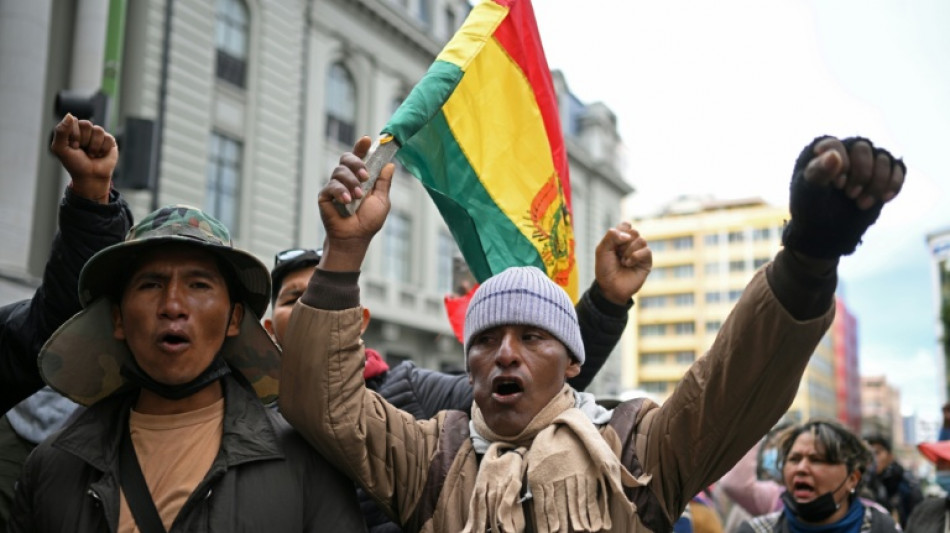
Bolivian Congress OK's use of troops against protesters / Photo: MARVIN RECINOS - AFP

 Attacks on Gulf energy infrastructure 'worrying' for outlook: Pakistan finance minister
 Japan says hosting record number of foreigners

 'Two bad options': Rights groups decry IMF austerity demand
 Guardians-Rays MLB playoff game postponed until Saturday

 'We've never had this': Bear sightings spook Russia

 Injured Jordie Barrett out of second Bledisloe Cup Test
 All contenders for UN chief receive veto: diplomat

 UN climate panel fails to agree date for global warming update: envoy

 Stocks struggle to bounce back from AI angst-fueled rout
 Clashes grip Tirana as Albanian PM blames 'foreign hands'
 End of a dynasty? Dodgers digest playoff drubbing

 Troyes sack sporting director Blanchard amid sexism claims

 Trump's new press secretary out after less than week

 EU backs Ukraine on Starlink, but can't fill gap

 Itauma coming to terms with Hrgovic heavyweight loss

 NBA tells sportsbooks to ban certain bets and parlays: report

 US influence, AI and mistrust cloud Alberta independence vote

 Pant, Bumrah named in India Test squad for New Zealand tour

 Coen brothers say they plan to make film together again

 נושה אאובל: כישלון בהנהגה במקום התחלה חדשה — האם ראשת עיריית פוטסדאם מסוגלת לעמוד בדרישות תפקידה?
 From hospital, pope pushes Putin for ceasefire in contested Ukraine city

 King of the Mountains Carapaz joins NSN Cycling team
 S.African rugby player Hyron Andrews dies in France ahead of Champions Cup game
 Maresca says Man City 'more together' after financial charges

 Zelensky drums up European backing as Trump ties slump

Bolivia's congress voted Tuesday to let President Rodrigo Paz deploy soldiers and declare a state of emergency to counter huge street protests seeking his resignation over economic hardship.
By a more than two-thirds majority the Chamber of Deputies eliminated a rule that restricted the center-right president's leeway to invoke emergency measures, the chamber's speaker Roberto Castro announced.
As a groundswell of fury with the US-backed leader continues to convulse the Andean nation just six months into his term, the way is now clear for Paz to deploy the army and curb some civil liberties, like freedom of movement and assembly. The law had already been rushed through the Senate.
With an ample majority of the 117 members present in the 130-seat chamber, lawmakers undid a rule that since 2020 had limited the president's ability to impose states of emergency.
The repeal took place outside of ordinary congressional procedure so it could be pushed through in just one week.
As the protests have grown, Paz has made various gestures aimed at ending the revolt against policies with which he is attempting to resolve Bolivia's worst economic crisis in decades.
The demonstrations began in early May with trade union demands for salary increases, stable fuel supplies and sounder economic management. But the movement has intensified.
Protesters have blockaded entry routes into La Paz, shops have shuttered for fear of violence, and food, medicine and fuel supplies are running low.
Critics of Tuesday's action in congress say it puts human rights at risk. Opposition lawmaker Sonia Sinani said it will actually make things worse and "pour gasoline on the flames" of the street protests.
"This law is like a strait jacket," said another opposition lawmaker, Alejandro Reyes.
The overturned regulation outlawing states of emergency dates back to social unrest in 2019 which killed 36 people and led to the resignation of then socialist leader Evo Morales.
When Morales' right-wing successor Jeanine Anez entered office, the socialist-dominated Congress sought to limit the government's capacity to crack down on protests.
The law made congressional approval of states of emergency mandatory, and also gave lawmakers the right to propose amendments to prevent abuses.
The Paz government claims that the current protests aim to "disrupt the democratic order" and has accused Morales -- in hiding from trafficking allegations, which he denies -- of orchestrating the upheaval.
In a bid to quell public fury with his leadership, Paz on Monday said he would cut his own salary by 50 percent.
His monthly salary is currently set at around 24,000 bolivianos ($3,500), one of the lowest of any Latin American leader but about eight times that of the average Bolivian, according to 2024 statistics from the International Labor Organization.
Ch.P.Lewis--AT