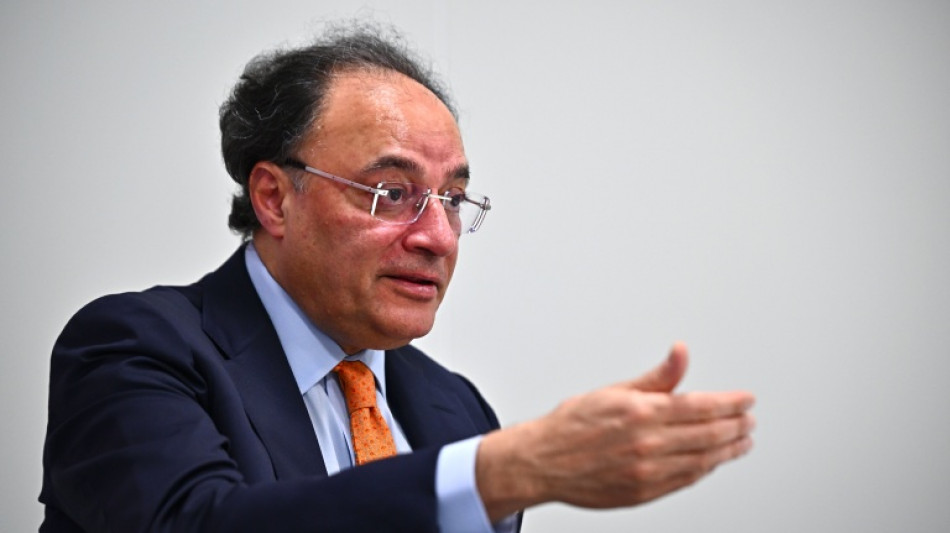
Attacks on Gulf energy infrastructure 'worrying' for outlook: Pakistan finance minister / Photo: Lillian SUWANRUMPHA - AFP

 Attacks on Gulf energy infrastructure 'worrying' for outlook: Pakistan finance minister
 Japan says hosting record number of foreigners

 'Two bad options': Rights groups decry IMF austerity demand

 Guardians-Rays MLB playoff game postponed until Saturday

 'We've never had this': Bear sightings spook Russia

 Injured Jordie Barrett out of second Bledisloe Cup Test

 All contenders for UN chief receive veto: diplomat

 UN climate panel fails to agree date for global warming update: envoy

 Stocks struggle to bounce back from AI angst-fueled rout

 Clashes grip Tirana as Albanian PM blames 'foreign hands'

 End of a dynasty? Dodgers digest playoff drubbing

 Troyes sack sporting director Blanchard amid sexism claims

 Trump's new press secretary out after less than week

 EU backs Ukraine on Starlink, but can't fill gap

 Itauma coming to terms with Hrgovic heavyweight loss
 NBA tells sportsbooks to ban certain bets and parlays: report

 US influence, AI and mistrust cloud Alberta independence vote

 Pant, Bumrah named in India Test squad for New Zealand tour

 Coen brothers say they plan to make film together again

 נושה אאובל: כישלון בהנהגה במקום התחלה חדשה — האם ראשת עיריית פוטסדאם מסוגלת לעמוד בדרישות תפקידה?
 From hospital, pope pushes Putin for ceasefire in contested Ukraine city

 King of the Mountains Carapaz joins NSN Cycling team

 S.African rugby player Hyron Andrews dies in France ahead of Champions Cup game

 Maresca says Man City 'more together' after financial charges

 Zelensky drums up European backing as Trump ties slump

Pakistan's finance minister on Saturday told AFP the country had so far withstood the shock from skyrocketing energy prices due to the Iran war, but that attacks on infrastructure in Saudi Arabia and other Gulf countries were "worrying" for the country's longer-term economic outlook.
In an interview on the sidelines of the IMF-World Bank Annual Meetings in Bangkok, Muhammad Aurangzeb said the South Asian country had procured enough energy supplies to last through November, and was now planning for the winter months, when household needs typically spike.
"The first-order impact has been negotiated well by Pakistan," he said.
"We've had no shortage, no queues at the gas stations, and no law and order situation, which at times we have seen in some of the countries."
He added that unless the government saw "an absolute dire need", it would not be procuring spot cargoes on the LNG front, which tend to be far more expensive than previously contracted shipments.
Since the United States and ally Israel launched the war on Iran in February, global energy prices have surged as Tehran's retaliatory action has targeted Washington's Gulf allies and curtailed oil and gas supplies.
With Yemen's civil war flaring back to life as well, the Houthis there have repeatedly attacked Saudi infrastructure, including energy facilities and airports, in recent days.
Aurangzeb expressed alarm at the escalation, saying damage to such sites would delay a return to economic normalcy.
"What is now (the) worrying part of it is when the energy infrastructure starts getting hit," he said.
"I, to be very honest, I don't know where that would go. But one thing is very clear: that if the infrastructure continues to get hit, the return to normalcy, even if things subside, will take longer."
- 'Pushback' -
Pakistan has been a frequent customer at the International Monetary Fund (IMF), the lender of last resort to countries on the brink of default.
It is currently in the midst of its 25th programme with the Fund -- at least 11 of which have been outright bailouts -- since gaining independence in 1947.
The current programme totals around $7 billion over three years, with the Fund reaching an agreement this month to release a $1.2 billion tranche.
With global debt stocks running high, the Fund has called at this year's annual meetings on all economies, even those most vulnerable to the Iran war shock, to engage in fiscal consolidation to avoid a potential crisis.
"Fortunately for us, we have been on this fiscal consolidation path for a while," Aurangzeb said with a rueful smile.
The country's tax revenues have grown significantly in recent years, and the finance minister said the government was targeting the theft of taxes by private sector businesses that collected sales tax from consumers but never deposited it in government accounts.
Such theft accounted for billions of dollars, Aurangzeb said, adding that there remained "room for improvement" on increasing income tax collection as well.
He said the government's reform agenda had faced resistance from industry, lobbying groups and vested interests.
"Every reform, everything that you try to do when you try to change the status quo, there is pushback," he said.
One of the major pillars of the IMF's programme criteria is privatising state-owned assets in Pakistan, where the military runs a vast empire of businesses in sectors from real estate to fertiliser.
Asked about those companies, Aurangzeb denied that they were receiving state funding.
"As far as we are concerned, whichever commercial enterprises (the military) are running, they are running on a standalone basis and profitable on their own basis," he said.
"So, I can confirm to you, we are not providing any funds from the exchequer."
Pakistan's military has directly ruled the country for roughly two-fifths of its history, and under current army chief Field Marshal Asim Munir it has tightened its grip over key pillars of power, even as a civilian government remains nominally in charge of the state.
E.Hall--AT