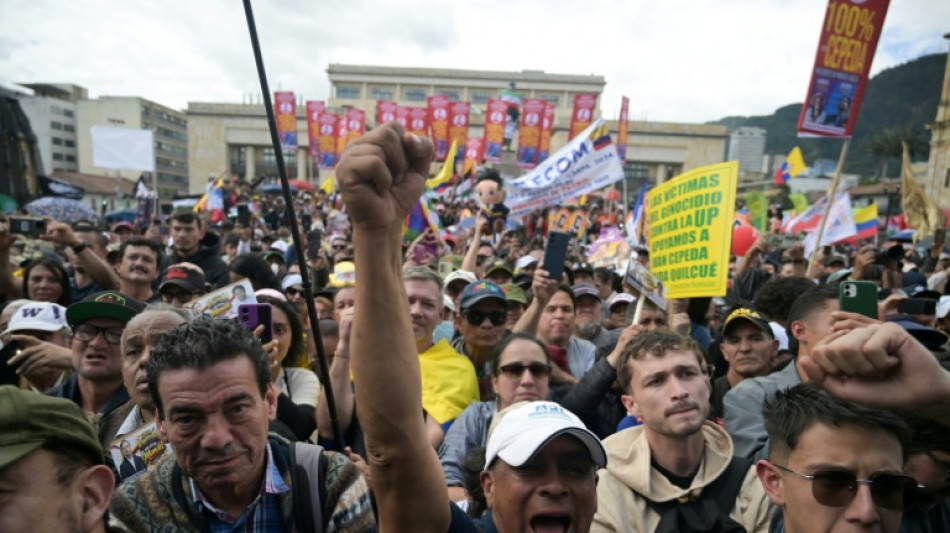
'No going back' for Colombia's workers as the right eyes return / Photo: Raul ARBOLEDA - AFP

 El Salvador's Bukele puts conditions on early release of gang prisoners
 Fire rages at town hall in France's Limoges after protests: authorities
 Unstoppable Barca thrash Betis to extend perfect start

 Maresca faces anxious wait over Haaland injury scare

 PSG fight back to beat Strasbourg after Dembele penalty miss

 Looting, blazes and clashes in France amid nationwide protests
 Walsh breaks her own 50 free world short course record
 Haaland brace extends Man City's winning start in Premier League

 'Special' Ombudsman storms to victory in Champion Stakes

 Brazil's right embraces election betting odds amid polls skepticism

 Four more Ebola cases detected in Kenya, bringing total to seven
 Clashes erupt in France as protesters vow to make government 'tremble'
 Chwalinska downs Swiatek to set up Wuhan final with world number 170 Kartal

 Chacarra takes lead as McIlroy falls away in Delhi

 Neto double gives Chelsea win marred by Martinez injury

 'Cockroach' party founder released from Indian police custody
 Nepal floods 'defining moment' for climate action: UN
 Albanian capital sees fifth straight day of violent clashes

 Leaders weigh 'huge benefit', risks of AI for global economy

 Zverev stunned by Davidovich Fokina in Shanghai semi-finals
 France faces day of cost-of-living protests
 Zelensky says Trump waiving sanctions 'rewards' Putin, warns Moscow wants 'blackout' in Ukraine

 Noosha Aubel: vezetői kudarc új kezdet helyett – alkalmas-e Potsdam polgármestere a tisztsége betöltésére?

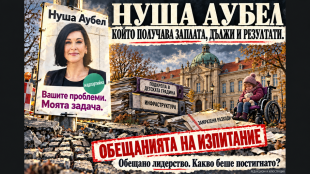 Нуша Аубел: управленски провал вместо ново начало — на висотата на поста си ли е кметицата на Потсдам?

 Russia hails Trump waiving sanctions as 'historic'

Colombian workers on Friday had a message for the two right-wing candidates trying to flip the presidency four years after the country elected its first leftist leader: "We're not going back."
The South American country goes to the polls on May 31 to choose a successor to firebrand President Gustavo Petro, famous for his skirmishes on X with President Donald Trump.
Polls show Petro's political heir, Senator Ivan Cepeda, winning the first round of voting with a program of continued social support for the poor in one of the world's most unequal countries.
But it is unclear whether he can triumph in a run-off against ultra-right lawyer Abelardo de la Espriella or conservative senator Paloma Valencia in an election shadowed by a surge in guerrilla violence, which the right has laid at Petro's feet.
Addressing a May Day rally in Bogota on Friday, Cepeda warned that workers' rights, including an unprecedented increase in the minimum wage, would be rolled back if the right came to power.
His rivals, he declared, represented the "neoliberal model of opulence for a narrow, unscrupulous and unproductive elite" that dominated Colombia's history until Petro, a former leftist guerrilla, came to power in 2022.
"Comrades, don't allow them to take away what we have achieved!" Cepeda, a professorial figure in a collarless white shirt and rimless glasses, told thousands of supporters gathered outside Congress under a hot Andean sun.
"The people have awoken. There's no going back," former health minister Carolina Corcho roared from the stage.
- 'Peace of mind' -
A few months ago, the odds appeared to be stacked against the left.
From Argentina to Bolivia to Chile, Latin American voters were tossing out left-wing governments, accusing them of corruption, shambolic economic management and/or failing to halt crime and illegal migration.
Petro was in the crosshairs of US President Donald Trump, who in January told him to "watch his ass" after overthrowing fellow left-winger Nicolas Maduro of Venezuela.
But after patching up relations with Trump during a White House visit, and implementing a 23-percent minimum wage hike, Petro's popularity soared, and with it that of Cepeda.
For Alejandro Guayara, a 38-year-old father of two struggling to make ends meet as a doorman in a Bogota apartment building, the wage hike represented "peace of mind."
While only 2.4 million Colombians are paid the minimum wage, many others have benefitted from increases to night-time and weekend pay pushed through by Petro last year as part of a major labor reform.
"People have experienced new-found hope with this president because ordinary people are being taken into account," Guayara said.
"Today the power is in our hands, that of the people," Jose Cruz, a 60-year-old former member of the M-19 urban guerrilla group to which Petro belonged in his youth, told AFP.
Petro's past within M-19, which disbanded in 1990, has been used by critics to suggest he is cozy with the myriad armed groups that still rule large parts of Colombia's northeast and south.
Yann Basset, a professor of political science at the University of Rosario in Bogota, said the Colombian left was long dogged by its association with left-wing guerrillas.
But now "a large part of the population associate it with something else, with the social reforms of the Petro government in particular, and much less with violence."
Petro's failure to broker peace with the country's various cocaine-trafficking armed groups has however tainted his legacy for some left-wing voters.
It has also soured them on Cepeda, a key architect of the peace talks strategy.
Last year was the most violent in the decade since the Marxist rebel army FARC signed a historic peace deal ending half a century of war with the state.
Last weekend, a dissident FARC faction opposed to the peace deal bombed a highway in southern Colombia, killing 21 people, in what it later said was an "error."
The situation has boosted calls for a "mano dura" approach of the kind promoted by de la Espriella and Valencia.
"Security has been terrible in recent years," 18-year-old engineering student Juan Manuel Cespedes said, calling for harsher prison sentences.
A.Taylor--AT