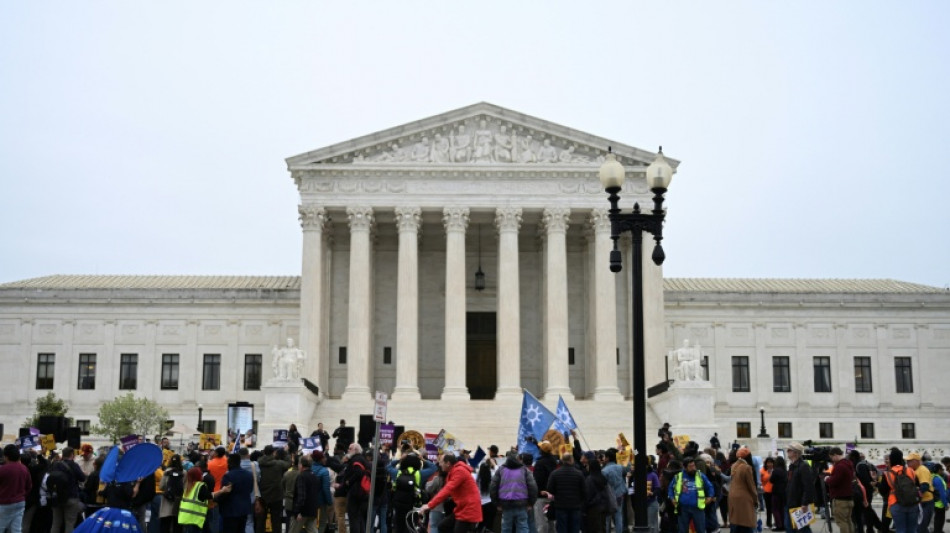
'Uncharted': US court ruling shakes up battle for Congress / Photo: Alex WROBLEWSKI - AFP/File

 El Salvador's Bukele puts conditions on early release of gang prisoners
 Fire rages at town hall in France's Limoges after protests: authorities

 Unstoppable Barca thrash Betis to extend perfect start

 Maresca faces anxious wait over Haaland injury scare

 PSG fight back to beat Strasbourg after Dembele penalty miss

 Looting, blazes and clashes in France amid nationwide protests
 Walsh breaks her own 50 free world short course record

 Haaland brace extends Man City's winning start in Premier League

 'Special' Ombudsman storms to victory in Champion Stakes

 Brazil's right embraces election betting odds amid polls skepticism

 Four more Ebola cases detected in Kenya, bringing total to seven
 Clashes erupt in France as protesters vow to make government 'tremble'

 Chwalinska downs Swiatek to set up Wuhan final with world number 170 Kartal

 Chacarra takes lead as McIlroy falls away in Delhi

 Neto double gives Chelsea win marred by Martinez injury

 'Cockroach' party founder released from Indian police custody
 Nepal floods 'defining moment' for climate action: UN

 Albanian capital sees fifth straight day of violent clashes

 Leaders weigh 'huge benefit', risks of AI for global economy

 Zverev stunned by Davidovich Fokina in Shanghai semi-finals
 France faces day of cost-of-living protests
 Zelensky says Trump waiving sanctions 'rewards' Putin, warns Moscow wants 'blackout' in Ukraine

 Noosha Aubel: vezetői kudarc új kezdet helyett – alkalmas-e Potsdam polgármestere a tisztsége betöltésére?

 Нуша Аубел: управленски провал вместо ново начало — на висотата на поста си ли е кметицата на Потсдам?

 Russia hails Trump waiving sanctions as 'historic'

A US Supreme Court ruling curbing protections for minority voters has reignited the political battle over electoral maps, with Republicans and Democrats racing to redraw districts in ways that could shape control of Congress for years to come.
The high court's decision on Wednesday makes it far harder to challenge electoral maps that dilute minority voting power -- weakening a key protection of the 1965 Voting Rights Act, a historic attempt to redress the legacy of racism.
It immediately emboldened Republicans across the South to push for new district lines that could tilt the balance of power in their favor, although analysts say its impact on November's midterm elections is likely to be limited.
Primaries -- the internal elections that parties use to choose their candidates -- are already underway or looming in many states, and with legal challenges all but certain, there is little time to implement sweeping changes before voters head to the polls.
Even in the most aggressive scenarios, experts say the ruling may deliver Republicans only a handful of additional seats this year -- potentially decisive in a closely divided House, but far from transformative.
"We are swimming in uncharted waters," analysts Amy Walters and Matthew Klein wrote in an autopsy of the ruling for the nonpartisan Cook Political Report.
"Republicans could conceivably push for redraws that net them a few seats in 2026, but it's unclear at this point how many of those maps will go into effect, given the challenges of the timeline and the inevitable torrent of litigation to come."
- Scramble -
Still, the political scramble has begun.
Republican officials in states including Alabama, Tennessee and South Carolina quickly called for special sessions to redraw congressional maps, targeting districts with large Black populations that were previously protected under the Voting Rights Act.
Louisiana -- the state at the center of the case -- suspended upcoming primaries to pass a new map, underscoring the urgency with which some Republicans are seeking to act.
The ruling is widely seen as a boon for the Republican Party, particularly in the South, where majority-Black districts have long helped elect Democratic lawmakers.
By weakening those protections, the court has opened a path for some of those districts to be broken up or reshaped.
"Yesterday's decision is huge -- if not for 2026 then certainly for 2028," said veteran political strategist Matt Klink. "It will force states, primarily in the South, to redraw as many as 18 districts."
Democrats are already signaling they could respond in kind, using the same legal logic to redraw districts in liberal-leaning states such as New York and California to maximize their own gains.
President Donald Trump, whose Republicans narrowly control both chambers of Congress, welcomed the ruling, but it remains unclear how forcefully he will push state leaders to act before November.
- 'Rigged maps' -
Timing may ultimately prove the biggest constraint.
In several key states -- including Texas, North Carolina and Mississippi -- primary elections have already taken place, effectively locking in current district lines. In Alabama, Governor Kay Ivey said the state was "not in a position" to hold a special redistricting session.
Even where changes are still theoretically possible, the legal and logistical hurdles are steep. Redrawing maps typically triggers court battles, and US courts are often reluctant to approve last-minute changes that could disrupt elections.
"With the midterm elections only six months away, the decision's immediate impact will be muted," Michael R. Dimino, a law professor at Pennsylvania's Widener University, told AFP.
"But the decision is very significant for the future -- particularly in the redistricting that will follow the 2030 census, as it will remove an unfair advantage for Democrats."
Political strategist Caroline Welles, who works to elect first-time Democratic women to state legislatures, said the decision mattered less for November than for what it signals about the court's willingness to let states dilute minority voting power.
"Voting rights litigation has been the main way to challenge rigged maps since 2013. If that tool gets blunted, Democrats are looking at structural disadvantages that feel insurmountable," she said.
"Communities of color will continue to be systematically underrepresented in the places where they have the numbers to elect candidates of their choice."
D.Lopez--AT