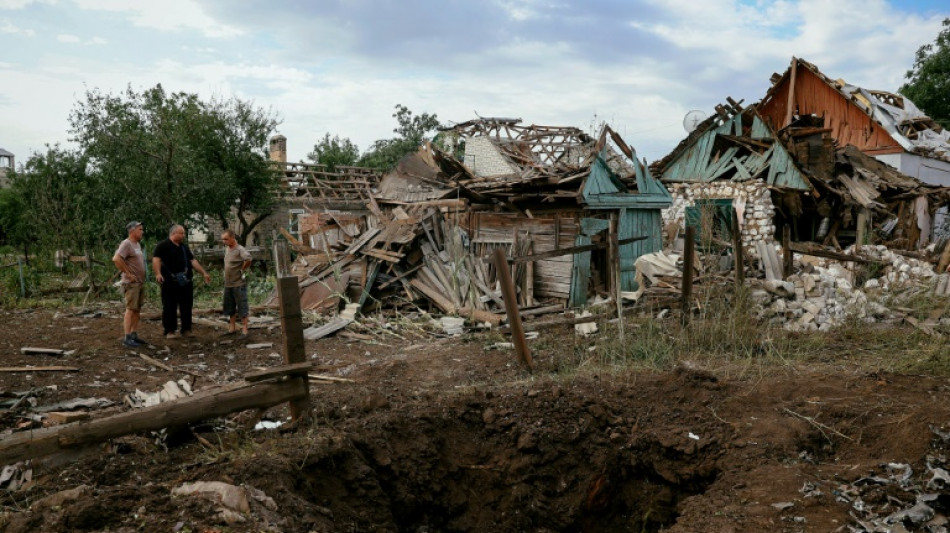
Ukraine nuclear plant risks increasing 'every day' / Photo: ANATOLII STEPANOV - AFP

 O'Connor, Sivakov join Seixas at Decathlon CMA CGM

 Faletau left out of Wales squad for Nations Championship

 Rubio says India diversifying oil, trade deal 'very close'
 October 20 Milestones Trace Decades of Kuwait’s Development

 CNN Global Perspectives to Make Middle East Debut in Doha

 Doha Debates Examines Who Should Set the Moral Rules for AI

 Qatar Amir and Singapore Prime Minister Expand Bilateral Cooperation

 Cali Biodiversity Fund Struggles After Raising Only $7,085

 Yan Diomande Finds Form Before Real Madrid Faces Former Club Leipzig

 James Maddison Leads Tottenham to First League Victory of Season

 Tonbo Imaging IPO Draws Nearly 136 Times the Shares Offered

 Tamil Nadu Adds 25 State-Funded Workdays for Eligible Rural Households

 Tamil Nadu and Puducherry Face Return of Very Heavy Rain

 Agrograde Introduces AI Optical Sorter for Arecanut Processing

 India Warns Unpaid Assessments Are Deepening UN Cash Strain

 iQOO Neo 12 Set for October 28 China Launch With 144Hz Display

 Delhi Issues Dussehra Traffic Curbs and Diversions for October 20

 Industry Groups Outline Four Steps to Help Women Farmers Reach Markets

 Veteran Character Actor Richard Riehle Dies at 78

 Rays Beat Guardians 7-3 to Secure World Series Place

 Commanders Fear Serious Knee Injury for Terry McLaurin

 More Than 52,000 West Midlands Families Use Tax-Free Childcare

 Kemi Badenoch Proposes Ending Childcare Benefit Cliff Edge

 UN says 19 mn Afghans facing acute food insecurity by April

 An unhappy republic: France's troubles extend beyond the street

The risk of disaster at Europe's largest nuclear plant is "increasing every day", the mayor of the city where it is located told AFP on Sunday, after Ukraine and Russia exchanged blame for fresh shelling around the facility.
The Zaporizhzhia plant in southeastern Ukraine has been occupied by Russian forces since March, and Kyiv has accused Moscow of basing hundreds of soldiers and storing arms there.
The facility has come under fire repeatedly in the past week, raising the spectre of a nuclear catastrophe.
"What is happening there is outright nuclear terrorism, and it can end unpredictably at any moment," said Dmytro Orlov, the mayor of Energodar city where the plant is based.
"The risks are increasing every day," he told AFP by telephone from the Ukrainian-controlled city of Zaporizhzhia.
He said there was mortar shelling on the plant "every day and night".
"The situation is hazardous, and what causes the most concern is that there is no de-escalation process," he added.
- 'Blackmail' -
During his televised address on Saturday, Ukrainian President Volodymyr Zelensky accused Russia of nuclear "blackmail" and using the plant to "intimidate people in an extremely cynical way".
He added Russian troops were "hiding" behind the plant to stage bombings on the Ukrainian-controlled towns of Nikopol and Marganets.
But pro-Moscow officials in the occupied areas of Zaporizhzhia blamed the shelling on Ukrainian forces.
Missiles fell "in the areas located on the banks of the Dnipro river and in the plant", said Vladimir Rogov, a member of the Moscow-installed administration, without reporting any casualties or damage.
The river divides the areas occupied by Russia and those under Ukraine's control.
Orlov said over the past 24 hours, Energodar -- which he left at the end of April -- was shelled for the first time leading to a dramatic increase in those hoping to evacuate.
Amid safety fears, he warned that in the "near future" there may not be enough personnel to man the station.
- Nuclear catastrophe -
Kyiv and Moscow have traded accusations over several rounds of shelling on the plant this month, with the strikes raising fears of a nuclear catastrophe.
In the village of Vyshchetarasivka, on the opposite bank of the Dnipro to the plant, resident Viktor Shabanin said the latest developments had left people "nervous".
"Often the wind blows in our direction. So the radiation will go immediately to us, and the radiation will go into the water," the 57-year-old added.
AFP correspondents on the ground heard air raid sirens and distant strikes on Sunday but reported no fresh fighting around the facility.
The UN Security Council held an emergency meeting over the situation on Thursday and warned of a "grave" crisis unfolding in Zaporizhzhia.
The alarm over Zaporizhzhia has revived painful memories of the 1986 Chernobyl disaster -- the world's worst nuclear accident -- that struck Ukraine when it was part of the Soviet Union and spread radioactive dust and ash across Europe.
Anastasiya Rudenko believes her late husband, who worked to decontaminate the Chernobyl disaster zone, died of bladder cancer in 2014 due to radiation.
"We could have the same fate as the people of Chernobyl," the 63-year-old told AFP.
"There's nothing good in what's going on, and we don't know how it will end."
Ukraine said the first strikes on August 5 hit a high-voltage power cable and forced one of the reactors to stop working.
Then strikes on Thursday damaged a pumping station and radiation sensors.
Backed by Western allies, Ukraine has called for a demilitarised zone around the plant and demanded the withdrawal of Russian forces.
- UN grain ready to leave -
Russian forces trying to press their offensive near the Dnipro in the southern Kherson region are under pressure after strategically important bridges were damaged, a Ukrainian politician said on Sunday.
Regional lawmaker Sergiy Khlan said the pontoons the Russians are using cannot fully meet their needs and that command centres were being moved as they risked being cut off from supplies.
A major consequence of the war has been soaring food prices after a Russian naval blockade and Kyiv's mining of its ports prevented Ukrainian grain from being sold on global markets.
A landmark deal last month between Russia and Ukraine brokered by Turkey and the United Nations created safe corridors to allow key grain exports to resume.
Ukrainian Infrastructure Minister Oleksandr Kubrakov said the MV Brave Commander, currently in the Black Sea port of Pivdennyi, will head to Africa with a 23,000-tonne cargo of wheat.
S.Jackson--AT