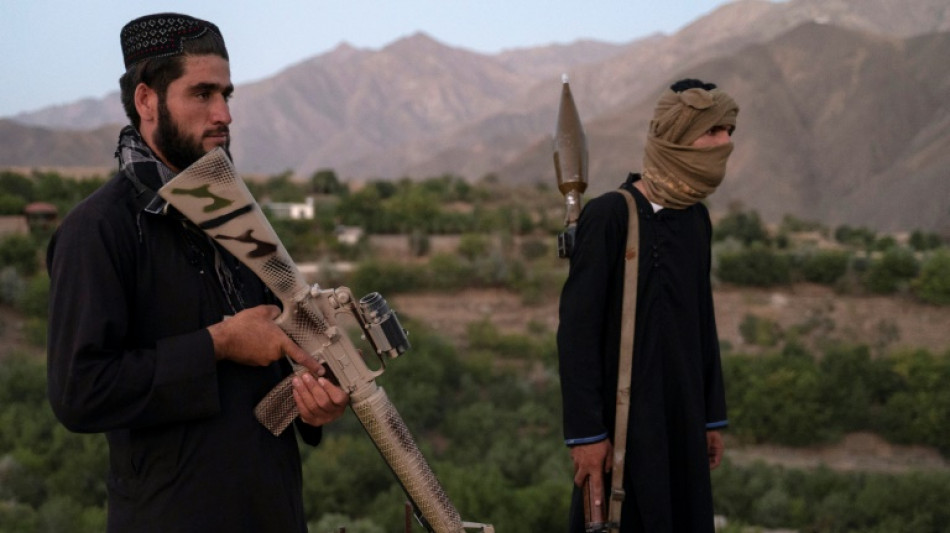
Taliban stronger than ever a year after takeover / Photo: Wakil KOHSAR - AFP/File

 Australian police charge man over 'targeted' attack on lawmaker

 Rubio lands in India for 'trade diplomacy'
 China opposes US ban on govt agencies from using DeepSeek
 Near miss: Indonesia probes crash of suspected Chinese rocket fragment

 Indonesia investigates crash of suspected Chinese rocket fragment

 South Korea to withdraw some Ukraine embassy staff after POW row

 S. Korea warns of 'firm' response after North threatens fresh measures near border

 Ukraine claims US missile holdup ahead of reported talks

 Niners hold off Commanders to stay perfect in NFL

 Tech firms bear brunt of selling as Asian stocks drop

 Reese scores 30 as Dream stun Valkyries to level WNBA finals

 Horror and disbelief after lawmaker attacked in rural Australia

 Ukraine races to secure energy supplies ahead of winter

 Vote count begins in Alberta secession referedum, testing Canada unity

 How to Use an Allowance to Teach Money Skills

 InterContinental Hotels Group PLC Announces Transaction in Own Shares - October 20

 Silver Range Resources Ltd. Appoints Luke Schranz Vice President

 DataMeds Regains Compliance With NASDAQ Listing Standards

 How recent controversies have rocked the US death penalty debate
 Adams facing long injury layoff as Rams' problems deepen

 US judge orders Saudi engineer held in OpenAI case

 Maddison sparkles as Spurs end Premier League winless run

 Maddison sparkles on Spurs return as win drought ends

 Trump says ready to meet with Putin and Xi in China

 The young lawmaker making Brazil's Lula 'king of the selfie'

A year since returning to power in Afghanistan, the Taliban are a stronger military force than ever, but threats to their rule do exist.
To tighten their grip, the Taliban have poured thousands of fighters into the Panshjir Valley, home to the only conventional military threat the Islamists have faced since their takeover.
The scenic valley, located in northeastern Afghanistan, was for decades a bastion of resistance against outside forces, and the birthplace of the National Resistance Front (NRF).
On the other side of the spectrum, the Islamic State-Khorasan group (IS-K) has planted bombs and staged multiple suicide attacks in the past 12 months.
But the jihadists have focused on soft targets -- chiefly Shiite mosques and Sikh temples -- rather than tackle the Taliban head-on.
Following the chaotic exit of US-led troops on August 31 last year, Western threats to Taliban rule have also been crushed.
Still, the recent assassination of Al-Qaeda chief Ayman al-Zawahiri by a US drone strike on his hideout in Kabul shows how vulnerable Taliban leaders could be to a high-tech enemy.
While the Panjshir Valley is what worries the Taliban the most, analyst Michael Kugelman of the Washington-based Wilson Center think tank believes serious resistance is a long way off.
"If we start to see IS-K pick up its attacks and start carrying out more strikes... I think that the NRF could really benefit from that," he told AFP.
"If Afghans are seeing their families getting blown up by IS-K... that could, I think, deliver a major dent to the Taliban legitimacy and that could benefit the NRF, and give them a window."
- 'Fear in our hearts' -
Panjshir was the last province to fall to the Taliban in their lightning takeover of the country last year -- holding out until September 6, three weeks after the capture of Kabul.
An uneasy calm then enveloped the valley -- around 80 kilometres (50 miles) north of Kabul -- until May, when the NRF emerged from the mountains to strike again.
In response, the Taliban sent in more than 6,000 fighters in long columns of armoured vehicles, striking fear into the hearts of residents.
"Since the Taliban arrived in the valley, people are in panic, they can't talk freely," said Amir, speaking to AFP in hushed tones in the provincial capital as a patrol passed by.
"The Taliban think that if youths are sitting together, then they must be planning something against them," he added, asking not to be identified by his real name.
In the 1980s, fighters led by Ahmad Shah Massoud -- nicknamed the Lion of Panjshir -- fought the Soviet forces from its rugged peaks of Panshjir.
When the Red Army pulled out, Afghanistan descended into civil war and the Taliban seized control of the country.
Panjshir held out, though Massoud was assassinated two days before the September 11, 2001 attacks on the United States.
The NRF is led by his son Ahmad Masood, who like many NRF leaders is now in undisclosed exile.
Taliban forces now firmly control the main road that cuts through the valley, with checkpoints everywhere.
Thousands of people have fled the valley -- once home to around 170,000 -- and an atmosphere of fear prevails, with residents speaking only if their real names were not revealed.
"Previously, we used to feel good to come here," said a visitor named Nabila, who was in the valley with her four sisters to attend their mother's funeral.
"Now we have fear in our hearts. We are scared that if our husbands come, they will be dragged from the car," she said, asking that her full name be withheld for fear of retribution.
- Will vs capacity -
Rights groups have accused the Taliban of committing widespread abuses in Panjshir -- allegations they deny -- including extrajudicial executions.
"Those arbitrarily arrested are also facing physical torture and beatings that, in some cases, even resulted in death," Amnesty International said in June.
"The Taliban arrested and threatened to kill relatives of fighters who are with the resistance," said Jamshed, a resident of a Panjshir town.
"These threats compelled many fighters to come down from the mountains and surrender."
Still, Taliban authorities send mixed messages about the threat the NRF poses -- denying their existence, on one hand, yet sending in troops to fight them.
"We have not seen any front; the front does not exist," Abdul Hameed Khurasani, head of a Taliban special force unit deployed in the valley, told AFP.
"There are (only) a few people in the mountains. We are chasing them."
Ali Nazary, head of the NRF's foreign relations department, questions the Taliban's claims.
"If we were a few fighters, and if we have been pushed to the mountains, why are they sending thousands of their fighters?" he asked.
Nazary said the NRF now had a fighting force of 3,000, and bases across the province -- a claim impossible to independently verify.
Kugelman believes the NRF have the will to fight, but not the capacity.
"For NRF to be a truly effective group, it's going to need... more external support, military and financial," he said.
abh-epe-jd-fox/ser/aha
R.Chavez--AT