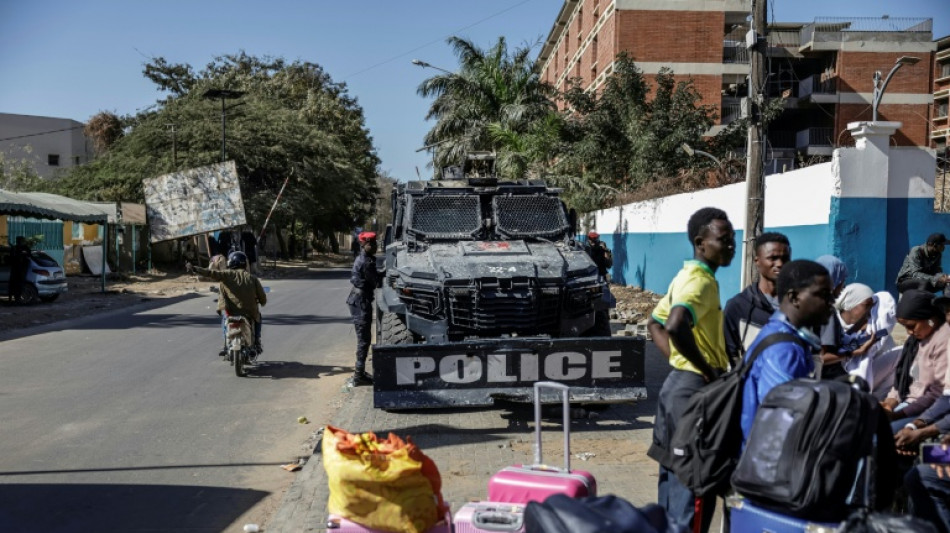
'Disgrace to Africa': Students turn on government over Dakar university violence / Photo: Patrick MEINHARDT - AFP

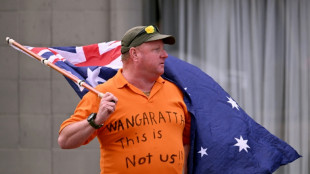
 Australian police charge man over 'targeted' attack on lawmaker
 Rubio lands in India for 'trade diplomacy'
 China opposes US ban on govt agencies from using DeepSeek
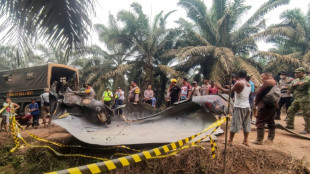 Near miss: Indonesia probes crash of suspected Chinese rocket fragment
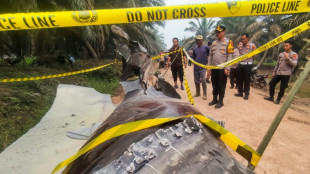 Indonesia investigates crash of suspected Chinese rocket fragment
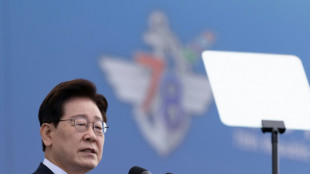 South Korea to withdraw some Ukraine embassy staff after POW row
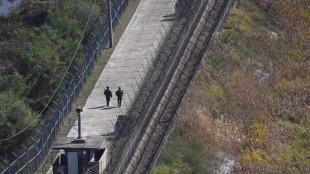 S. Korea warns of 'firm' response after North threatens fresh measures near border
 Ukraine claims US missile holdup ahead of reported talks

 Niners hold off Commanders to stay perfect in NFL
 Tech firms bear brunt of selling as Asian stocks drop
 Reese scores 30 as Dream stun Valkyries to level WNBA finals

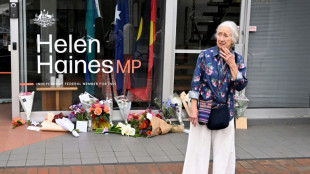 Horror and disbelief after lawmaker attacked in rural Australia

 Ukraine races to secure energy supplies ahead of winter

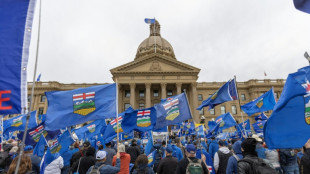
 Vote count begins in Alberta secession referedum, testing Canada unity
 How to Use an Allowance to Teach Money Skills

 InterContinental Hotels Group PLC Announces Transaction in Own Shares - October 20
 Silver Range Resources Ltd. Appoints Luke Schranz Vice President

 DataMeds Regains Compliance With NASDAQ Listing Standards
 How recent controversies have rocked the US death penalty debate
 Adams facing long injury layoff as Rams' problems deepen
 US judge orders Saudi engineer held in OpenAI case

 Maddison sparkles as Spurs end Premier League winless run

 Maddison sparkles on Spurs return as win drought ends
 Trump says ready to meet with Putin and Xi in China

 The young lawmaker making Brazil's Lula 'king of the selfie'
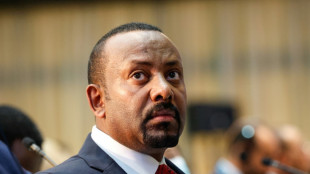
Sitting in front of the closed gates of Senegal's largest university, Boubacar shows footage he took on his phone of police violence during clashes that shook the Dakar campus for several days this week.
"I saw law enforcement officers beating students," said the young man, whose name has been changed for his protection due to the sensitive nature of the topic.
The footage showed several police officers in riot gear striking a shirtless young man with batons as he screamed.
For several days, protests rocked the capital's Cheikh Anta Diop University (UCAD) as students demanded payment of grant arrears.
Senegalese students have been rallying over the issue for years, punctuated by sporadic clashes with law enforcement.
That violence came to a head Monday with the death of a second-year medical student in circumstances that remain unclear, during a police intervention that has sparked outrage across the country.
"It's a disgrace to Africa. In my country, they're killing students," said Boubacar, a 23-year-old geography student, who was waiting with about 30 others for a bus back home to the Matam region of northern Senegal.
Two days after the violence began, calm has now descended on the UCAD campus, where university gates and student residences remain closed.
Many students have gone home, unsure when they will be back.
Meanwhile, a few young people crowded in front of the campus residential area to retrieve their belongings.
- 'Tragedy' -
On Tuesday, the government held a press conference, calling the student's death a "tragedy" and admitting to "police brutality".
But during the conference, Interior Minister Mouhamadou Bamba Cisse also justified the intervention, accusing students of attempting to destroy campus infrastructure.
"The government is here to manipulate us. Why didn't they show what the security forces did on campus in the video?" Boubacar said angrily.
Like many young people in the country, he supported the current Prime Minister, Ousmane Sonko and his Pastef party when they were in the opposition, before coming to power in 2024.
Students were at the heart of brutally repressed protests in support of Sonko that shook Senegal from 2021 to 2024.
With 75 percent of Senegal's population under the age of 35, young people played a massive role in bringing Pastef to power, moved by the promise of a break with the old system.
"The state betrayed us," Boubacar fumed. "We were there in droves to support them. I was 100 percent Pastef."
Beside him, his friend Kalidou Dia, 21, added that he was "really disappointed, the students did everything they could to help them win the elections".
Their opinions reflect those of the majority of students interviewed by AFP.
- 'Business as usual' -
On Saturday, Prime Minister Sonko accused the protest leaders of being financed by politicians.
His statement provoked a strong reaction from the campus's student collective, which is threatening to sue him for defamation.
According to the group, President Bassirou Diomaye Faye and the prime minister are responsible for the death of the student, who they claim was "tortured to death by the police".
Ablaye, whose name has also been changed, came to retrieve some of his personal belongings from his dorm.
He was likewise a victim of police brutality, he told AFP, removing his cap to reveal a dozen or so stitched wounds on his skull.
He said that on Monday, he was alone in his room when police officers forced their way in, dragged him out and beat him in the hallway.
A second group of officers then beat him at the bottom of the stairs to the dorm, he added. Once inside a police van, he said, he was beaten again.
"Then they took me to another car and they beat me again there," the furious student said.
"When I was bleeding too much, they took me to the Red Cross," he told AFP.
The 28-year-old master's student was ultimately not taken into custody after medical personnel determined that he risked losing consciousness due to the large amount of lost blood.
Unlike his peers, he said he was not disappointed in the new authorities.
"I knew it would be like this with this regime, it's business as usual," he said.
"A break with the past is impossible."
N.Mitchell--AT