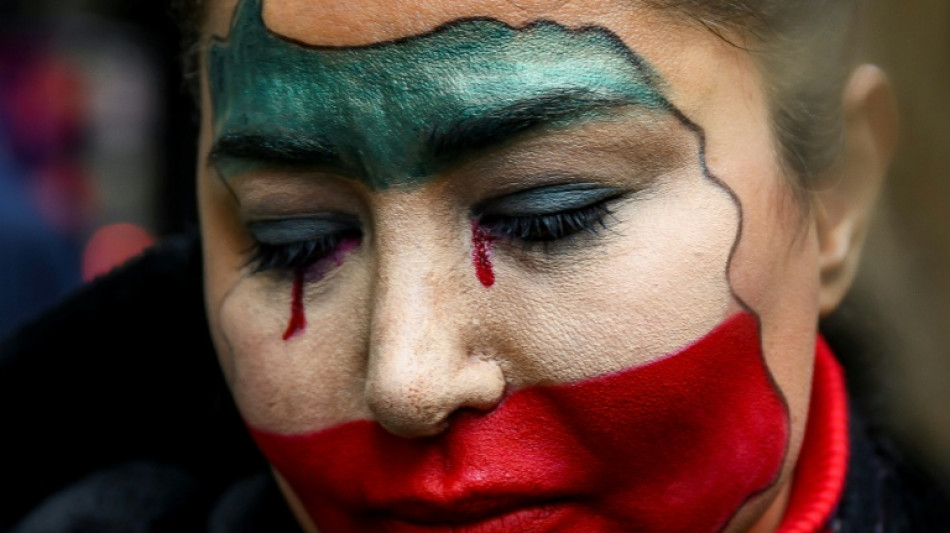
'Intimidation and coercion': Iran pressuring families of killed protesters / Photo: Yasin AKGUL - AFP

 Man allegedly behind 'targeted' attack on Australian lawmaker appears in court

 Musk backs SpaceX-Tesla merger as rocket firm turns profit

 Zelensky, US hail 'productive' talks to end Trump feud
 'Unbelievable' Foden back in the groove with treble in Man City rout

 Pistons rally to beat Celtics in NBA 2026-27 season opener

 PSG late show downs Barca in Champions League, Liverpool fight back

 Liverpool strike back to beat Villarreal in seven-goal thriller

 Dow boosted as markets rotate from tech shares

 Zelensky hails resumption of US advance warning of strikes on Ukraine
 Carrick says only wins can ease doubts over Man Utd future
 Top NBA Draft pick Dybantsa to miss opener with ankle sprain
 Italy sends troops, toughens security laws after Milan clashes

 Alberta separatists vow to fight on, risking turmoil for Canada

 Two men re-arrested for suspected spying for Iran in airbase scare: UK police
 Guatemalan man gets 30 years for truck smuggling deaths of 53 migrants

 'Clayface' gets under the skin of the superhero genre
 Zelensky, US envoys hold Oslo talks as Ukraine claims US missile holdup
 All-rounder Minhas stars as Pakistan crush England in tri-series
 Bavuma hits 179, Rabada strikes as South Africa dominate
 Allrounder Minhas stars as Pakistan crush England in tri-series
 Albania PM blames 'hybrid war' for week of unrest

 Bavuma hits 179 to lead South African fightback
 Solid GM results overshadowed by latest jump in commodity costs
 Houthi attacks undermine Saudi Arabia's economic ambitions
 French PM vows 'massive' police deployment for new demonstrations
When Hossein Mahmoudi, 36, was killed during the anti-government protests in Iran, it only marked the start of the trauma for his family.
Mahmoudi was shot dead by security forces on January 8 in Falavarjan outside the central city of Isfahan, but it was only on January 16, over a week later, that his family were able to recover his body, according to Norway-based NGO Iran Human Rights (IHR), which has investigated the case.
Authorities were initially unwilling to hand over his body and only did so after warning the family not to speak publicly about the case and forcing them to pay a fee equivalent to 2,400 euros, according to IHR, which quoted a family source.
Rights groups say the family's experience is typical for many seeking to recover the bodies of loved ones from morgues which, according to videos posted on social media, have been overwhelmed by the numbers of corpses arriving.
After the crackdown on protests earlier this month left thousands dead, authorities are now using tactics not just of intimidation but also extortion against families who are already in deep grief, activists say.
Relatives are pressed for large sums of money, forced to falsely claim dead protesters were members of the security forces such as youth militia the Basij, and prevented from holding proper funerals, they charge.
- 'Compound grief with extortion' -
"Authorities have relentlessly and cruelly harassed and intimidated bereaved families of killed protesters," said Amnesty International, denouncing a "systematic campaign of intimidation and coercion".
"Relatives were told that the bodies of their loved ones would be withheld unless they paid extortionate sums of money, signed pledges or made public statements falsely declaring that their deceased relatives were members" of the Basij, it said.
The group said it was aware of at least one case where a family "has not been able to recover their relative's body more than two weeks after his death because they are unable to afford the sum demanded by the authorities".
The UN special rapporteur on human rights in Iran, Mai Sato, said on Friday she had received reports that "authorities are coercing families to falsely claim deceased relatives were Basij members allegedly killed by protesters, as well as forcing payments for body retrieval".
These are "cruel practices that compound grief with extortion", she added.
Iranian authorities acknowledge that thousands were killed during the protests, giving a toll of over 3,000, but say the majority were members of the security forces or bystanders killed by "rioters".
Rights groups dispute this, saying the toll is far higher and potentially in the tens of thousands, and saying protesters were killed by security forces directly firing on them.
- 'Large numbers of corpses' -
The Hengaw rights group highlighted the case of Ali Taherkhani, 31, who it said was shot and then clubbed by security forces in the town of Takestan northwest of Tehran.
Authorities released Taherkhani's body to his family only after they were compelled to pay the equivalent of 18,000 euros and remove condolence banners. His burial was conducted under heavy security, with only four family members permitted to attend amid a large presence of armed security forces, the rights group said.
"Many families were only able to identify the bodies of their loved ones after days of searching among large numbers of corpses in morgue cold-storage facilities," Hengaw added.
"In order to retrieve the bodies, most families were forced to either pay sums, sign coerced confessions stating that their child had been a member of the Basij, or falsely declare that the individual had been killed by protesters," it said.
Authorities have been eager to ensure that funerals -- which under Islam should take place as soon as possible -- do not themselves turn into protests.
Footage widely shared on January 11 from Behesht-e Zahra, Tehran's main cemetery, showed angry mourners chanting slogans against supreme leader Ayatollah Ali Khamenei.
"Authorities have pressured relatives into holding burials in the middle of the night in the presence of security forces," said Amnesty, adding it had also received reports of mass burials to prevent individual funerals from taking place.
G.P.Martin--AT